

The Google Cloud Certified Professional Security Operations Engineer certification validates advanced expertise in detecting, monitoring, analyzing, and responding to security threats within Google Cloud environments. Professionals in this role are responsible for safeguarding workloads, endpoints, and infrastructure by leveraging Google Cloud’s security tools and frameworks.
A certified Security Operations Engineer is proficient in developing detection rules, managing log ingestion and prioritization, orchestrating responses, and automating remediation tasks. Beyond operational skills, they effectively apply posture management and threat intelligence to strengthen detection and accelerate incident response. Further, the exam is designed to assess the candidate’s ability to apply Google Cloud security practices in real-world enterprise environments. Key areas of evaluation include:
- Platform Operations – Managing and securing cloud-based workloads and systems.
- Data Management – Applying proper handling, storage, and protection mechanisms for sensitive data.
- Threat Hunting – Proactively identifying and investigating suspicious activities.
- Detection Engineering – Creating and optimizing detection rules and alerts to mitigate threats.
- Incident Response – Responding to security events, investigating root causes, and ensuring recovery.
- Observability – Utilizing monitoring, logging, and telemetry tools to maintain visibility across cloud assets.
Prerequisites
There are no mandatory prerequisites for taking this certification exam, making it accessible to a wide range of professionals.
Recommended Experience
Although prerequisites are not required, Google recommends that candidates have:
- 3+ years of professional security industry experience.
- At least 1 year of experience using Google Cloud security tooling, including services such as Cloud Logging, Security Command Center, and Chronicle Security Operations.
Who Should Take the Exam?
This certification is best suited for:
- Security Engineers who manage threat detection and incident response within cloud environments.
- Cloud Security Analysts responsible for monitoring and investigating suspicious activity.
- SOC (Security Operations Center) Professionals who work with SIEM tools and orchestrate responses.
- IT Security Specialists seeking to expand their expertise into Google Cloud security.
- Enterprises adopting Google Cloud that require in-house professionals skilled in cloud-native security operations.
Exam Details
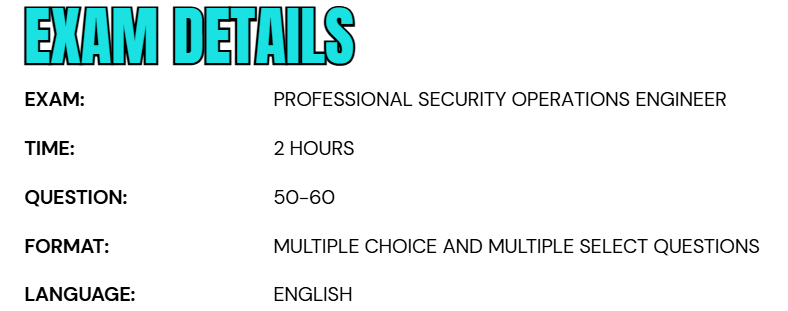
- The Google Cloud Certified Professional Security Operations Engineer exam is designed to evaluate a candidate’s expertise in monitoring, detecting, and responding to security threats within Google Cloud environments.
- The exam has a duration of 2 hours and is delivered in English.
- It consists of approximately 50–60 questions presented in both multiple-choice and multiple-select formats. These questions are designed to measure practical knowledge and applied skills across core domains such as platform operations, threat detection, incident response, and observability.
- Candidates can choose from two delivery methods for this certification exam.
- The first option is to take the online-proctored exam from a remote location, provided that the system and environment meet the technical requirements for secure online testing.
- The second option is to schedule the exam at an onsite-proctored testing center, allowing candidates to sit for the test in a controlled professional environment.
Course Outline
The exam covers the following topics:
Section 1: Learn about Platform operations (14%)
1.1 Enhancing detection and response. Considerations include:
- Prioritizing telemetry sources (e.g., Security Command Center [SCC], Google Security Operations [SecOps], GTI, Cloud IDS) to detect incidents or miscongurations within an enterprise environment
- Integrating multiple tools (e.g., SCC, Google SecOps, GTI, Cloud IDS, downstream third-party system) in the security architecture to enhance detection capabilities
- Justifying the use of tools with overlapping capabilities based on a set of requirements
- Evaluating the eectiveness of existing tools to identify gaps in coverage and mitigate potential threats
- Evaluating automation and cloud-based tools to enhance existing detection and response processes
1.2 Conguring access. Considerations include:
- Conguring user and service account authentication to security tools (e.g., SCC, Google SecOps)
- Conguring user and service account authorization for feature access using IAM roles and permissions
- Conguring user and service account authorization for data access using IAM roles and permissions
- Conguring and analyzing audit logs (e.g., Cloud Audit Logs, data access logs) for the solution
- Conguring API access for automations within security tools (e.g., service accounts, API keys, SCC, Google SecOps, GTI)
- Provisioning identities using Workforce Identity Federation
Section 2: Understand Data management (14%)
2.1 Ingesting logs for security tooling. Considerations include:
- Determining approaches for data ingestion within security tools (e.g., SCC, Google SecOps)
- Conguring an ingestion tool or features within security tools (e.g., SCC, Google SecOps)
- Assessing required logs for detection and response, including automated sources, within security tools (e.g., SCC Event Threat Detection, Google SecOps)
- Evaluating parsers for data ingestion in Google SecOps
- Conguring parser modications or extensions in Google SecOps
- Evaluating data normalization techniques from log sources in Google SecOps
- Evaluating new labels for data ingestion
- Managing log and ingestion costs
2.2 Identifying a baseline of user, asset, and entity context. Considerations include:
- Identifying relevant threat intelligence information in the enterprise environment
- Dierentiating event and entity data log sources (e.g., Cloud Audit Logs, Active Directory organizational context)
- Evaluating event and entity data matches for enrichment by using aliasing elds
Section 3: Threat hunting (19%)
3.1 Performing threat hunting across environments. Considerations include:
- Developing queries to search across environment logs to identify anomalous activity
- Analyzing user behavior to identify anomalous activity
- Investigating the network, endpoints, and services to identify threat paerns or indicators of compromise (IOCs) using Google Cloud tools (e.g., Logs Explorer, Log Analytics, BigQuery, Google SecOps)
- Collaborating with the incident response team to identify active threats in the environment
- Developing hypotheses based on behavior, threat intel, posture, and incident data (e.g., SCC, GTI)

3.2 Leveraging threat intelligence for threat hunting. Considerations include:
- Searching for IOCs within historical logs
- Identifying new aack paerns and techniques in real time using threat intelligence and risk assessments (e.g., GTI, detection rules, SCC toxic combinations)
- Analyzing entity risk score to identify anomalous behavior
- Comparing and performing retrohunt of historical event data with newly enriched logs (e.g., Google SecOps rules engine, BigQuery, Cloud Logging)
- Searching proactively for underlying threats using threat intelligence (e.g., GTI, detection rules)
Section 4: Detection engineering (22%)
4.1 Developing and implementing mechanisms to detect risks and identify threats. Considerations include:
- Reconciling threat intelligence with user and asset activity
- Analyzing logs and events to identify anomalous activity
- Assessing suspicious behavior paerns by using detection rules and searches across various timelines
- Designing detection rules that use risk values (e.g., Google SecOps reference lists) to identify threats matching risk proles
- Discovering anomalous behavior of assets or users, and assigning risk values to the detections (e.g., Google SecOps Risk Analytics, curated detection rules)
- Designing detection rules to discover posture or risk prole changes within the environment (e.g., SCC Security Health Analytics [SHA], SCC posture management, Google SecOps)
- Identifying new or low prevalence processes, domains, and IP addresses that do not appear in threat intelligence sources using various methods (e.g., writing YARA-L rules, dashboards)
- Assessing how to use entity/context data within detection rules to improve their accuracy (e.g., Google SecOps entity graph)
- Conguring SCC Event Threat Detection custom detectors for IOCs
4.2 Leveraging threat intelligence for detection. Considerations include:
- Scoring alerts based on the risk level of IOCs
- Using latest IOCs to search within ingested security telemetry
- Measuring the frequency of repetitive alerts to identify and reduce false positives
Section 5: Incident response (21%)
5.1 Containing and investigating security incidents. Considerations include:
- Collecting evidence on the scope of the incident, including forensic images and artifacts
- Observing and analyzing alerts related to the incident using security tooling (e.g., SCC, Google SecOps)
- Analyzing the scope of the incident using security tooling (e.g., Logs Explorer, Log Analytics, BigQuery, Cloud Logging, Cloud Monitoring)
- Collaborating with other engineering teams for detection and long-term remediation eorts
- Isolating aected services and processes to prevent further damage and spread of aack
- Analyzing identied artifacts based on forensic analysis (e.g., Hash, IP, URL, Binaries) (GTI)
- Performing root cause analysis using security tools (e.g., SCC, Google SecOps SIEM)
5.2 Building, implementing, and using response playbooks. Considerations include:
- Determining the appropriate response steps for automation
- Prioritizing high-value enrichments based on threat proles
- Evaluating appropriate integrations to be leveraged by playbooks
- Designing new processes in response to newly identied aack paerns from recent incidents
- Recommending new orchestrations and automation playbooks based on gaps in the current implementation (e.g., Google SecOps SOAR)
- Implementing mechanisms to notify analysts and stakeholders of incidents
5.3 Implementing the case management lifecycle. Considerations include:
- Assigning cases into appropriate response stages
- Implementing ecient workows for case escalation
- Assessing the eectiveness of case handos
Section 6: Observability (10%)
6.1 Developing and maintaining dashboards and reports to provide insights. Considerations include:
- Identifying key security analytics (e.g., metrics, KPIs, trends)
- Implementing dashboards to visualize security telemetry, ingestion metrics, detections, alerts, and IOCs (e.g., Google SecOps SOAR, SIEM, Looker Studio)
- Generating and customizing reports (e.g., Google SecOps SOAR, SIEM)
6.2 Conguring health monitoring and alerting. Considerations include:
- Identifying important metrics for health monitoring and alerts
- Creating dashboards that centralize metrics
- Creating alerts with thresholds for specic metrics
- Conguring notications using Google Cloud tools (e.g., Cloud Monitoring)
- Identifying health issues using Google Cloud tools (e.g., Cloud Logging)
- Conguring silent source detection
Professional Security Operations Engineer Exam FAQs

Exam Policies
Below are some of the Exam Policies for the Google Cloud Certifications:
– Recertification Policy
To ensure certifications remain current and reflect up-to-date skills, candidates are required to complete the recertification process within the validity period of their credential. Each Google Cloud certification is valid for three years from the date of issuance. To maintain active status, candidates must retake and pass the exam before the certification expires. The recertification process can be started up to 60 days prior to the expiration date.
– Scoring Policy
Google Cloud certification exams are designed to assess whether a candidate meets the established minimum competency standard. Exam results are reported on a pass or fail basis only. These certifications are not intended to serve as diagnostic assessments, nor are they used to rank or compare candidates. To avoid misinterpretation, numerical scores are not shared with test takers.
Google Professional Security Operations Engineer Exam Study Guide

Step 1: Understand the Exam Objectives and Domains
The first step in preparing for the exam is to gain a comprehensive understanding of its objectives and key domains. The certification evaluates your ability to perform platform operations, manage and protect data, conduct threat hunting, engineer detection mechanisms, respond to incidents, and maintain observability across Google Cloud environments. Reviewing the official exam guide helps candidates identify the areas where they need to focus, ensuring that preparation aligns with the practical skills required to detect, investigate, and respond to security threats effectively.
Step 2: Gain Hands-On, Real-World Experience
Practical experience is essential for success. Candidates should work extensively with Google Cloud security tools, such as Cloud Logging, Security Command Center, Chronicle Security Operations, and other monitoring and orchestration platforms. Real-world tasks like configuring detection rules, performing log ingestion, investigating alerts, and automating response actions help solidify theoretical knowledge. This hands-on experience develops confidence in handling complex incidents and applying security best practices in live cloud environments.
Step 3: Complete Targeted Training and Labs
Structured training complements practical experience by filling knowledge gaps and reinforcing core concepts. Candidates should engage in Google Cloud digital training courses, interactive labs, and workshops focusing on threat detection, incident response, and security operations workflows. These learning resources provide guided exercises that simulate real-world scenarios, allowing candidates to practice problem-solving and develop a deeper understanding of cloud-native security operations. However, the trainging path for this exam includes:
– Security Operations Engineer
This learning path offers a structured selection of on-demand courses, hands-on labs, and skill badges, designed to provide practical, real-world experience with Google Cloud technologies critical for the Security Operations Engineer role. Upon completing this path, you can advance your career by pursuing the Google Cloud Security Operations Engineer certification to validate your expertise and take the next step in your professional development.
Step 4: Collaborate and Participate in Study Groups
Collaboration is an effective strategy to enhance understanding and retention. Joining study groups or online communities allows candidates to discuss challenging topics, share experiences, and explore different approaches to incident management and threat detection. Peer learning provides exposure to diverse scenarios and practical tips, while discussions help clarify complex concepts and ensure readiness for scenario-based exam questions.
Step 5: Take Practice Tests and Review Key Resources
The final step focuses on exam readiness and validation of knowledge. Candidates should take practice tests to become familiar with the exam format, question styles, and timing. Reviewing results helps identify weak areas that require additional study. Additionally, revisiting Google Cloud documentation, whitepapers, and best practice guides ensures a solid understanding of security operations frameworks and compliance requirements. This combination of practice exams and targeted review prepares candidates to confidently tackle the actual exam.
