

The Google Cloud Generative AI Leader certification validates your ability to understand and lead business transformation initiatives powered by generative AI (gen AI). This credential is designed for professionals who can bridge the gap between innovation and strategy, helping organizations adopt AI responsibly and effectively. A Generative AI Leader is a forward-thinking professional with business-level knowledge of how gen AI can be applied across industries. They understand Google Cloud’s AI-first approach and its enterprise-ready offerings, enabling them to:
- Identify potential use cases for generative AI across diverse business functions.
- Influence and guide gen AI-powered initiatives within their organization.
- Engage in meaningful discussions with both technical and non-technical stakeholders.
- Foster collaboration while ensuring responsible and innovative AI adoption.
While the focus of this role is strategic leadership and business influence rather than technical implementation, candidates are expected to have a conceptual understanding of gen AI technologies, techniques, and their applications.
Further, the exam assesses your knowledge in the following key areas:
- Fundamentals of Generative AI – Core concepts, use cases, and limitations.
- Google Cloud’s Generative AI Offerings – Business-level knowledge of tools and services.
- Improving Gen AI Model Output – Techniques to enhance reliability and performance.
- Business Strategies for Gen AI Adoption – Driving innovation and delivering value with responsible AI solutions.
Prerequisites: None. No hands-on technical experience is required.
– Who Should Take the Exam?
This certification is ideal for professionals in any role or industry who want to understand and leverage generative AI at a strategic level, including:
- Business Leaders & Executives – Driving digital transformation and innovation strategies.
- Product Managers & Consultants – Identifying and aligning AI use cases with business goals.
- Non-Technical Professionals – Gaining foundational knowledge of gen AI to collaborate with technical teams.
- AI Advocates & Innovators – Leading responsible AI adoption within their organizations.
Exam Details
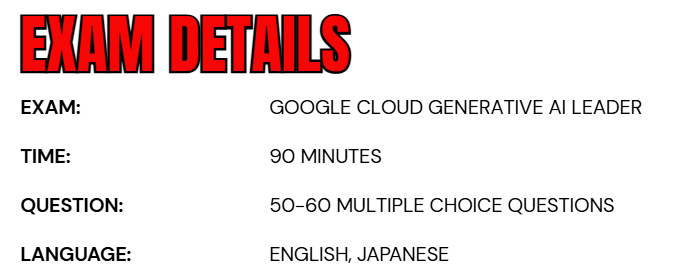
- The Google Cloud Generative AI Leader exam is a 90-minute assessment available in English and Japanese, designed to evaluate your strategic understanding of generative AI and its business applications.
- The exam consists of 50–60 multiple-choice questions that test your knowledge across fundamental gen AI concepts, Google Cloud’s offerings, and practical business strategies for AI adoption.
- Candidates can choose to take the exam either through an online-proctored environment for remote convenience or at an onsite testing center for a supervised setting.
- Upon successful completion, the certification remains valid for a period of three years, ensuring that professionals stay recognized as credible leaders in the evolving field of generative AI.
Course Outline
The exam covers the following topics:
Section 1: Understand the Fundamentals of gen AI (30%)
1.1 Describing core generative AI (gen AI) concepts and use cases. Considerations include:
- Defining core gen AI concepts (e.g., articial intelligence, natural language processing, machine learning, generative AI, foundation models, multimodal foundation models, diusion models, prompt tuning, prompt engineering, large language models).
- Describing the machine learning approaches (e.g., supervised, unsupervised, reinforcement).
- Identifying the stages of the machine learning lifecycle; data ingestion, data preparation, model training, model deployment, and model management; and the Google Cloud tools for each stage.
- Identifying how to choose the appropriate foundation model for a business use case (e.g., modality, context window, security, availability and reliability, cost, performance, ne-tuning, and customization).
- Identifying business use cases where gen AI can create, summarize, discover, and automate (e.g., text generation, image generation, code generation, video generation, data analysis, and personalized user experience).
- Describing how various data types are used in gen AI and the business implications.
- Explaining the characteristics and importance of data quality and data accessibility in AI (e.g., completeness, consistency, relevance, availability, cost, format).
- Identifying the dierences between structured and unstructured data, and identifying real-world examples of each type.
- Identifying the dierences between labeled and unlabeled data.
1.2 Describing how various data types are used in gen AI and the business implications. Considerations include:
- Explaining the characteristics and importance of data quality and data accessibility in AI (e.g., completeness, consistency, relevance, availability, cost, format).
- Identifying the dierences between structured and unstructured data, and identifying real-world examples of each type.
- Identifying the dierences between labeled and unlabeled data.
1.3 Identifying the core layers of the gen AI landscape and the business implications. Considerations include:
- Infrastructure
- Models
- Plaorms
- Agents
- Applications
1.4 Identifying the use cases and strengths of Google’s foundation models. Considerations include:
- Gemini
- Gemma
- Imagen
- Veo
Section 2: Learn about Google Cloud’s gen AI offerings (35%)
2.1 Describing Google Cloud’s strengths in the eld of gen AI. Considerations include:
- Describing how Google’s AI-rst approach and commitment to future innovation translate into cuing-edge gen AI solutions.
- Describing how Google Cloud has an enterprise-ready AI plaorm (e.g., responsible, secure, private, reliable, scalable).
- Recognizing the advantages of Google’s comprehensive AI ecosystem (e.g., integration of gen AI across Google products and services).
- Describing the benets of Google Cloud’s open approach.
- Identifying the essential components of Google Cloud’s AI-optimized infrastructure and its benets (e.g., hypercomputer, Google’s custom-designed TPUs, GPUs, data centers, cloud computing).
- Explaining how Google Cloud’s AI plaorm provides users with control over their data (e.g., security, privacy, governance, open and leading rst party models, pre-built and customizable solutions, agents).
- Describing how Google Cloud’s AI plaorm democratizes AI development (e.g., low-code and no-code tools, pre-trained models, APIs).
2.2 Describing how Google Cloud’s prebuilt gen AI offerings enable AI powered work. Considerations include:
- Recognizing the functionality, use cases, and business value of the Gemini app and Gemini Advanced (e.g., Gems).
- Recognizing the functionality, use cases, and business value of Google Agentspace (e.g., Cloud NotebookLM API, multimodal search, and custom agent capabilities).
- Recognizing the functionality, use cases, and business value of Gemini for Google Workspace.
2.3 Describing how Google Cloud’s gen AI offerings improve the customer experience. Considerations include:
- Recognizing the functionality, use cases, and business benets of Google Cloud’s external search offerings (e.g., Vertex AI Search, Google Search).
- Recognizing the functionality, use cases, and business value of Google’s Customer Engagement Suite (e.g., Conversational Agents, Agent Assist, Conversational Insights, Google Cloud Contact Center as a Service).
2.4 Describing how Google Cloud empowers developers to build with AI. Considerations include:
- Recognizing the functionality, use cases, and business value of Vertex AI Plaorm (e.g., Model Garden, Vertex AI Search, AutoML).
- Recognizing the functionality, use cases, and business value of Google Cloud’s RAG offerings (e.g., prebuilt RAG with Vertex AI Search, RAG APIs).
- Recognizing the functionality, use cases, and business value of using Vertex AI Agent Builder to build custom agents.
2.5 Defining the purpose and types of tooling for gen AI agents. Considerations include:
- Identifying how agents use tools to interact with the external environment and achieve tasks (e.g., extensions, functions, data stores, and plugins).
- Identifying relevant Google Cloud services and pre-built AI APIs for agent tooling (e.g., Cloud Storage, databases, Cloud Functions, Cloud Run, Vertex AI, Speech-to-Text API, Text-to-Speech API, Translation API, Document Translation API, Document AI API, Cloud Vision API, Cloud Video Intelligence API, Natural Language API, Google Cloud API Library).
- Determining when to use Vertex AI Studio and Google AI Studio.

Section 3: Understand the Techniques to improve gen AI model output (20%)
3.1 Describing how to proactively overcome foundation model limitations. Considerations include:
- Identifying common limitations of foundation models (e.g., data dependency, the knowledge cuto, bias, fairness, hallucinations, edge cases).
- Describing the Google Cloud-recommended practices to address limitations (e.g., grounding, retrieval-augmented generation [RAG], prompt engineering, ne-tuning, human in the loop [HITL]).
- Recognizing Google-recommended practices for continuous monitoring and evaluation of gen AI models (e.g., automatic model upgrades, key performance indicators, security patches and updates, versioning, performance tracking, dri monitoring, Vertex AI Feature Store).
3.2 Describing prompt engineering techniques and how they drive beer results. Considerations include:
- Defining prompt engineering and describing its signicance in interacting with large language models (LLMs).
- Identifying prompting techniques and use cases (e.g., zero-shot, one-shot, few-shot, role prompting, prompt chaining).
- Identifying advanced prompting techniques and when to use them (e.g., chain-of-thought prompting, ReAct prompting).
3.3 Identifying grounding techniques and their use cases. Considerations include:
- Describing the concept of grounding in LLMs and dierentiating between grounding with rst-party enterprise data, third-party data, and world data.
- Describing how retrieval-augmented generation (RAG) can aect the generated output from your gen AI models.
- Google Cloud grounding offerings:
- Pre-built RAG with Vertex AI Search
- RAG APIs
- Grounding with Google Search
- Identifying how sampling parameters and seings are used to control the behavior of gen AI models (e.g., token count, temperature, top-p [nucleus sampling], safety seings, and output length).
Section 4: Understand the Business strategies for a successful gen AI solution (15%)
4.1 Describing the Google Cloud-recommended steps to successfully implement a transformational gen AI solution. Considerations include:
- Recognizing the dierent types of gen AI solutions (e.g., text generation, image generation, code generation, personalized user needs).
- Identifying the key factors that inuence gen AI needs (e.g., business requirements, technical constraints).
- Describing how to choose the right gen AI solution for a specic business need.
- Identifying the steps to integrate gen AI into an organization.
- Identifying techniques to measure the impact of gen AI initiatives.
4.2 Defining secure AI and its importance in protecting AI systems from malicious aacks and misuse. Considerations include:
- Explaining security throughout the ML lifecycle.
- Identifying the purpose and benets of Google’s Secure AI Framework (SAIF).
- Recognizing Google Cloud security tools and their purpose (e.g., secure-by-design infrastructure, Identity and Access Management (IAM), Security Command Center, and workload monitoring tools).
4.3 Describing the importance of responsible AI in business. Considerations include:
- Explaining the importance of responsible AI and transparency.
- Describing privacy considerations (e.g., privacy risks, data anonymization and pseudonymization).
- Describing the implications of data quality, bias, and fairness.
- Describing the importance of accountability and explainability in AI systems.
Google Cloud Generative AI Leader Exam FAQs
Exam Policies
To maintain fairness, consistency, and credibility across all Google Cloud certifications, specific exam policies are in place. Some of them are:
– Recertification Policy
Google Cloud certifications are valid for three years from the date they are awarded. To maintain an active certification status, candidates must successfully complete the recertification exam before their credential expires. The recertification process ensures that certified professionals remain up to date with the latest skills and industry practices. Candidates may begin the recertification process up to 60 days prior to the expiration date of their certification.
– Scoring Policy
Google Cloud certification exams are designed to measure whether candidates meet the required minimum competency standard. Results are reported as pass or fail only; no numerical scores are disclosed. These exams are not intended to serve as diagnostic tools, nor are they used to rank or compare individuals. This approach ensures fairness and prevents misinterpretation of performance.
Google Cloud Generative AI Leader Exam Study Guide
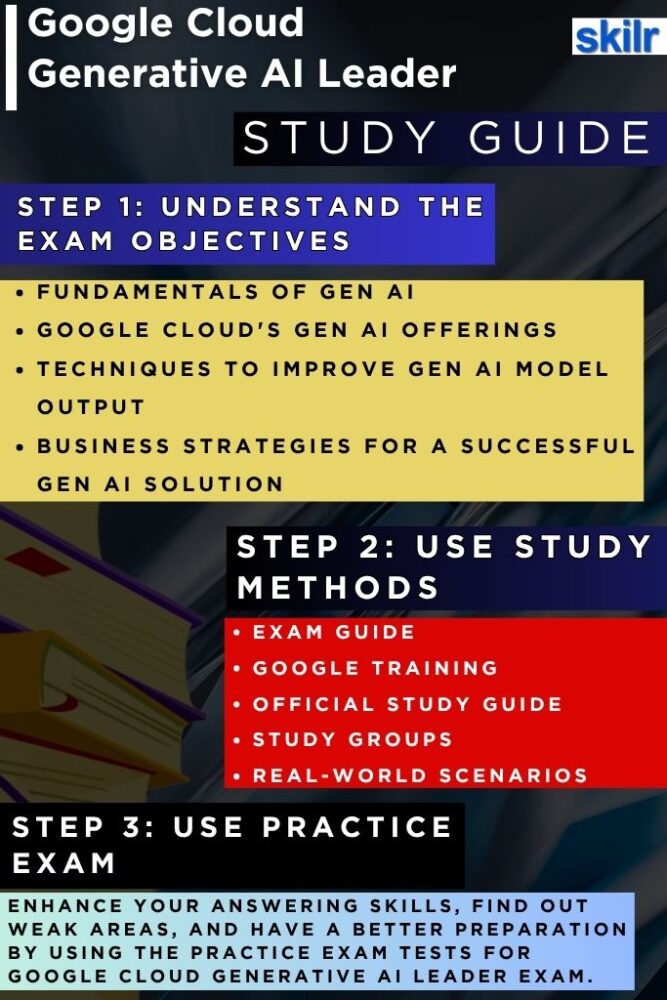
Step 1: Understand the Exam Objectives
Preparing for the Google Cloud Generative AI Leader exam begins with a clear understanding of its objectives. This certification is designed to measure business-level expertise rather than deep technical implementation, so the focus should be on strategic and conceptual knowledge. The exam evaluates understanding across four core domains: the fundamentals of generative AI, Google Cloud’s gen AI offerings, techniques for improving model outputs, and strategies for responsible AI adoption. By carefully studying these areas and linking them to practical business applications, candidates can establish a strong foundation that ensures their preparation is both comprehensive and aligned with exam expectations.
Step 2: Expand Your Knowledge with Official Training
Once the objectives are clear, the next step is to build knowledge through structured training programs. Google Cloud offers curated learning paths and advanced courses that dive into enterprise-ready AI solutions. These training modules provide a systematic way to understand not only the technology but also the strategic value it brings to organizations. They help candidates develop confidence in discussing how Google Cloud’s AI-first offerings can drive innovation and foster responsible adoption. Training also ensures that candidates are able to communicate complex AI concepts in a way that resonates with both technical experts and business leaders. However, the training path includes:
– Generative AI Leader Training
This training program, delivered through a series of on-demand courses, guides learners from a broad introduction to generative AI toward a deeper understanding of how it can be leveraged with Google Cloud to drive organizational transformation. Featuring engaging video lessons and interactive modules, the program provides both conceptual knowledge and practical exposure. Learners gain hands-on experience with tools such as Gemini Advanced, Notebook LM, and Google AI Studio, enabling them to connect theory with real-world application.
Step 3: Reviewing the Study Guide
Reviewing the Generative AI Leader Study Guide is an essential step in your exam preparation, as it provides a structured outline of the key domains and competencies you will be tested on. The guide highlights critical areas such as the fundamentals of generative AI, Google Cloud’s offerings, methods to improve model outputs, and strategies for adopting AI responsibly within business contexts. By carefully studying this resource, candidates gain clarity on the scope of the exam and can align their preparation with the specific knowledge areas required. It also serves as a roadmap to prioritize learning efforts, ensuring that no important topics are overlooked while reinforcing the balance between conceptual understanding and strategic application.
Step 4: Join Study Groups and Communities
Learning is most effective when it is collaborative. Engaging with study groups, online forums, and professional communities can greatly enhance preparation. These platforms create opportunities to exchange knowledge, clarify doubts, and explore diverse perspectives on the use of generative AI in real-world contexts. Participating in discussions, webinars, and peer-driven learning sessions can also help candidates stay motivated and disciplined throughout their exam journey. In addition, communities often share helpful resources such as practice questions, study notes, and exam tips that can make preparation more structured and efficient.
Step 5: Apply Knowledge to Real-World Scenarios
The Generative AI Leader certification is focused on business leadership, so applying knowledge to real-world use cases is crucial. Candidates should actively think through scenarios where generative AI could transform industries such as healthcare, finance, retail, or education. For example, they might explore how generative AI can improve customer experiences, optimize business processes, or support creative problem-solving. By considering such practical applications, candidates develop the ability to connect technical capabilities with strategic outcomes. This not only sharpens their exam readiness but also prepares them to act as effective leaders within their organizations.
Step 6: Take Practice Tests and Review Thoroughly
The final stage of preparation involves taking practice tests and reviewing results to measure readiness. Practice exams simulate the real test environment, allowing candidates to become familiar with question formats and time constraints. More importantly, they provide insights into areas that need additional focus. Reviewing explanations for correct and incorrect answers deepens understanding and builds confidence. Consistent practice helps ensure that candidates approach the exam with clarity, strategic thinking, and the assurance that they are well-prepared to succeed.
