
The Salesforce Certified Industries CPQ Developer credential validates the expertise of professionals who design, develop, and configure Configure, Price, Quote (CPQ) applications within Salesforce Industries Clouds such as Communications, Media, and Energy & Utilities. This certification demonstrates a candidate’s ability to build and maintain product catalogs, pricing structures, promotions, and business rules used in order and quoting processes.
– Who Should Take This Exam
This certification is ideal for individuals who want to showcase their technical proficiency in building CPQ solutions using Salesforce Industries CPQ. Candidates are typically professionals with at least one year of experience working with Industries CPQ and three to six months of hands-on project implementation experience in any of the following roles:
- Salesforce Platform Developer
- Salesforce App Builder
- Solution Architect
- Technical Architect
- Support Engineer
The exam is best suited for those responsible for configuring products, promotions, pricing, and business rules that align with organizational requirements. It’s also valuable for developers involved in guided selling and digital commerce processes using CPQ functionality.
– Key Knowledge and Skills Required
A successful Salesforce Certified Industries CPQ Developer demonstrates strong understanding and practical experience in:
- Core Industries CPQ entities and their features
- Cart management and configuration capabilities
- Opportunity, quoting, and ordering workflows, including multi-site quoting
- Building products and promotions with attributes, cardinality, and object hierarchy
- Configuring and debugging pricing models and pricing plans
- Implementing and troubleshooting rules (context and advanced)
- Understanding Industries CPQ interfaces, APIs, and their appropriate use cases
- Managing cache operations and CPQ jobs for testing and design
- Executing catalog data and metadata migrations between orgs
- Applying org and catalog mastery strategies
Exam Details
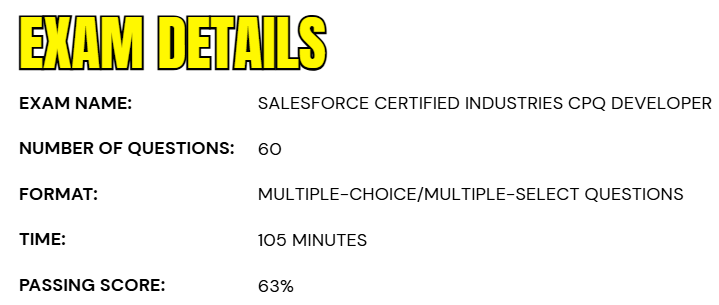
- The Salesforce Industries CPQ Developer Exam consists of 60 multiple-choice or multiple-select questions, along with up to five unscored questions that do not impact the final result.
- Candidates are given 105 minutes to complete the test, and a minimum passing score of 63% is required to earn the certification.
- The exam can be taken either onsite at an authorized testing center or through an online proctored environment, offering flexibility for different test-takers.
- During the exam, the use of hard-copy or online reference materials is strictly prohibited.
- There are no formal prerequisites for attempting this certification, making it accessible to anyone seeking to validate their expertise in Salesforce Industries CPQ development.
Course Outline
The Salesforce Industries CPQ Developer Exam evaluates a candidate’s understanding and practical ability to apply the key features and functionalities associated with the following core objectives.
1. Overview of Products: 20%
- Identifying concepts required to configure product and product bundles.
- Identifying concepts required to configure object type hierarchies.
- Identifying concepts required to configure attributes.
- Determining the implications of the configurations of a product.
2. Understand about Promotions and Discounts: 7%
- Identifying concepts required to configure promotions.
- Identifying concepts required to configure discounts.
- Determining when to use promotions and/or discounts.
- Describing the capabilities and use cases for formula fields and roll-up summary fields.
3. Basics of Pricing: 17%
- Identifying concepts required to build pricing.
- Identifying concepts required to configure attribute based pricing.
- Defining how to adjust pricing.
- Determining which types of pricing to use and when.
- Identifying concepts required to create cost and margin.
4. Learn about Rules: 12%
- Identifying concepts required to build context rules.
- Identifying concepts required to build advanced rules.
- Identifying concepts required to build product configuration procedures.
- Determining which type of rule to use and when.
5. Understand APIs: 12%
- Determining when to use cart based APIs or the digital commerce APIs.
- Differentiating among the cart based APIs methods, parameters, and how to use them.
- Differentiating among the digital commerce APIs methods, parameters, and how to use them.
- Identifying concepts required to build sales catalogs.

6. Learn about Ordering and Quoting: 12%
- Describing the user experience of the cart.
- Identifying concepts required to configure multi-site quoting.
- Identifying concepts required to create basic configurations to ordering and quoting.
- Describing asset based ordering (ABO).
7. Understand Troubleshooting: 20%
- Troubleshooting product, pricing, promotions and discounts, and rules.
- Troubleshooting API parameters, responses, and requests.
Salesforce Certified Industries CPQ Developer Exam FAQs

Salesforce Certification Exam Policy
The Salesforce Certification Exam Policy defines the official guidelines and procedures for scheduling, rescheduling, canceling, and completing Salesforce certification exams—whether taken online or at an authorized testing center. These policies are in place to ensure fairness, consistency, and exam integrity across all testing environments.
– Onsite (Testing Center) Exams
Candidates taking exams at Pearson VUE testing centers can reschedule or cancel their appointments up to 48 hours before the scheduled time through their Pearson VUE account. Requests made after this window are typically not accepted. Candidates who fail to attend the exam without prior notice will be marked as no-shows, resulting in forfeiture of the exam fee.
– Online Proctored Exams
For online proctored exams, candidates may reschedule or cancel their test up to 24 hours before the scheduled start time using the Pearson VUE platform at no additional cost. Changes made after this deadline are generally not permitted. Missing the exam without prior rescheduling will lead to loss of the full exam fee.
Salesforce Exam Candidate Code of Conduct
All participants in the Salesforce Certification Program are expected to maintain the highest standards of honesty, integrity, and professionalism throughout their certification journey. By registering for any Salesforce exam, candidates agree to comply with the Salesforce Credential and Certification Program Agreement, which sets clear expectations for ethical conduct during preparation, testing, and all related activities.
Candidates are encouraged to use official Salesforce learning resources, engage ethically within the Trailblazer Community, and follow all exam rules and security protocols. Acts of misconduct—such as requesting or sharing confidential exam materials, using unauthorized assistance, or violating test procedures—are strictly prohibited. Any breach of Salesforce’s ethical standards may lead to serious disciplinary actions, including invalidation of results, suspension or revocation of credentials, and, in severe cases, permanent disqualification from the Salesforce Certification Program.
Salesforce Certified Industries CPQ Developer Exam Study Guide
Step 1: Review and Understand the Exam Guide
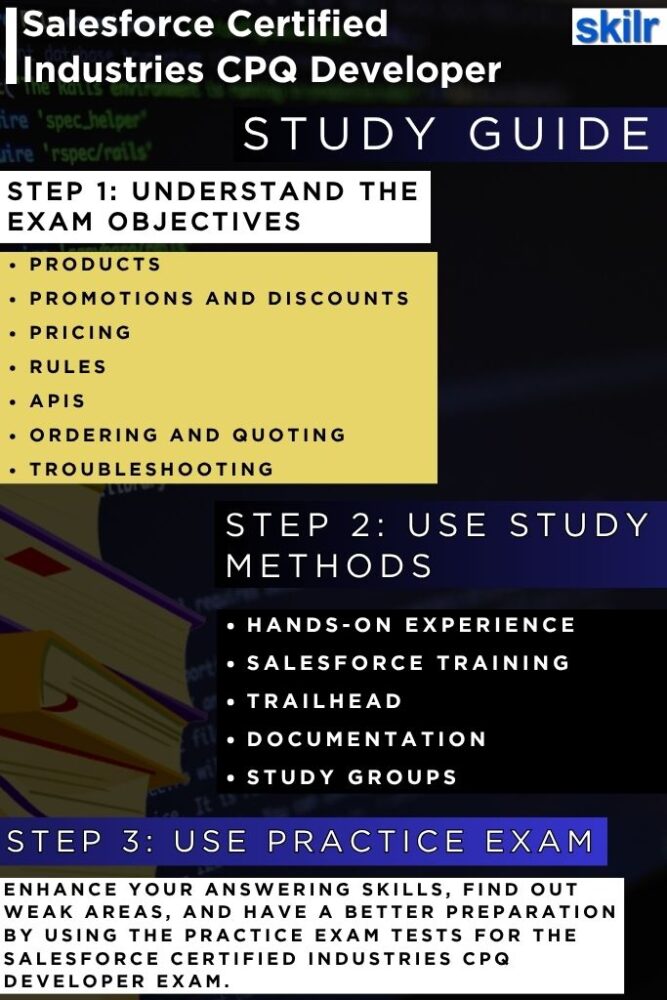
The first and most crucial step in preparing for the Salesforce Certified Industries CPQ Developer Exam is to carefully study the official exam guide provided by Salesforce. This document serves as your blueprint, outlining everything from the exam structure to the weightage of each topic. It explains key areas such as product configuration, pricing, promotions, and rule management, helping you understand where to focus your learning efforts.
Take time to review the recommended resources and related Salesforce documentation mentioned in the guide. Familiarizing yourself with the guide early ensures you have a clear understanding of the knowledge areas being assessed and how the exam aligns with real-world CPQ implementation scenarios.
Step 2: Combine Hands-On Experience with Formal Training
Success in this exam requires a balance of practical experience and structured learning. While theoretical understanding is essential, Salesforce emphasizes the ability to apply concepts to real business use cases. Start by working on live projects or in a sandbox environment to gain firsthand experience in configuring products, creating pricing plans, setting up promotions, and defining rule logic. This hands-on practice strengthens your technical foundation.
At the same time, enroll in Salesforce-approved training courses offered through Trailhead Academy or authorized partners. These training modules are designed by Salesforce experts and align directly with the certification objectives. Combining project exposure with formal learning ensures you develop both conceptual clarity and implementation proficiency.
Step 3: Gain Practical Experience to Strengthen Expertise
The Salesforce Industries CPQ Developer certification tests more than just your knowledge—it evaluates your ability to apply that knowledge in real-world situations. Therefore, practical experience plays a vital role. Set up a developer org or sandbox where you can experiment freely with product hierarchies, attribute configurations, and pricing models. Try to replicate end-to-end quoting processes, from creating products and promotions to managing guided selling flows and testing pricing rules.
Explore how context rules, cardinality, and inheritance impact configuration behavior. By troubleshooting and solving implementation challenges on your own, you’ll develop a deeper understanding of how different CPQ components interact. This kind of real, scenario-based practice is often what separates successful candidates from those who rely solely on theoretical preparation.
Step 4: Skill Up on Trailhead
Salesforce Trailhead remains one of the most powerful tools for certification preparation. It offers an interactive, self-paced learning experience with trails and modules specifically designed for Industries CPQ Developers. Begin by completing the Industries CPQ Developer Trailmix, which covers foundational topics such as catalog management, product modeling, pricing and promotions, and rule configuration. Each unit includes hands-on challenges, allowing you to apply what you’ve learned in a simulated Salesforce environment.
Trailhead also provides access to release updates and best practices, ensuring your knowledge stays current with the latest Salesforce platform enhancements. Consistent practice on Trailhead not only strengthens your theoretical understanding but also familiarizes you with the Salesforce interface and terminology you’ll encounter during the exam.
Step 5: Engage with Study Groups and Trailblazer Communities
Learning in isolation can be limiting, especially when preparing for a technical exam like this. Engaging with the Salesforce Trailblazer Community, local user groups, or dedicated online study forums can make a significant difference. These platforms allow you to discuss complex CPQ scenarios, share learning resources, and gain insights from professionals who have already passed the certification.
Many Trailblazers share real exam experiences, common pitfalls, and recommended study strategies. You can also attend webinars, workshops, or Trailhead Academy study sessions where Salesforce experts provide guidance and clarify key topics. Active participation in these communities helps you stay motivated, keeps you informed about recent platform changes, and offers valuable networking opportunities within the Salesforce ecosystem.
Step 6: Take Practice Tests and Assess Your Readiness
Once you have a strong grasp of the core concepts, it’s time to put your knowledge to the test by attempting practice exams. These tests are designed to simulate the actual certification experience, both in terms of question style and time constraints. Practice tests help you identify areas that need further improvement and refine your time management skills under pressure.
Analyze your performance carefully after each attempt—focus on understanding why the correct answers are right and where your reasoning went wrong. Many candidates find that repeated practice improves not only accuracy but also confidence. Use official Salesforce practice tests or trusted third-party providers to ensure the questions align with the latest exam format and content.
Step 7: Review Salesforce Documentation, Tip Sheets, and User Guides
As your final preparation step, revisit the official Salesforce documentation, implementation guides, and tip sheets related to Industries CPQ. These resources provide in-depth explanations of features, configuration steps, and use cases that go beyond what is covered in the exam guide. Pay attention to details like cache management, API usage, catalog data migration, and pricing plan troubleshooting—topics that often appear in the exam.
Salesforce frequently updates its documentation to reflect new features or best practices, so make sure you’re referring to the latest version. Reviewing these materials will not only reinforce your understanding of technical concepts but also give you a strong command of Salesforce’s terminology and real-world use cases, ensuring you enter the exam with complete confidence and clarity.
