

The Salesforce Certified JavaScript Developer credential is designed for professionals who actively build applications using JavaScript across the web technology stack. Whether working on front-end interfaces or back-end services, candidates are expected to understand modern JavaScript features, patterns, and development practices that apply to any framework. This certification is framework-agnostic and does not require mobile-specific or device-specific expertise.
– What This Certification Validates
This credential confirms a candidate’s ability to:
- Apply core JavaScript concepts, including programming fundamentals, data handling, asynchronous operations, and error management.
- Work effectively with Salesforce’s JavaScript-based technologies, especially the Lightning Component Framework.
- Build, maintain, and test Lightning Web Components (LWC) — custom web components built using modern JavaScript and standard web technologies.
LWC enables developers to use familiar JavaScript, HTML, and CSS capabilities to create fast, reusable, and scalable UI components on the Salesforce platform.
– Skills Expected from a JavaScript Developer Candidate
A qualified candidate for this exam should be able to:
- Build front-end and/or back-end applications using JavaScript in one or more frameworks.
- Architect solutions that are performant, reusable, and maintainable.
- Apply JavaScript-specific design patterns and combine JavaScript with HTML, CSS, and related technologies.
- Integrate modern JavaScript capabilities with Salesforce’s developer services to build high-performance applications on the Lightning Platform.
Because LWC uses standard JavaScript, developers familiar with modern JS can begin building Salesforce apps with minimal learning curve.
– Who Should Take the Salesforce Certified JavaScript Developer Exam?
This certification is ideal for Salesforce ecosystem professionals and JavaScript specialists looking to demonstrate their ability to build web applications using JavaScript and Salesforce technologies. It is especially suited for:
– Target Audience
- Salesforce partners, customers, and employees who work with JavaScript
- Developers aiming to expand into the Salesforce development ecosystem
- Professionals who want to validate their JavaScript expertise through an industry-recognized credential
– Typical Job Roles
- JavaScript Developer / Programmer
- Salesforce Developer
- Full-Stack Developer
- Web Application Developer
- Front-End Developer
- Backend / Software Developer
- UI/UX Engineer
- Support Engineer
- Technical Product or Project Manager
– Industry Recognition of the JavaScript Developer Certification
The Salesforce Certified JavaScript Developer exam stands as a respected, industry-recognized credential within the broader JavaScript ecosystem. It is designed for professionals who have approximately 1–2 years of hands-on experience building JavaScript applications across the web stack, whether on the client side, server side, or both. The certification focuses on validating a candidate’s core understanding of JavaScript and their ability to work confidently with JavaScript-based technologies.
Successful candidates demonstrate mastery of fundamental JavaScript concepts, modern programming practices, and real-world application development skills. These capabilities directly translate into building Lightning Web Components (LWC) on the Salesforce platform, enabling developers to leverage their existing JavaScript expertise without learning an entirely new language.
There are no formal prerequisite certifications, making this credential accessible to anyone with solid JavaScript development experience who wants to strengthen their professional profile or expand into Salesforce development.
Exam Details
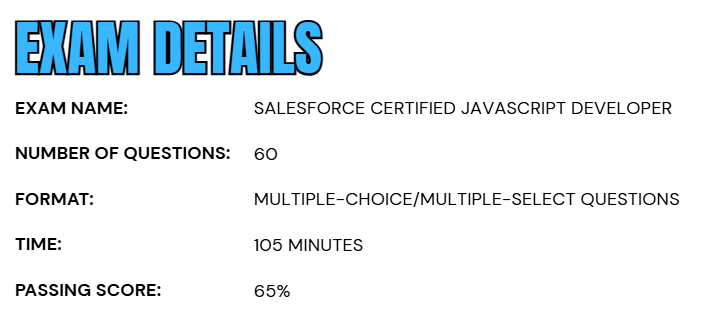
- The Salesforce JavaScript Developer Exam consists of 60 scored multiple-choice or multiple-select questions, along with a small number of unscored items that do not affect the final result.
- Candidates are given 105 minutes to complete the assessment, and must achieve a minimum score of 65% to pass.
- The exam can be taken either at an authorized testing center or remotely through an online proctored setup, offering flexibility based on the candidate’s preference.
- During the test, no external resources—whether printed materials or online references—are permitted, ensuring that the exam accurately reflects the candidate’s individual knowledge and hands-on JavaScript proficiency.
Course Outline
The Salesforce JavaScript Developer Exam evaluates a candidate’s proficiency across the following key domains and objectives.
1. Understand about Variables, Types, and Collections: 23%
- Given a scenario, writing code to create variables and initialize them correctly.
- Given a business requirement, utilizing strings, numbers, and dates effectively.
- Given a scenario or example, demonstrating awareness of type coercion and its effects.
- Given a specific scenario, distinguishing truthy or falsey evaluations.
- Given a list of data, demonstrating data manipulation with arrays.
- Given a JSON response, demonstrating how to operate the JSON object.
2. Concepts of Objects, Functions, and Classes: 25%
- Given a business requirement, locating the best function implementation.
- Given a business requirement, applying fundamentals of object implementation to solve the business requirement.
- Given a business requirement, applying fundamentals of class implementation to solve the business requirement.
- Given a JavaScript module, giving examples of how to use the module.
- Given a JavaScript decorator, giving examples of how to use the decorator.
- Given a block of code, analyzing the variable scope and the execution flow.
3. Understand Browser and Events: 17%
- Given a business requirement, utilizing Events, event handlers, and propagation.
- Given a business requirement, evaluate and manipulate the DOM.
- Given a scenario, utilizing the Browser Dev Tools to investigate code behavior.
- Given a scenario and requirements, utilizing browser specific APIs.
4. Overview of Debugging and Error Handling: 7%
- Given a scenario, handling errors properly.
- Given code to be debugged, using the console and breakpoints.
5. Understand Asynchronous Programming: 13%
- Given a scenario, applying asynchronous programming concepts.
- Given a scenario, using event loop and event monitor or determine loop outcomes.

6. Understand Server Side JavaScript: 8%
- Given a scenario and requirements, infer which Node.js implementation is a good solution.
- Given a scenario and requirements, infer which Node.js CLI command is a good solution.
- Know the core Node.js modules and given requirements, infer which Node.js library/framework is a good solution.
- Given a scenario and requirements, distinguishing which Node.Js Package Management solution is the most fitting.
7. Learn About Testing: 7%
- With a block of code and the associated Unit Test, determining where the test is ineffective and modify it to make it more effective.
Salesforce Certified JavaScript Developer Exam FAQs
Salesforce Certification Exam Policy
The Salesforce Certification Exam Policy outlines the formal rules and procedures for booking, modifying, canceling, and completing Salesforce certification exams—whether taken online or at a Pearson VUE testing center. These guidelines are designed to maintain fairness, consistency, and the highest level of exam security across all testing environments.
– Onsite (Testing Center) Exams
Candidates testing at a Pearson VUE center may reschedule or cancel their exam up to 48 hours before their appointment through their Pearson VUE account. Requests submitted after this deadline are generally not accepted. Failure to appear for the scheduled exam without proper cancellation is treated as a no-show, resulting in the loss of the full exam fee.
– Online Proctored Exams
For candidates opting for an online proctored experience, rescheduling or canceling is permitted up to 24 hours before the exam start time via the Pearson VUE platform at no extra charge. Changes requested after this period are typically denied. Missing the exam without prior adjustment will also lead to forfeiture of the exam fee.
Salesforce Exam Candidate Code of Conduct
All Salesforce certification candidates are expected to uphold strong principles of honesty, professionalism, and ethical behavior throughout the certification process. By registering for any exam, candidates agree to the terms of the Salesforce Credential and Certification Program Agreement, which clearly defines acceptable conduct during exam preparation and testing.
Candidates should rely on legitimate Salesforce study materials, participate responsibly within the Trailblazer Community, and follow all exam procedures and security requirements. Any form of misconduct—including sharing or soliciting confidential exam content, using unauthorized aids, or violating test center or online proctoring rules—strictly violates Salesforce policy. Consequences for such violations may include exam invalidation, suspension or revocation of credentials, and, in serious cases, permanent removal from the Salesforce Certification Program.
Salesforce Certified JavaScript Developer Exam Study Guide
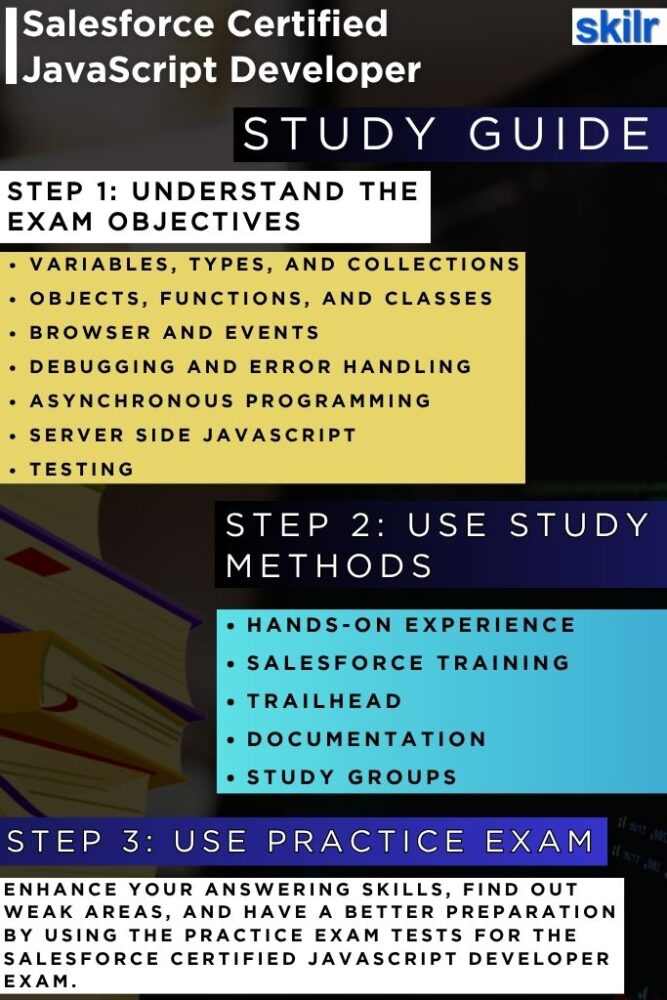
1. Review the Official Exam Guide Thoroughly
Your preparation should begin with a complete reading of the Salesforce JavaScript Developer Exam Guide, as this document defines exactly what the certification will test. It outlines the exam domains, scoring distribution, skills required, and question format. Understanding the guide ensures that you prepare strategically rather than studying random JavaScript topics that may not align with the exam’s expectations. The guide helps you map out a clear study direction, set timelines, and identify which areas require deeper attention, especially if you are new to modern ES6+ features or Salesforce-specific implementations like Lightning Web Components.
2. Strengthen Your Core JavaScript Knowledge Through Hands-On Experience
Since the exam targets individuals with one to two years of JavaScript development experience, practical coding exposure is essential. Candidates should be confident working with fundamental areas such as variables, data types, operators, strings, and type coercion, both implicit and explicit. It is equally important to understand how functions operate, including higher-order functions, closures, and callback behavior. Knowledge of arrays, objects, inheritance models, classes, modules, and the inner workings of the Document Object Model (DOM) is expected.
Proficiency in event handling, debugging strategies, testing patterns that are not tied to any particular platform, asynchronous programming, and server-side JavaScript will significantly enhance your readiness. Real-world development experience helps build the intuition required to approach exam scenarios analytically.
3. Combine Real Development Work with Formal Salesforce Training
Although practical JavaScript knowledge forms the foundation, structured learning amplifies your understanding and improves exam readiness. Salesforce offers training through its learning platforms and Trailhead Academy, allowing developers to explore modern JavaScript concepts systematically. Training courses often include guided examples, code-along exercises, and Salesforce-specific best practices that bridge the gap between general JavaScript development and Salesforce’s implementation of web technologies. These learning experiences help reinforce your fundamentals and introduce you to areas of the platform you may not encounter during regular JavaScript development.
4. Advance Your Skills with Trailhead Modules and Guided Projects
Trailhead is one of the most valuable resources for exam preparation because it breaks complex topics into interactive, digestible learning paths. Completing modules related to JavaScript, Lightning Web Components, and core Salesforce development patterns allows you to connect general-purpose JavaScript skills with Salesforce’s practical requirements. The hands-on projects and exercises help you apply concepts directly in a safe, guided environment. Working through these modules builds both technical confidence and familiarity with platform-specific practices, which is crucial for real exam success.
5. Gain Practical Experience Through Real-World Development Scenarios
One of the most effective ways to prepare is by applying your knowledge in actual development projects. Building sample Lightning Web Components, experimenting with browser events, manipulating the DOM, handling errors, performing asynchronous tasks, and working with data processing patterns reinforce your theoretical understanding. Real-world development challenges often reveal gaps in your knowledge, highlight areas you need to revisit, and help you gain the problem-solving mindset required for scenario-based exam questions. The more you code, test, break, and fix, the more exam-ready you become.
6. Leverage Additional Resources to Deepen Understanding
To strengthen your preparation further, explore the extensive set of Salesforce documentation, developer guides, tip sheets, and official user guides. These materials provide insights into best practices, recommended architecture patterns, and common pitfalls to avoid when building JavaScript applications on Salesforce. Practice exams are equally important, as they help you evaluate your knowledge, understand the exam’s tone, and become comfortable with the style of questions you will encounter. Reviewing explanations from practice tests can reveal misunderstood concepts, enabling targeted improvement before taking the actual certification. The additional resources include:
- JavaScript Language
- JavaScript Guide
- JavaScript Reference
- JavaScript – Dynamic client-side scripting
- CLI commands
- Web APIs
- Node.js API
- Popular Node.js Frameworks
7. Engage with Study Groups, Developer Communities, and Trailblazer Networks
Preparing in isolation can be limiting, which is why participating in community groups adds tremendous value. The Trailblazer Community, local developer meetups, online forums, Discord groups, and study circles provide opportunities to ask questions, discuss concepts, exchange notes, and gain clarity on difficult topics. Interacting with other learners exposes you to varied perspectives and tips from candidates who have already taken the exam. These collaborative environments encourage consistent study habits and help you stay aligned with the broader Salesforce development ecosystem.
