

The Salesforce Certified MuleSoft Developer exam validates a candidate’s ability to work effectively with Mule 4, focusing on the development and management of basic APIs and integrations. This certification is ideal for individuals who have hands-on experience with MuleSoft projects under guidance and are ready to handle foundational integration responsibilities independently.
This certification also serves as a mandatory prerequisite for the more advanced Salesforce MuleSoft Developer II credential.
– Who Should Take the Exam
This exam is best suited for:
- Individuals with foundational experience in Mule 4 development.
- Developers who want to formalize their skills in building and managing integrations using Anypoint Platform and Anypoint Studio.
- IT professionals transitioning into MuleSoft development roles.
- System integrators and junior middleware engineers looking to strengthen their API and integration competencies.
- Professionals planning to progress toward advanced MuleSoft certifications, such as the Developer II exam.
– Skills Validated by the Certification
A Salesforce Certified MuleSoft Developer is expected to demonstrate proficiency in the following areas:
1. API Development and Lifecycle Management
- Using MuleSoft-hosted Anypoint Platform to design, build, deploy, manage, and govern a basic API throughout its lifecycle.
2. Integration Development Using Anypoint Studio
- Creating, testing, and debugging basic integration flows and API implementations within Anypoint Studio.
3. Connectivity to Data and Services
- Establishing connections to diverse resources including databases, files, web services, SaaS applications, and JMS queues.
4. Data Transformation
- Performing essential data transformations using DataWeave 2.0.
5. Event Handling and Error Management
- Managing flow control, routing events, and configuring error-handling strategies.
6. Batch Processing
- Processing and managing batch records for large-volume data integrations.
– Typical Job Roles for Certified MuleSoft Developers
Professionals who earn this certification often work in roles such as:
- MuleSoft Developer
- Integration Developer
- System or Solution Architect (junior/intermediate)
- Salesforce or MuleSoft Administrator with integration responsibilities
Exam Details
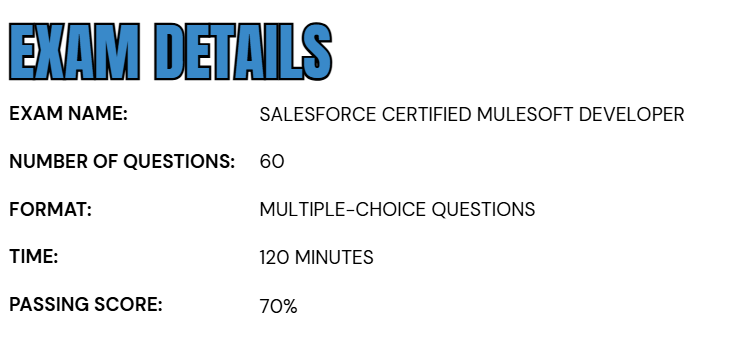
- The Salesforce Certified MuleSoft Developer Exam consists of 60 multiple-choice questions, along with up to five additional unscored items that do not impact the final result.
- Candidates are provided 120 minutes to complete the exam, a duration that includes time for any unscored questions.
- To earn the certification, a minimum passing score of 70% is required.
- The exam can be taken either in person at an authorized testing center or online through a remote proctored environment.
- During the assessment, no external resources—whether printed materials or online references—are permitted, ensuring that the evaluation reflects a candidate’s true understanding of MuleSoft development concepts.
Course Outline
The Salesforce Certified MuleSoft Developer Exam evaluates a candidate’s understanding of core Mule 4 concepts and their ability to work on basic integration projects under guidance. It also requires familiarity with fundamental integration and API-led connectivity concepts, along with a solid grasp of Anypoint Platform’s key components and its value in system integration and API management. The related objectives include:
1. Understand about Creating Application Networks 7%
- Identifying core architectural concepts of the Application Network and modern APIs.
- Identifying features of an API-led approach.
- Identifying features of MuleSoft’s recommended Operational Model (C4E).
- Applying correct processors/syntax and predict outcomes to consume RESTful web services (RAML-based).
2. Learn about Designing APIs: 8%
- Using REST API methods and resources.
- Defining REST API parameters and responses.
- Calling RESTful services defined by RAML syntax.
3. Understand about Accessing and Modifying Mule events: 10%
- Applying correct processors/DataWeave expressions to access and modify Mule event payloads, and predict outcomes.
- Applying correct processors/DataWeave expressions to access and modify Mule event attributes, and predict outcomes.
- Applying correct processors/DataWeave expressions to access and modify Mule variables, and predict outcomes.
- Applying correct processors/DataWeave expressions to enrich Mule events using Mule 4 connector targets, and predict outcomes.
4. Process of Structuring Mule Applications: 10%
- Specifying when and how to structure Mule applications into separate configuration and properties files, and predict outcomes.
- Specifying when and how to pass events between flows and subflows using connectors and flow references, and predict outcomes.
5. Steps for Building API Implementation Interfaces: 7%
- Manually building API implementations from an API specification, RAML or not.
- Predicting the results of APIkit based upon a RAML specification.
- Implementing correct responses based on a RAML specification, either manually or with APIkit.
6. Using Connectors: 10%
- Applying correct processors/syntax to connect to databases, and predict outcomes.
- Applying correct processors/syntax to connect to files or FTP servers, and predict outcomes.
- Applying correct processors/syntax to retrieve and combine data in the middle of a flow, and predict outcomes.

7. Learn about Processing Records: 10%
- Applying correct processors/syntax to process individual records in a collection using For Each scopes, and predict outcomes.
- Applying correct processors/syntax to process individual records in a collection using batch scopes, and predict outcomes.
- Applying correct processors/syntax to process individual records in a collection using async scopes, and predict outcomes.
- Implementing correct processors/syntax to process individual records in a collection using DB listeners, and predict outcomes.
- Applying correct processors/syntax to process individual records in a collection using messaging queues, and predict outcomes.
- Applying correct processors/syntax to persist data between flow executions.
8. Undertand about Transforming Data: 10%
- Converting between output types and data types using DataWeave.
- Predicting the result of core DataWeave functions.
- Applying correct syntax to write DataWeave transformations to coerce, format, order, and filter data, and predict outcomes.
- Calling Mule flows from a DataWeave script.
- Defining, using, and reusing DataWeave modules, functions, and variables, and predict outcomes.
9. Overview of Routing Events: 8%
- Applying correct processors/syntax to route messages using DataWeave conditions within a choice router, and predict outcomes.
- Applying correct processors/syntax to scatter and gather messages, and predict outcomes.
- Implementing correct processors/syntax to validate Mule events, and predict outcomes.
10. Learn about Handling Errors: 8%
- Applying correct processors/syntax to implement global error handlers, and predict outcomes.
- Applying correct processors/syntax to implement on-error continue and on-error propagate handlers, and predict outcomes.
- Implementing correct processors/syntax to combine multiple error handlers, and predict outcomes.
- Applying correct processors /syntax to implement try scopes, and predict outcomes.
- Applying correct processors/syntax to map custom errors, and predict outcomes.
11. Understand Debugging and Troubleshooting Mule Applications: 5%
- Applying correct MUnit processors to implement basic automatic tests for Mule applications, and predict outcomes.
- Identifying root causes for errors when debugging Mule applications, and predict outcomes.
12. Understand Deploying and Managing APIs and Integrations: 7%
- Deploying applications to CloudHub.
- Managing APIs using separate proxies and auto-discovery.
- Managing API policies.
Salesforce Certified MuleSoft Developer Exam FAQs

Salesforce Certification Exam Policy
The Salesforce Certification Exam Policy defines the official guidelines for scheduling, adjusting, canceling, and completing certification exams—whether taken online or at an authorized testing center. These rules are designed to maintain fairness, protect exam security, and ensure a consistent experience for all candidates.
– Onsite (Testing Center) Exams
Candidates taking their exam at a Pearson VUE testing center may reschedule or cancel their appointment through their Pearson VUE account up to 48 hours before the scheduled time. Requests submitted after this window are generally not permitted. Individuals who miss their appointment without prior rescheduling will be marked as no-shows and will lose the full exam fee.
– Online Proctored Exams
For online proctored exams, candidates may modify or cancel their booking up to 24 hours before the exam start time via the Pearson VUE platform. Any changes requested after this deadline are typically declined. Failure to attend the online session without proper rescheduling will also result in forfeiture of the exam fee.
Salesforce Exam Candidate Code of Conduct
All participants in the Salesforce Certification Program are expected to demonstrate strong ethical behavior, professionalism, and integrity. By registering for an exam, candidates agree to comply with the Salesforce Credential and Certification Program Agreement, which outlines the required standards of conduct throughout exam preparation and delivery.
Candidates must use only approved Salesforce learning resources, engage responsibly within the Trailblazer Community, and follow all exam security instructions. Activities such as sharing or requesting confidential exam questions, using unauthorized materials, or violating proctoring procedures are strictly prohibited. Any misconduct may lead to serious consequences, including invalidated results, loss of existing certifications, or permanent disqualification from the Salesforce Certification Program.
Salesforce Certified MuleSoft Developer Exam Study Guide

1. Understanding the Exam Guide
The first step in preparing for the Salesforce Certified MuleSoft Developer Exam is to thoroughly review the official exam guide. This document outlines the exam format, domains, scoring criteria, and the depth of knowledge expected from candidates. A careful reading ensures you are aware of what skills are assessed—ranging from basic Mule 4 development to API-led connectivity concepts—allowing you to approach your preparation with clarity and confidence. Treat the exam guide as your roadmap, as it helps you align your study strategy with the actual exam objectives.
2. Combining Hands-On Experience with Training and Trailhead Learning
A strong preparation plan requires a blend of practical experience, formal training, and self-paced learning. Completing MuleSoft training courses provides structured instruction, while Trailhead’s learning paths offer scenario-based modules that reinforce key concepts through interactive exercises. Working through these resources in parallel strengthens both foundational theory and practical application.
These instructor-led courses offered through Trailhead Academy or certified training providers provide an immersive learning experience. These sessions allow you to engage directly with certified instructors, ask questions, and participate in hands-on activities that reinforce essential topics. Such training not only deepens your conceptual understanding but also helps you master the exam objectives in a structured, guided manner. If you learn best through interaction and live demonstrations, this format can be highly effective. However, the related training course include:
– Anypoint Platform Development: Fundamentals – DEX401
The Anypoint Platform Development: Fundamentals (DEX401) course provides a comprehensive introduction to building and managing APIs using MuleSoft’s Anypoint Platform. Over the span of five days in an instructor-led format, participants learn the core principles of API development, hands-on integration design, and how to create Mule applications using Mule 4 and Anypoint Studio.
This intensive, concept-rich course is tailored for developers and architects who work with API-led integrations and are responsible for delivering integration solutions on the Anypoint Platform. To get the most out of this training, learners are expected to have prior experience with an object-oriented programming language and a basic understanding of data formats such as JSON, XML, and CSV. Familiarity with foundational integration technologies—including HTTP, REST, SOAP, JMS, and JDBC—will also support a smoother learning experience.
3. Gaining Practical Experience to Grow Your Expertise
Hands-on practice is one of the most critical aspects of preparing for this certification. Spending time in Anypoint Studio, building flows, working with connectors, implementing transformations with DataWeave, and deploying basic APIs will significantly enhance your comfort with Mule 4. Real-world practice exposes you to integration challenges, error-handling scenarios, and flow design patterns—components frequently reflected in exam questions. The deeper your practical experience, the more naturally you will approach both conceptual and task-based questions in the exam.
4. Learning from Industry Experts
Engaging with professionals who have experience in MuleSoft development can greatly enrich your understanding. Expert-led sessions, webinars, technical blogs, and community discussions offer valuable insights into best practices and common pitfalls. Learning from seasoned developers helps you understand how MuleSoft is applied in real business environments, making abstract concepts more tangible. Their practical tips can also provide clarity on complex areas such as event processing, API lifecycle management, and batch operations.
5. Building Your Knowledge through Study Groups and Learning Communities
Participating in the Trailblazer Community, joining study groups, or connecting with peer learning circles adds collaborative strength to your preparation. Discussions with other learners can help clarify doubts, expose you to different problem-solving approaches, and keep you accountable throughout the study process. These communities often share additional study tips, practice questions, and valuable experiences that help you gain a broader perspective of the exam topics.
6. Using Practice Tests and Reviewing Official Documentation
Attempting practice tests is one of the most reliable ways to gauge your readiness and identify areas needing improvement. These mock exams simulate the real testing environment, helping you become familiar with the question style and time constraints. Alongside practice tests, reviewing MuleSoft’s official documentation, tip sheets, user guides, and product references ensures that you develop a detailed understanding of platform capabilities. These resources provide accurate, up-to-date information that aligns closely with exam objectives and real-world use cases.
