
The Salesforce Certified Nonprofit Success Pack (NPSP) Consultant certification validates the skills required to help nonprofit organizations implement, optimize, and sustain Salesforce-based solutions. This credential is tailored for professionals experienced in deploying Salesforce.org’s nonprofit offerings, including Nonprofit Success Pack (NPSP), Nonprofit Cloud Case Management (NCCM), and the Program Management Module (PMM).
Certified professionals are capable of configuring Salesforce.org products, designing scalable architectures, and delivering long-term, maintainable solutions that support fundraising, program delivery, constituent engagement, and mission-driven operations.
This exam is built for consultants working directly with nonprofit clients and implementing Salesforce’s managed package solutions. Successful candidates know how to:
- Install, configure, and customize nonprofit-focused Salesforce.org tools
- Translate organizational needs into secure, scalable technical designs
- Build solutions that improve operational efficiency and mission outcomes
- Support long-term customer success through best practices and structured implementation planning
A certified NPSP Consultant has the skills to lead end-to-end implementations, manage complex requirements, and coordinate with stakeholders across technical and functional domains.
– Prerequisite
To sit for the Salesforce Certified Nonprofit Success Pack Consultant exam, candidates must already hold the Salesforce Administrator certification, ensuring they possess foundational knowledge of core Salesforce features, configuration capabilities, and system management best practices.
– Who Should Take This Exam?
This certification is ideal for professionals who:
- Work closely with nonprofit organizations in consulting, implementation, or system administration roles
- Have hands-on experience with NPSP or Salesforce Nonprofit Cloud solutions
- Aim to specialize in nonprofit digital transformation using Salesforce
- Want to validate their ability to lead projects, design solutions, and manage data-heavy environments
– Required Background and Experience
Qualified candidates typically bring 2–5 years of experience in the nonprofit ecosystem, along with expertise in Salesforce configuration, data management, and consulting best practices.
Successful professionals demonstrate:
Core Skills
- Strong understanding of nonprofit operations, terminology, and domain processes
- Experience managing end-to-end implementation projects
- Working knowledge of Salesforce cloud applications and the broader ecosystem
- Comfort with database modeling, data governance, and migration activities
- Ability to evaluate risks, manage expectations, and communicate with stakeholders
- Familiarity with the software development lifecycle and cloud technologies
Technical Capabilities
- Installing and configuring nonprofit-specific Salesforce managed packages
- Designing scalable, maintainable solutions aligned with industry standards
- Supporting change management and user training
- Troubleshooting issues and escalating complex technical challenges
- Ensuring successful deployment and post-implementation support
– Key Knowledge Areas
1. Product Knowledge
Candidates should understand how to:
- Administer and configure a Salesforce org
- Install and manage Salesforce.org products such as NPSP, PMM, and NCCM
- Work with both B2B and B2C account models used in nonprofit operations
- Apply Salesforce security principles and compliance best practices
- Use Salesforce Customer 360 and understand multi-tenant platform constraints
- Apply table-driven trigger management (TDTM) concepts
- Handle large data volumes and performance considerations
- Understand the interaction between core Salesforce clouds (Sales, Service, Marketing, Experience) and nonprofit modules
- Navigate sandbox types, release cycles, and development environments
- Map nonprofit challenges—fundraising, engagement, program management, grants—to practical Nonprofit Cloud solutions
2. Domain Knowledge
Candidates are expected to demonstrate expertise in nonprofit operating models, including the ability to:
- Identify common nonprofit business processes and industry best practices
- Understand the impact of privacy laws and compliance requirements
- Recognize key nonprofit KPIs, success metrics, and operational constraints
- Recommend appropriate communication and engagement strategies
- Understand continuity planning and operational challenges for nonprofits
- Compare various nonprofit types and their unique drivers
3. Consulting Skills
A successful consultant must know how to:
- Conduct requirements-gathering workshops and stakeholder meetings
- Evaluate legacy systems and plan data migration strategies
- Translate business requirements into detailed solution designs
- Decide between declarative configurations, custom development, or third-party apps
- Optimize system performance and plan scalable architectures
- Execute the full project lifecycle—from discovery to testing, deployment, and documentation
- Select appropriate deployment and release management strategies
- Clearly articulate the value of Salesforce solutions to nonprofit leaders
– Typical Job Roles
Professionals preparing for this certification often hold roles such as:
- Project Manager
- Business Analyst
- Salesforce Consultant
- Solution Architect
- Senior Administrator
- Salesforce Developer
- Technical Architect
- Data Migration Specialist
Exam Details
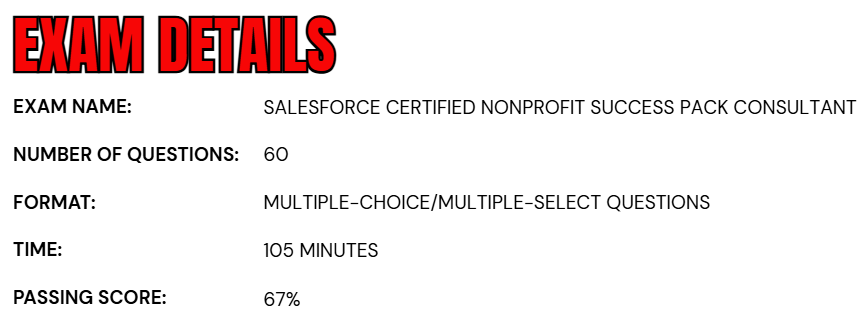
- The Salesforce Certified Nonprofit Success Pack Consultant exam consists of 60 scored multiple-choice and multiple-select questions, along with up to five additional unscored items.
- Candidates are given 105 minutes to complete the test and must achieve a minimum passing score of 67%.
- The exam is available through both onsite proctored testing centers and a remote online proctored mode, ensuring flexibility for test-takers.
- During the exam, the use of hard-copy notes or online reference materials is strictly prohibited.
- When responding to questions, candidates should base their answers on the full range of features currently available in both Salesforce Classic and Lightning Experience.
- Salesforce periodically introduces new, unscored questions to evaluate their performance under real testing conditions. These items—limited to no more than five per exam—are not labeled, ensuring they are treated like scored questions. Data from these trial questions helps refine future versions of the exam without affecting a candidate’s final score.
Course Outline
The Salesforce Certified Nonprofit Success Pack Consultant exam evaluates a candidate’s expertise across the following key objective areas.
1. Learn about Domain Expertise: 20%
- Identifying the appropriate Salesforce solutions for fundraising and donor management.
- Identifying the appropriate Salesforce solutions for marketing and engagement.
- Identifying the appropriate Salesforce solutions for program and/or volunteer management.
- Distinguishing and rationalizing the purpose for resource sites like the Trailblazer Community, Trailhead, and AppExchange, etc.
2. Understand Nonprofit Cloud Product Configuration: 22%
- Given a set of requirements, modifying NPSP Settings for people management (Leads, Contacts, Accounts, Affiliations, Relationships, Addresses) defaults.
- Given a set of requirements, configuring fundraising features (Opportunities, Payments, Allocations, Gift Entry and Recurring Donations) and batch process handling.
- Given an error message through a Nonprofit Cloud application, determine whether it is a Nonprofit Cloud application issue and appropriate next steps.
- Explaining the implications of the Salesforce release window on implementations.
- Installing Nonprofit Cloud applications and/or solutions.
- Configuring the Nonprofit Cloud application security model to meet customer requirements.
3. Learn Implementation Strategies and Best Practices: 18%
- Given a scenario, facilitate a successful Nonprofit Cloud consulting engagement.
- Gather requirements, create user stories, and turn business processes into solution design.
- Creating a change management process based on Salesforce best practices for governance.
- Determining and implementing the appropriate testing and deployment strategy (sandbox, production, tools, etc.).

4. Understand Solution Design: 20%
- Identifying the appropriate Salesforce solution(s) to meet customer requirements.
- Distinguishing when it is appropriate to use declarative development (low code), custom code development, or a third-party solution.
- Analyzing customer requirements to determine appropriate solution design considering capabilities, limitations, and design trade-offs.
- Determining the appropriate security features to use following Salesforce best practices.
5. Concepts of Integration and Data Management: 15%
- Given a specific data requirement, explain the use cases and considerations for using Salesforce native, third-party, or Nonprofit Cloud application data tools.
- Given customer requirements, articulate and implement data migration and/or integration strategies for a Nonprofit Cloud implementation.
- Identifying which duplicate management tools to use for a Salesforce implementation.
6. Analytics: 5%
- Given a scenario, determining the appropriate analytics solution (Reports, Dashboards, Tableau and Tableau CRM, third-party solutions, etc.) in Nonprofit Cloud.
Salesforce Certified Nonprofit Success Pack Consultant Exam FAQs
Salesforce Certification Exam Policy
The Salesforce Certification Exam Policy outlines the official procedures for scheduling, modifying, canceling, and completing any Salesforce certification exam. These rules apply equally to candidates testing through an online proctored session or at an approved testing center. The policy is designed to protect exam integrity, ensure fairness, and create a consistent testing experience for every participant.
– Onsite Testing at Authorized Centers
Candidates who choose to take their exam at a Pearson VUE testing facility may update or cancel their appointment through their Pearson VUE profile, provided the request is made at least 48 hours before the scheduled start time. Changes requested after this cutoff are generally not permitted.
Failure to attend an in-person exam—without making the required changes within the allowed window—will be treated as a no-show, and the full exam fee will be forfeited.
– Online Proctored Testing
For online proctored deliveries, Pearson VUE allows candidates to reschedule or cancel their session up to 24 hours prior to the exam. Requests submitted after the deadline are typically declined.
Candidates who miss their online session without rescheduling in time will also lose the entire exam fee, as the absence is considered a no-show.
Salesforce Exam Candidate Code of Conduct
All individuals participating in the Salesforce Certification Program are expected to maintain high standards of ethics, integrity, and professionalism. By registering for any exam, candidates agree to the terms outlined in the Salesforce Credential and Certification Program Agreement, which governs appropriate behavior during exam preparation and test delivery.
Candidates must rely only on approved Salesforce resources, participate responsibly within the Trailblazer Community, and adhere to all exam security and proctoring requirements.
Prohibited behaviors include, but are not limited to:
- Sharing, requesting, or distributing confidential exam content
- Using unapproved materials or tools during the exam
- Ignoring or violating proctor instructions
Salesforce Certified Nonprofit Success Pack Consultant Exam Study Guide
1. Understanding the Exam Guide
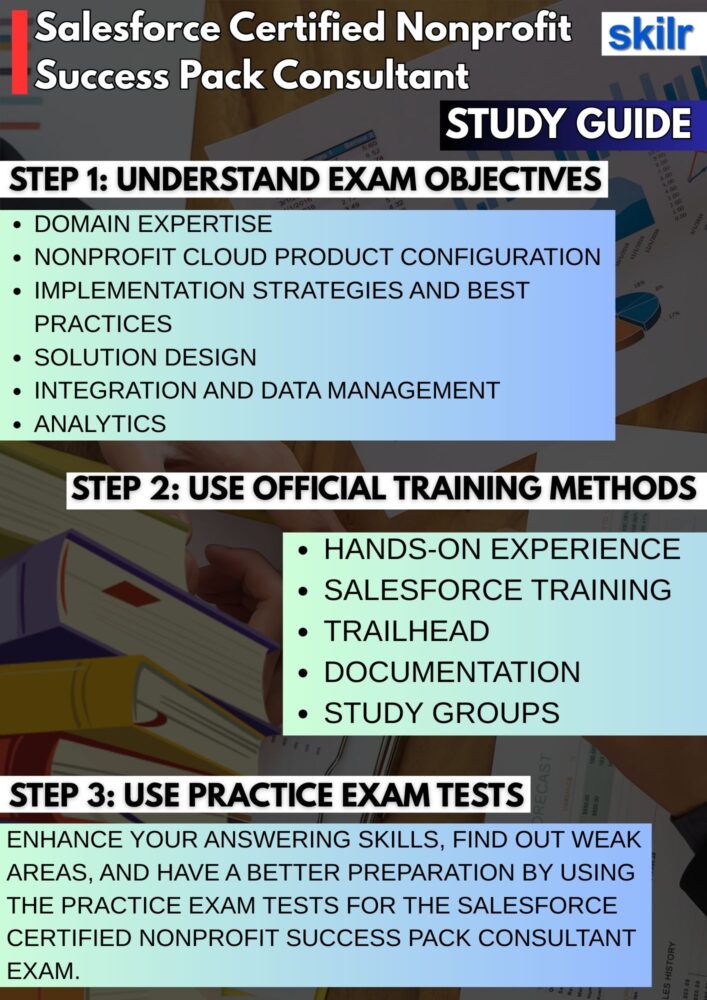
Your preparation should begin with a deep review of the official Salesforce Certified Nonprofit Success Pack Consultant Exam Guide. This provides the complete blueprint of what the exam covers, including the weighting of each objective, the technical and functional areas you are expected to master, and the topics that consistently appear in real exam scenarios.
Studying the guide thoroughly allows you to understand the exam’s scope and complexity, align your study strategy with Salesforce’s expectations, and avoid spending unnecessary time on areas that are not evaluated. The Exam Guide essentially acts as your roadmap, helping you prioritize concepts such as NPSP configuration, program management, data management best practices, and nonprofit-specific features across the Salesforce ecosystem.
2. Building Expertise Through Hands-On Experience
Hands-on experience is the most critical and impactful element of preparation for this certification. Since the exam heavily emphasizes practical application, spending time in a real or sandbox Salesforce org enables you to translate theoretical knowledge into working solutions. Installing the Nonprofit Success Pack, configuring donor management settings, setting up engagement plans, building program models, and managing data imports all contribute to your readiness.
Direct experience also allows you to recognize how Salesforce.org products behave in different scenarios, how data flows across objects, and how customizations can help address nonprofit business requirements. The more time you spend solving realistic challenges, the stronger your confidence will be when encountering complex, scenario-based exam questions.
3. Leveraging Salesforce Training and Structured Learning
Formal learning through Salesforce training programs or Trailhead Academy courses adds structure and depth to your preparation. These instructor-led or self-paced courses often mirror the exam’s content outline and provide valuable guidance on best practices for designing and implementing nonprofit solutions.
Training sessions also offer real-world examples, architectural insights, and expert explanations that go beyond what documentation alone provides. Whether you attend virtual classes or take recommended learning paths, completing official training ensures that your understanding of NPSP, PMM, Nonprofit Cloud Case Management, and the Salesforce Platform aligns with professional standards used across the industry.
4. Strengthening Your Skills with Trailhead
Trailhead remains one of the most effective ways to enhance both foundational and advanced knowledge. Through its interactive modules, trails, and hands-on projects, Trailhead helps you reinforce key concepts such as data modeling, security, automation, and the specific capabilities of nonprofit-focused Salesforce products.
Completing projects allows you to apply features in real-time, while scenario-driven challenges encourage deeper problem-solving. Trailhead also stays updated with new releases, ensuring your learning reflects the most current platform features and functionality. As you accumulate badges and work through specialized nonprofit learning paths, you build a strong competency base that directly supports your success in the certification exam.
5. Learning Through Communities, Study Groups, and Trailblazer Resources
Salesforce’s community ecosystem offers valuable opportunities to connect with others preparing for the same certification. Joining the Trailblazer Community, nonprofit user groups, or dedicated study circles provides exposure to collective knowledge and practical insights from peers, experts, and certified consultants.
These discussions often clarify complex topics, introduce helpful study techniques, and provide context that might not be immediately obvious when studying alone. Participating in virtual meetups, attending Trailhead Academy webinars, and interacting with mentors also helps deepen your understanding of the exam objectives while giving you access to guidance from professionals who have firsthand experience with real nonprofit implementations.
6. Practicing with Mock Exams and Simulated Testing
Taking practice tests is essential for assessing your preparedness and identifying areas that require additional focus. Mock exams help you become familiar with question formats, time constraints, and the level of analysis required to interpret scenario-based items. They reveal weaknesses in your understanding, reinforce strengths, and build your ability to think critically within the context of Salesforce’s features and nonprofit-specific workflows. Regularly reviewing your results and revisiting incorrect answers sharpens your accuracy and boosts your confidence, making the final exam experience far more manageable.
7. Exploring Documentation, User Guides, and Official Resources
Salesforce’s official documentation library is one of the most comprehensive sources for mastering the finer details of Salesforce.org products. Reviewing user guides, feature documentation, implementation help articles, and NPSP release notes allows you to understand how features behave, why certain configurations are recommended, and how nonprofit tools interact with the broader Salesforce ecosystem.
Tip sheets and product-specific guides help clarify nuanced functionality that frequently appears in exam questions, such as automation behavior, data structure decisions, or lifecycle management practices. By exploring these resources, you ensure your knowledge is accurate, complete, and aligned with real-world implementations—ultimately giving you the depth needed to succeed on the certification exam.
