

The Salesforce Certified OmniStudio Developer certification validates an individual’s ability to build cloud applications using Salesforce’s OmniStudio declarative development suite. Professionals with this credential can architect, design, and configure applications using the full OmniStudio toolkit, including FlexCards, OmniScripts, Integration Procedures, Data Mappers, Expression Sets, Decision Matrices, and Industry Consoles.
This certification is ideal for individuals who want to demonstrate proficiency in building scalable, guided user experiences and data-driven processes within the Salesforce ecosystem using low-code tools.
– Who Should Take the Exam
This exam is best suited for:
- Those who want to prove expertise in configuring business processes with OmniStudio’s declarative tools.
- Professionals who have 1 year of general development experience and 3–6 months of hands-on work with OmniStudio project implementations.
- Candidates working in roles such as:
- Salesforce Platform Developer
- Salesforce App Builder
- Solution Architect
- Technical Architect
- UI Developer
– Required Skills and Competencies
A qualified OmniStudio Developer should be capable of:
1. Designing Declarative Solutions
- Translating business needs into OmniStudio-driven technical configurations.
- Building guided workflows with conditional navigation, integrating both Salesforce and external data using JSON and REST APIs.
2. Working with OmniStudio Tooling
- Using out-of-the-box configurations to design processes with OmniScripts, FlexCards, and Integration Procedures.
- Customizing and extending solutions when required.
- Leveraging components from the Industry Process Library (IPL) and enhancing them based on business requirements.
3. Data and Component Management
- Creating test data to validate behavior and functionality.
- Migrating OmniStudio assets and configurations using the IDX migration tool.
4. Development & Deployment Understanding
- Understanding the Salesforce development lifecycle across environments—from development to testing.
- Knowing when to use declarative approaches instead of programmatic solutions.
5. Debugging & Troubleshooting
- Effectively using OmniStudio’s internal debugging utilities to resolve configuration issues.
6. Web Application Fundamentals
- Possessing foundational knowledge of how interactive web apps operate, including HTML, JavaScript, and CSS concepts.
– What the Candidate Is Not Expected to Do
The OmniStudio Developer exam does not require expertise in:
- Browser-level console debugging.
- Advanced development skills such as Lightning Web Components, Apex, or Angular.
- Performance tuning or scalability optimization.
- Integrating OmniStudio components with external industry solutions.
- Managing installations, post-installation setup, or industry-specific data such as products, pricing, or rules.
Exam Details
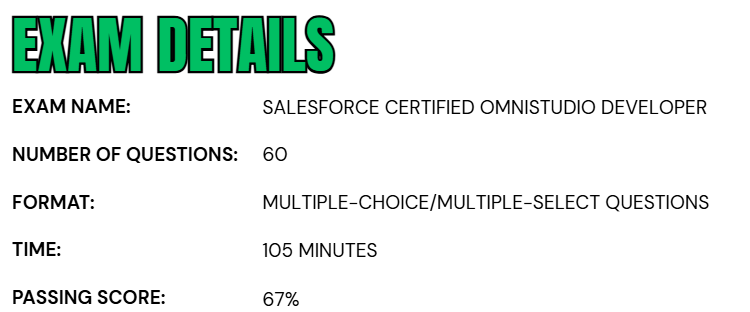
- The Salesforce OmniStudio Developer exam consists of 60 scored multiple-choice or multiple-select questions, along with up to five additional unscored items that are included solely for research and exam-quality improvement.
- Candidates are provided 105 minutes to finish the entire test.
- To earn the certification, test-takers must achieve a minimum passing score of 67%.
- The exam can be taken either in person at an authorized testing center or online with a remote proctor, offering flexibility for different preferences and locations.
- During the assessment, no reference materials—digital or physical—are allowed, ensuring a controlled and fair testing environment.
- There are no prerequisites required to sit for this exam, making it accessible to professionals who are ready to demonstrate their OmniStudio expertise.
- Salesforce periodically includes up to five unscored pilot questions in the exam. These questions do not influence the final result and are used exclusively to evaluate future exam content. The overall exam time already accounts for these additional items, ensuring that candidates have sufficient time to complete the test comfortably.
Course Outline
The Salesforce OmniStudio Developer Exam evaluates a candidate’s expertise across several core objectives. Applicants are expected to have practical experience working with OmniStudio tools and to have successfully applied the features and functionalities outlined below.
1. Understand Flexcards: 15%
- Given a set of requirements, determining appropriate card style, data sources, fields, and actions to configure on cards and card states.
- Applying concepts required to build the JSON data structure that supports Flexcards framework.
- Given a set of functional requirements, match these requirements to the Flexcards framework functionality.
2. Learn about Omniscripts: 20%
- Given a use case, comparing and contrasting various elements and their configuration that will meet the requirements with an Omniscript.
- Demonstrating an understanding of the JSON data structure that supports Omniscript.
- Given a set of functional requirements, selecting the Omniscript elements and common properties to meet the requirements.
3. Understand Integration Procedures: 17%
- Given a use case, comparing and contrasting various elements and their configuration that will meet the requirements with an Integration Procedure.
- Given a set of functional requirements, selecting the Integration Procedure elements and common properties to meet the requirements.
4. Overview Omnistudio Data Mappers: 20%
- Identifying which Omnistudio Data Mapper to use to meet a requirement.
- In a given use case, determining which Omnistudio Data Mapper Extract functionality is needed.
- In a given use case, determining which Omnistudio Data Mapper Load functionality is needed.
- In a given use case, determining which Omnistudio Data Mapper Transform functionality is needed.
- In a given use case, determining which Omnistudio Data Mapper Turbo Extract functionality is needed.

5. Expression Sets & Decision Matrices: 8%
- Demonstrating an understanding of the mechanics of a Decision Matrix.
- Demonstrating an understanding of the mechanics of an Expression Set.
6. Learn about Integrated Troubleshooting and Deployment: 20%
- Given a scenario, determining the cause for an error in Omnistudio tools.
- Given a customer issue, determining the breakdown location in the data flow.
Salesforce Certified Omnistudio Developer Exam FAQs
Salesforce Certification Exam Policy
The Salesforce Certification Exam Policy outlines the official procedures for scheduling, rescheduling, canceling, and taking any Salesforce certification exam. These requirements apply equally to candidates testing through an online proctored session or at a designated testing center. The policy exists to protect exam security, ensure fairness, and deliver a consistent and reliable experience for every test-taker.
Onsite Testing at Authorized Centers
Candidates opting to take their exam at a Pearson VUE testing center may reschedule or cancel their appointment through their Pearson VUE account up to 48 hours before the scheduled exam time. Requests made after this deadline usually cannot be accommodated. Failure to appear for the appointment without an approved change within the permitted window is considered a no-show, and the full exam fee will be forfeited.
Online Proctored Testing
For candidates testing remotely, Pearson VUE allows schedule adjustments or cancellations up to 24 hours before the exam session. Any request submitted after this period is ordinarily declined. Missing an online proctored exam without proper rescheduling also results in the loss of the entire exam fee.
Salesforce Exam Candidate Code of Conduct
All individuals participating in the Salesforce Certification Program are expected to demonstrate integrity, professionalism, and ethical behavior at every stage of the process. By registering for an exam, candidates automatically agree to the Salesforce Credential and Certification Program Agreement, which defines the standards of acceptable conduct for exam preparation and delivery.
Candidates must rely solely on authorized Salesforce learning materials, participate responsibly within the Trailblazer Community, and comply with all exam security and proctoring requirements. Prohibited actions include sharing or requesting confidential exam questions, using unauthorized aids during testing, or disregarding proctor instructions. Any violation may result in exam invalidation, revocation of earned certifications, or permanent removal from the Salesforce Certification Program.
Salesforce Certified Omnistudio Developer Exam Study Guide
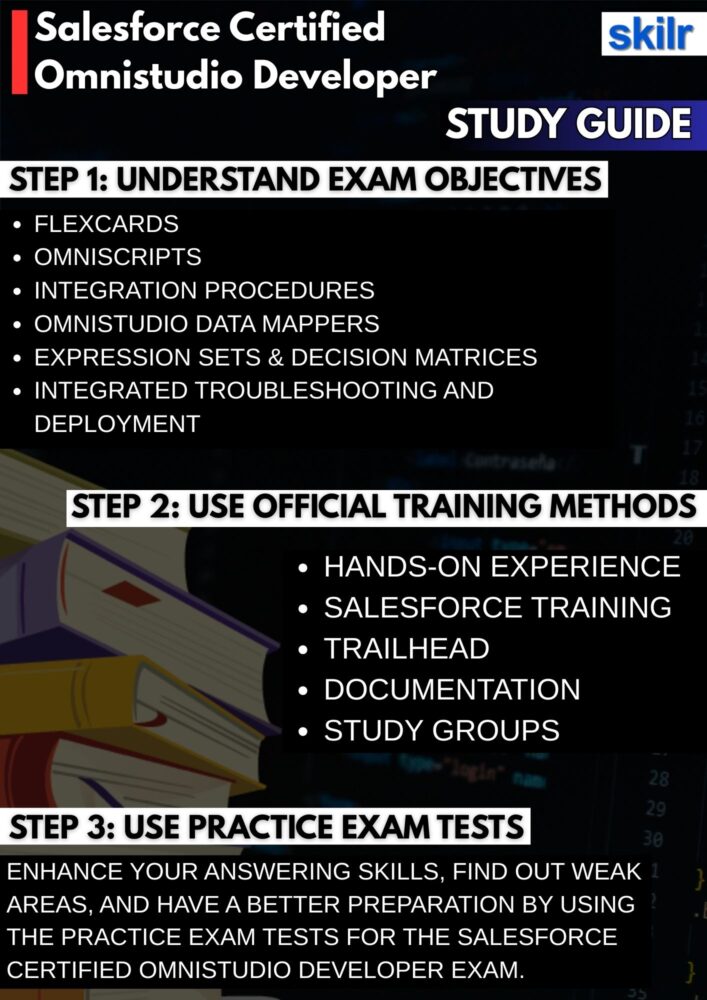
1. Review and Understand the Official Exam Guide
Your preparation should begin with a careful study of the Salesforce OmniStudio Developer Exam Guide. This document is your roadmap, outlining the format, number of questions, time limit, scoring criteria, and the exact knowledge areas that will be evaluated. Understanding the weightage of each domain helps you prioritize your study plan effectively.
The guide also provides insight into the types of skills Salesforce expects candidates to demonstrate—ranging from designing OmniScripts to creating Integration Procedures—which ensures that your preparation stays aligned with official standards right from the start.
2. Build Deep Expertise Through Hands-On Experience
Practical experience with OmniStudio tools is one of the strongest predictors of exam success. Spend substantial time working directly with FlexCards, OmniScripts, Integration Procedures, Data Mappers, Expression Sets, Decision Matrices, and Industry Console components. The more you experiment with real configurations, the better you will understand how these tools interact, how they handle data, and how they support guided business processes. Hands-on practice also sharpens your ability to troubleshoot, optimize business logic, and translate requirements into functional solutions—all of which are essential skills tested on the exam.
3. Enhance Your Knowledge Through Trailhead Learning
Trailhead provides a structured, self-paced learning environment where you can build and refine your OmniStudio knowledge. Completing the relevant trails, modules, and hands-on projects exposes you to real use cases and platform features in a progressive manner. The interactive challenges help reinforce your understanding of concepts such as data integration, declarative development, service management, and UI configuration.
As you complete modules, you not only strengthen your theoretical foundation but also gain confidence through practical exercises that closely mirror scenarios found in real implementations.
4. Attend Instructor-Led Training for Expert-Level Clarity
Instructor-led training from Trailhead Academy or Salesforce-certified training partners offers a more immersive and guided learning experience. These sessions are conducted by experts with real-world implementation experience and provide in-depth explanations of complex OmniStudio concepts. You’ll have the opportunity to ask questions, analyze different architectural approaches, and understand industry best practices.
This type of training offers a structured path that is especially beneficial if you prefer direct interaction, personalized guidance, or deeper discussions on topics that are often challenging to grasp independently. The related training course include:
– Build Guided Experiences with OmniStudio – OMS435
This 5-day instructor-led course teaches you how to design and build Salesforce Industries solutions using key OmniStudio components. You’ll work with FlexCards, OmniScripts, Data Mappers, and Integration Procedures to create digital-first, industry-focused experiences such as product issue reporting, customer onboarding, Industry 360 views, and program eligibility flows.
The course is ideal for platform developers, UI developers, solution architects, and technical architects who configure or maintain OmniStudio and Industry Cloud applications. Participants should have a basic understanding of Salesforce features, relational data models, LWCs, and JSON.
5. Participate in Study Groups and Community Learning
Engaging with the Trailblazer Community and other study groups offers the advantage of collaborative learning. Interaction with peers exposes you to a variety of problem-solving approaches, shared experiences, clarifications on difficult concepts, and practical insights that may not always be found in official documentation. Communities often share study notes, learning paths, and real-world implementation tips that add tremendous value.
Whether through online platforms, user groups, or Trailhead Academy communities, collective learning helps build motivation, expand your knowledge base, and reinforce your understanding of the exam material.
6. Strengthen Exam Preparedness Through Practice Tests
Practice exams are an essential part of your preparation strategy. They help you evaluate your readiness, understand your strengths, and identify areas that need deeper study. Simulated tests recreate the actual exam environment, allowing you to become comfortable with the format, timing, and complexity of the questions. After each practice session, reviewing and analyzing the reasoning behind both correct and incorrect answers is crucial. This reflective approach enhances retention, sharpens your analytical skills, and ensures you are fully prepared for the exam’s style and pace.
7. Study Official Salesforce Documentation, Tip Sheets, and User Guides
Before taking the exam, it is important to thoroughly review official Salesforce resources, including product documentation, feature overviews, user guides, configuration manuals, and tip sheets. These materials provide authoritative explanations of how OmniStudio tools function within the Salesforce ecosystem.
They also offer detailed insights into feature capabilities, best practices, configuration options, and troubleshooting methods. Reviewing documentation ensures that your understanding is accurate, up to date, and aligned with Salesforce’s recommended approaches, which is invaluable for addressing scenario-based exam questions. The related resources include:
