



The AWS Certified Machine Learning Engineer – Associate (MLA-C01) certification validates your technical expertise in designing, implementing, deploying, and maintaining machine learning (ML) workloads on AWS. This credential demonstrates your ability to operationalize ML solutions, making you a strong candidate for in-demand roles in machine learning and cloud-based AI engineering.
Earning this certification boosts your career profile, enhances credibility, and opens doors to specialized ML and MLOps job opportunities.
What the Exam Validates
The MLA-C01 exam assesses your ability to build and manage ML solutions and pipelines using AWS Cloud services. It covers key competencies, including:
- Data Preparation: Ingesting, transforming, validating, and preparing datasets for ML modeling.
- Model Development: Selecting modeling approaches, training models, tuning hyperparameters, analyzing performance, and managing versions.
- Deployment & Scaling: Choosing appropriate deployment infrastructure, provisioning compute resources, and configuring auto scaling.
- Workflow Automation: Setting up CI/CD pipelines to automate ML workflows and orchestration.
- Monitoring & Maintenance: Tracking models, data, and infrastructure to detect performance issues.
- Security & Compliance: Applying AWS security best practices for access control, encryption, and compliance.
Who Should Take the Exam?
This certification is ideal for professionals who want to validate their machine learning engineering expertise within the AWS ecosystem. However, professionals new to machine learning can still pursue this certification by leveraging the structured training provided in the Exam Prep Plans, which are designed to help them build the necessary foundational knowledge and technical skills.
– Intended Candidates:
- Individuals with at least 1 year of hands-on experience using Amazon SageMaker and other AWS ML services.
- Professionals with prior exposure to ML engineering workflows, cloud deployment, and MLOps practices.
– Candidate Role Examples:
- Backend Software Developers
- DevOps Engineers
- Data Engineers
- MLOps Engineers
- Data Scientists
Recommended Knowledge and Skills
– General IT and ML Knowledge
- Understanding of common ML algorithms and their use cases.
- Fundamentals of data engineering, including ingestion, transformation, and working with ML pipelines.
- Knowledge of querying and transforming data.
- Familiarity with software engineering best practices: modular code development, debugging, and deployment.
- Experience with CI/CD pipelines, infrastructure as code (IaC), and code repositories.
- Ability to provision and monitor both cloud and on-premises ML resources.
– AWS Knowledge
- Proficiency with Amazon SageMaker for model building, training, and deployment.
- Familiarity with AWS data storage and processing services for preparing datasets.
- Experience deploying applications and infrastructure on AWS.
- Knowledge of AWS monitoring tools for logging and troubleshooting ML systems.
- Experience with AWS services for CI/CD automation and orchestration.
- Understanding of AWS security best practices, including IAM, encryption, and data protection.
Exam Details


- The AWS Certified Machine Learning Engineer – Associate (MLA-C01) is an Associate-level certification designed to validate the skills required to build, deploy, and maintain machine learning solutions on AWS.
- The exam has a duration of 130 minutes and consists of 65 questions, offered in different formats such as multiple choice, multiple response, ordering, matching, and case study-based questions.
- In multiple-choice items, candidates select one correct response from several options, while multiple-response items require selecting all correct answers from a larger set. Ordering questions test the ability to arrange steps in the correct sequence, matching items require pairing prompts with correct responses, and case studies present a scenario with multiple questions evaluated individually.
- The exam follows a pass/fail designation and is scored on a scaled range of 100–1,000, with a minimum passing score of 720.
- Candidates can take the test either through Pearson VUE testing centers or via online proctoring.
- To support global learners, the MLA-C01 exam is available in English, Japanese, Korean, and Simplified Chinese.
Course Outline
The exam covers the following topics:
Domain 1: Understand Data Preparation for Machine Learning (ML)
Task Statement 1.1: Ingesting and storing data.
Knowledge of:
- Data formats and ingestion mechanisms (for example, validated and non-validated formats, Apache Parquet, JSON, CSV, Apache ORC, Apache Avro, RecordIO) (AWS Documentation: Data ingestion methods)
- How to use the core AWS data sources (for example, Amazon S3, Amazon Elastic File System [Amazon EFS], Amazon FSx for NetApp ONTAP) (AWS Documentation: Getting started with Amazon FSx for NetApp ONTAP)
- How to use AWS streaming data sources to ingest data (for example, Amazon Kinesis, Apache Flink, Apache Kafka) (AWS Documentation: Working with streaming data on AWS, Apache Flink)
- AWS storage options, including use cases and tradeoffs (AWS Documentation: Storage, Choosing an AWS storage service)
Skills in:
- Extracting data from storage (for example, Amazon S3, Amazon Elastic Block Store [Amazon EBS], Amazon EFS, Amazon RDS, Amazon DynamoDB) by using relevant AWS service options (for example, Amazon S3 Transfer Acceleration, Amazon EBS Provisioned IOPS) (AWS Documentation: S3 Transfer Acceleration)
- Choosing appropriate data formats (for example, Parquet, JSON, CSV, ORC) based on data access patterns (AWS Documentation: Choose data formatting based on your data access pattern, Use columnar storage formats)
- Ingesting data into Amazon SageMaker Data Wrangler and SageMaker Feature Store (AWS Documentation: Data sources and ingestion, Prepare ML Data with Amazon SageMaker Data Wrangler)
- Merging data from multiple sources (for example, by using programming techniques, AWS Glue, Apache Spark) (AWS Documentation: Programming Spark scripts, Joining datasets)
- Troubleshooting and debugging data ingestion and storage issues that involve capacity and scalability (AWS Documentation: Data ingestion methods)
- Making initial storage decisions based on cost, performance, and data structure (AWS Documentation: Cost optimization)
Task Statement 1.2: Transforming data and perform feature engineering.
Knowledge of:
- Data cleaning and transformation techniques (for example, detecting and treating outliers, imputing missing data, combining, deduplication) (AWS Documentation: Transform Data)
- Feature engineering techniques (for example, data scaling and standardization, feature splitting, binning, log transformation, normalization) (AWS Documentation: Feature engineering)
- Encoding techniques (for example, one-hot encoding, binary encoding, label encoding, tokenization) (AWS Documentation: ONE_HOT_ENCODING, Transform Data)
- Tools to explore, visualize, or transform data and features (for example, SageMaker Data Wrangler, AWS Glue, AWS Glue DataBrew)
- Services that transform streaming data (for example, AWS Lambda, Spark) (AWS Documentation: Prepare ML Data with Amazon SageMaker Data Wrangler, Transform Data)
- Data annotation and labeling services that create high-quality labeled datasets (AWS Documentation: Data labeling with a human-in-the-loop, Training data labeling using humans with Amazon SageMaker Ground Truth)
Skills in:
- Transforming data by using AWS tools (for example, AWS Glue, AWS Glue DataBrew, Spark running on Amazon EMR, SageMaker Data Wrangler) (AWS Documentation: Transform data with AWS Glue managed transforms, Transform Data)
- Creating and managing features by using AWS tools (for example, SageMaker Feature Store) (AWS Documentation: Create, store, and share features with Feature Store, Get started with Amazon SageMaker Feature Store)
- Validating and labeling data by using AWS services (for example, SageMaker Ground Truth, Amazon Mechanical Turk) (AWS Documentation: Training data labeling using humans with Amazon SageMaker Ground Truth, Use Amazon SageMaker Ground Truth Plus to Label Data)
Task Statement 1.3: Ensuring data integrity and prepare data for modeling.
Knowledge of:
- Pre-training bias metrics for numeric, text, and image data (for example, class imbalance [CI], difference in proportions of labels [DPL]) (AWS Documentation: Pre-training Bias Metrics, Difference in Proportions of Labels (DPL))
- Strategies to address CI in numeric, text, and image datasets (for example, synthetic data generation, resampling) (AWS Documentation: Synthetic dataset)
- Techniques to encrypt data (AWS Documentation: Encrypting Data-at-Rest and Data-in-Transit, Data Encryption)
- Data classification, anonymization, and masking (AWS Documentation: Understand data classifications and their protection policies)
- Implications of compliance requirements (for example, personally identifiable information [PII], protected health information [PHI], data residency) (AWS Documentation: Personally identifiable information (PII))
Skills in:
- Validating data quality (for example, by using AWS Glue DataBrew and AWS Glue Data Quality) (AWS Documentation: Validating data quality in AWS Glue DataBrew, AWS Glue Data Quality)
- Identifying and mitigating sources of bias in data (for example, selection bias, measurement bias) by using AWS tools (for example, SageMaker Clarify) (AWS Documentation: Amazon SageMaker Clarify, Pre-training Bias Metrics)
- Preparing data to reduce prediction bias (for example, by using dataset splitting, shuffling, and augmentation) (AWS Documentation: Data preprocessing)
- Configuring data to load into the model training resource (for example, Amazon EFS, Amazon FSx) (AWS Documentation: Configure data input channel to use Amazon FSx for Lustre, Setting up training jobs to access datasets)


Domain 2: Learn About ML Model Development
Task Statement 2.1: Choosing a modeling approach.
Knowledge of:
- Capabilities and appropriate uses of ML algorithms to solve business problems (AWS Documentation: Solving Business Problems with Amazon Machine Learning)
- How to use AWS artificial intelligence (AI) services (for example, Amazon Translate, Amazon Transcribe, Amazon Rekognition, Amazon Bedrock) to solve specific business problems (AWS Documentation: Explore AWS AI services, Amazon Transcribe)
- How to consider interpretability during model selection or algorithm selection (AWS Documentation: Machine learning model interpretability with AWS, AWS Prescriptive Guidance)
- SageMaker built-in algorithms and when to apply them (AWS Documentation: Built-in algorithms and pretrained models in Amazon SageMaker, Types of Algorithms)
Skills in:
- Assessing available data and problem complexity to determine the feasibility of an ML solution
- Comparing and selecting appropriate ML models or algorithms to solve specific problems (AWS Documentation: Choosing an AWS machine learning service)
- Choosing built-in algorithms, foundation models, and solution templates (for example, in SageMaker JumpStart and Amazon Bedrock) (AWS Documentation: Amazon SageMaker JumpStart Foundation Models, Built-in algorithms and pretrained models in Amazon SageMaker)
- Selecting models or algorithms based on costs (AWS Documentation: Select the best pricing model, Types of Algorithms)
- Selecting AI services to solve common business needs (AWS Documentation: Explore AWS AI services, Choosing an AWS machine learning service)
Task Statement 2.2: Training and refining models.
Knowledge of:
- Elements in the training process (for example, epoch, steps, batch size) (AWS Documentation: Hyperparameters for optimizing the learning process of your text generation models, Distributed training in Amazon SageMaker AI)
- Methods to reduce model training time (for example, early stopping, distributed training) (AWS Documentation: Stop Training Jobs Early, Model Training and Tuning)
- Factors that influence model size (AWS Documentation: Influence response generation with inference parameters)
- Methods to improve model performance (AWS Documentation: Debugging and improving model performance)
- Benefits of regularization techniques (for example, dropout, weight decay, L1 and L2)
- Hyperparameter tuning techniques (for example, random search, Bayesian optimization) (AWS Documentation: Understand the hyperparameter tuning strategies available in Amazon SageMaker AI)
- Model hyperparameters and their effects on model performance (for example, number of trees in a tree-based model, number of layers in a neural network)
- Methods to integrate models that were built outside SageMaker into SageMaker (AWS Documentation: Model deployment options in Amazon SageMaker AI, Built-in algorithms and pretrained models in Amazon SageMaker)
Skills in:
- Using SageMaker built-in algorithms and common ML libraries to develop ML models (AWS Documentation: Built-in algorithms and pretrained models in Amazon SageMaker)
- Using SageMaker script mode with SageMaker supported frameworks to train models (for example, TensorFlow, PyTorch) (AWS Documentation: Resources for using PyTorch with Amazon SageMaker AI, Train a Model with Amazon SageMaker)
- Using custom datasets to fine-tune pre-trained models (for example, Amazon Bedrock, SageMaker JumpStart) (AWS Documentation: Fine-Tune a Model, SageMaker JumpStart pretrained models)
- Performing hyperparameter tuning (for example, by using SageMaker automatic model tuning [AMT]) (AWS Documentation: Automatic model tuning with SageMaker AI)
- Integrating automated hyperparameter optimization capabilities (AWS Documentation: Understand the hyperparameter tuning strategies available in Amazon SageMaker AI, Automatic model tuning with SageMaker AI)
- Preventing model overfitting, underfitting, and catastrophic forgetting (for example, by using regularization techniques, feature selection) (AWS Documentation: Model Fit: Underfitting vs. Overfitting)
- Combining multiple training models to improve performance (for example, ensembling, stacking, boosting) (AWS Documentation: Deep ensembles)
- Reducing model size (for example, by altering data types, pruning, updating feature selection, compression)
- Managing model versions for repeatability and audits (for example, by using the SageMaker Model Registry) (AWS Documentation: Model Registration Deployment with Model Registry, Register a Model Version)
Task Statement 2.3: Analyzing model performance.
Knowledge of:
- Model evaluation techniques and metrics (for example, confusion matrix, heat maps, F1 score, accuracy, precision, recall, Root Mean Square Error [RMSE], receiver operating characteristic [ROC], Area Under the ROC Curve [AUC]) (AWS Documentation: Define relevant evaluation metrics)
- Methods to create performance baselines (AWS Documentation: Key concepts for burstable performance instances, BaselinePerformanceFactorsRequest)
- Methods to identify model overfitting and underfitting (AWS Documentation: Model Fit: Underfitting vs. Overfitting)
- Metrics available in SageMaker Clarify to gain insights into ML training data and models (AWS Documentation: Metrics, Post-training Data and Model Bias Metrics)
- Convergence issues (AWS Documentation: ConvergenceDetected)
Skills in:
- Selecting and interpreting evaluation metrics and detecting model bias (AWS Documentation: Evaluate, explain, and detect bias in models, Fairness, model explainability and bias detection with SageMaker Clarify)
- Assessing tradeoffs between model performance, training time, and cost (AWS Documentation: Tradeoff analysis on custom versus pre-trained models, Perform a performance trade-off analysis)
- Performing reproducible experiments by using AWS services
- Comparing the performance of a shadow variant to the performance of a production variant (AWS Documentation: Create a shadow test, Testing models with shadow variants)
- Using SageMaker Clarify to interpret model outputs (AWS Documentation: SageMaker Clarify explainability with SageMaker AI Autopilot, Fairness, model explainability and bias detection with SageMaker Clarify)
- Using SageMaker Model Debugger to debug model convergence (AWS Documentation: Amazon SageMaker Debugger, Launch training jobs with Debugger using the SageMaker Python SDK)
Domain 3: Understand Deployment and Orchestration of ML Workflows
Task Statement 3.1: Selecting deployment infrastructure based on existing architecture and requirements.
Knowledge of:
- Deployment best practices (for example, versioning, rollback strategies) (AWS Documentation: Deployment strategies, Best practices for developing and deploying cloud infrastructure with the AWS CDK)
- AWS deployment services (for example, SageMaker) (AWS Documentation: Model deployment options in Amazon SageMaker AI, Deploy models with Amazon SageMaker Serverless Inference, CreateEndpoint)
- Methods to serve ML models in real time and in batches (AWS Documentation: Requesting Real-time Predictions, Deploy models for inference)
- How to provision compute resources in production environments and test environments (for example, CPU, GPU) (AWS Documentation: Compute environments for AWS Batch, Create a compute environment)
- Model and endpoint requirements for deployment endpoints (for example, serverless endpoints, real-time endpoints, asynchronous endpoints, batch inference) (AWS Documentation: Deploy models with Amazon SageMaker Serverless Inference)
- How to choose appropriate containers (for example, provided or customized) (AWS Documentation: Choosing an AWS container service)
- Methods to optimize models on edge devices (for example, SageMaker Neo) (AWS Documentation: Model performance optimization with SageMaker Neo, Set up Neo on Edge Devices)
Skills in:
- Evaluating performance, cost, and latency tradeoffs
- Choosing the appropriate compute environment for training and inference based on requirements (for example, GPU or CPU specifications, processor family, networking bandwidth)
- Selecting the correct deployment orchestrator (for example, Apache Airflow, SageMaker Pipelines) (AWS Documentation: Using workflows in Amazon SageMaker Unified Studio)
- Selecting multi-model or multi-container deployments (AWS Documentation: Multi-model endpoints, Multi-container endpoints)
- Selecting the correct deployment target (for example, SageMaker endpoints, Kubernetes, Amazon Elastic Container Service [Amazon ECS], Amazon Elastic Kubernetes Service [Amazon EKS], Lambda) (AWS Documentation: Amazon Elastic Kubernetes Service)
- Choosing model deployment strategies (for example, real time, batch) (AWS Documentation: Model deployment options in Amazon SageMaker AI, Deployment strategies)
Task Statement 3.2: Creating and scripting infrastructure based on existing architecture and requirements.
Knowledge of:
- Difference between on-demand and provisioned resources (AWS Documentation: DynamoDB on-demand and provisioned capacity)
- How to compare scaling policies (AWS Documentation: Step and simple scaling policies for Amazon EC2 Auto Scaling, Evaluate your predictive scaling policies)
- Tradeoffs and use cases of infrastructure as code (IaC) options (for example, AWS CloudFormation, AWS Cloud Development Kit [AWS CDK]) (AWS Documentation: Infrastructure as code)
- Containerization concepts and AWS container services (AWS Documentation: What is Containerization?)
- How to use SageMaker endpoint auto scaling policies to meet scalability requirements (for example, based on demand, time) (AWS Documentation: Auto scaling policy overview, Automatic scaling of Amazon SageMaker AI models)
Skills in:
- Applying best practices to enable maintainable, scalable, and cost-effective ML solutions (for example, automatic scaling on SageMaker endpoints, dynamically adding Spot Instances, by using Amazon EC2 instances, by using Lambda behind the endpoints) (AWS Documentation: Automatic scaling of Amazon SageMaker AI models)
- Automating the provisioning of compute resources, including communication between stacks (for example, by using CloudFormation, AWS CDK) (AWS Documentation: Introduction to AWS CDK stacks)
- Building and maintaining containers (for example, Amazon Elastic Container Registry [Amazon ECR], Amazon EKS, Amazon ECS, by using bring your own container [BYOC] with SageMaker) (AWS Documentation: How to Build Your Own Processing Container (Advanced Scenario), What is Amazon Elastic Container Registry?)
- Configuring SageMaker endpoints within the VPC network (AWS Documentation: Connect to SageMaker AI Within your VPC, Give SageMaker AI Hosted Endpoints Access to Resources in Your Amazon VPC)
- Deploying and hosting models by using the SageMaker SDK (AWS Documentation: Deploy a Compiled Model Using SageMaker SDK, Model deployment options in Amazon SageMaker AI)
- Choosing specific metrics for auto scaling (for example, model latency, CPU utilization, invocations per instance) (AWS Documentation: Amazon CloudWatch metrics for Amazon EC2 Auto Scaling, Automatic scaling of Amazon SageMaker AI models)
Task Statement 3.3: Using automated orchestration tools to set up continuous integration and continuous delivery (CI/CD) pipelines.
Knowledge of:
- Capabilities and quotas for AWS CodePipeline, AWS CodeBuild, and AWS CodeDeploy (AWS Documentation: Quotas in AWS CodePipeline, CodeDeploy quotas)
- Automation and integration of data ingestion with orchestration services (AWS Documentation: Automate data ingestion from AWS Data Exchange into Amazon S3, Data ingestion methods)
- Version control systems and basic usage (for example, Git) (AWS Documentation: Using Git version control systems in AWS Glue)
- CI/CD principles and how they fit into ML workflows CI/CD on AWS)
- Deployment strategies and rollback actions (for example, blue/green, canary, linear) (AWS Documentation: Deployment strategies)
- How code repositories and pipelines work together (AWS Documentation: What is AWS CodePipeline?)
Skills in:
- Configuring and troubleshooting CodeBuild, CodeDeploy, and CodePipeline, including stages (AWS Documentation: Troubleshooting CodePipeline, Troubleshooting AWS CodeBuild)
- Applying continuous deployment flow structures to invoke pipelines (for example, Gitflow, GitHub Flow) (AWS Documentation: Implement a GitHub Flow branching strategy for multi-account DevOps environments, Implement a Gitflow branching strategy for multi-account DevOps environments)
- Using AWS services to automate orchestration (for example, to deploy ML models, automate model building)
- Configuring training and inference jobs (for example, by using Amazon EventBridge rules, SageMaker Pipelines, CodePipeline) (AWS Documentation: Events that Amazon SageMaker AI sends to Amazon EventBridge, Inference pipelines in Amazon SageMaker AI)
- Creating automated tests in CI/CD pipelines (for example, integration tests, unit tests, end-to-end tests) (AWS Documentation: Tests for CI/CD pipelines, Testing stages in continuous integration and continuous delivery)
- Building and integrating mechanisms to retrain models (AWS Documentation: Retraining Models on New Data)
Domain 4: Understand about ML Solution Monitoring, Maintenance, and Security
Task Statement 4.1: Monitoring model inference.
Knowledge of:
- Drift in ML models (AWS Documentation: Feature attribution drift for models in production)
- Techniques to monitor data quality and model performance (AWS Documentation: Data and model quality monitoring with Amazon SageMaker Model Monitor, Data quality)
- Design principles for ML lenses relevant to monitoring (AWS Documentation: Machine Learning Lens)
Skills in:
- Monitoring models in production (for example, by using SageMaker Model Monitor) (AWS Documentation: Monitoring a Model in Production, Data and model quality monitoring with Amazon SageMaker Model Monitor)
- Monitoring workflows to detect anomalies or errors in data processing or model inference (AWS Documentation: Anomaly detection in AWS Glue Data Quality)
- Detecting changes in the distribution of data that can affect model performance (for example, by using SageMaker Clarify) (AWS Documentation: Fairness, model explainability and bias detection with SageMaker Clarify, Evaluate, explain, and detect bias in models)
- Monitoring model performance in production by using A/B testing (AWS Documentation: Testing models with production variants, Monitoring a Model in Production)
Task Statement 4.2: Monitoring and optimizing infrastructure and costs.
Knowledge of:
- Key performance metrics for ML infrastructure (for example, utilization, throughput, availability, scalability, fault tolerance)
- Monitoring and observability tools to troubleshoot latency and performance issues (for example, AWS X-Ray, Amazon CloudWatch Lambda Insights, Amazon CloudWatch Logs Insights) (AWS Documentation: Monitor function performance with Amazon CloudWatch Lambda Insights)
- How to use AWS CloudTrail to log, monitor, and invoke re-training activities (AWS Documentation: Logging data events, Understanding CloudTrail events)
- Differences between instance types and how they affect performance (for example, memory optimized, compute optimized, general purpose, inference optimized) (AWS Documentation: Amazon EC2 instance types)
- Capabilities of cost analysis tools (for example, AWS Cost Explorer, AWS Billing and Cost Management, AWS Trusted Advisor) (AWS Documentation: What is AWS Billing and Cost Management?, AWS Cost Explorer)
- Cost tracking and allocation techniques (for example, resource tagging) (AWS Documentation: Organizing and tracking costs using AWS cost allocation tags, Building a cost allocation strategy)
Skills in:
- Configuring and using tools to troubleshoot and analyze resources (for example, CloudWatch Logs, CloudWatch alarms) (AWS Documentation: Troubleshoot CloudWatch logs and metrics access errors, Using Amazon CloudWatch alarms)
- Creating CloudTrail trails (AWS Documentation: Creating a trail with the CloudTrail console, Creating a trail for your AWS account)
- Setting up dashboards to monitor performance metrics (for example, by using Amazon QuickSight, CloudWatch dashboards) (AWS Documentation: Monitoring data in Amazon QuickSight, Using Amazon CloudWatch dashboards)
- Monitoring infrastructure (for example, by using EventBridge events) (AWS Documentation: Monitoring Amazon EventBridge, Events in Amazon EventBridge)
- Rightsizing instance families and sizes (for example, by using SageMaker Inference Recommender and AWS Compute Optimizer) (AWS Documentation: Rightsizing recommendation preferences, Amazon SageMaker Inference Recommender)
- Monitoring and resolving latency and scaling issues (AWS Documentation: Decrease latency for applications with long boot times using warm pools, Monitoring the latency between health checkers and your endpoint)
- Preparing infrastructure for cost monitoring (for example, by applying a tagging strategy) (AWS Documentation: Organizing and tracking costs using AWS cost allocation tags, Building a cost allocation strategy)
- Troubleshooting capacity concerns that involve cost and performance (for example, provisioned concurrency, service quotas, auto scaling) (AWS Documentation: Configuring provisioned concurrency for a function, Understanding Lambda function scaling)
- Optimizing costs and setting cost quotas by using appropriate cost management tools (for example, AWS Cost Explorer, AWS Trusted Advisor, AWS Budgets) (AWS Documentation: Managing your costs with AWS Budgets)
- Optimizing infrastructure costs by selecting purchasing options (for example, Spot Instances, On-Demand Instances, Reserved Instances, SageMaker Savings Plans) (AWS Documentation: AWS Cost Optimization, Spot Instances)
Task Statement 4.3: Securing AWS resources.
Knowledge of:
- IAM roles, policies, and groups that control access to AWS services (for example, AWS Identity and Access Management [IAM], bucket policies, SageMaker Role Manager) (AWS Documentation: AWS Identity and Access Management for Amazon SageMaker AI, Policies and permissions in AWS Identity and Access Management)
- SageMaker security and compliance features (AWS Documentation: Configure security in Amazon SageMaker AI, Security in Amazon SageMaker Unified Studio)
- Controls for network access to ML resources (AWS Documentation: Controlling Access to Amazon ML Resources -with IAM, Actions, resources, and condition keys for Amazon Machine Learning)
- Security best practices for CI/CD pipelines (AWS Documentation: Best practices for CI/CD pipelines, Security in every stage of CI/CD pipeline)
Skills in:
- Configuring least privilege access to ML artifacts (AWS Documentation: Prepare for least-privilege permissions)
- Configuring IAM policies and roles for users and applications that interact with ML systems (AWS Documentation: Controlling Access to Amazon ML Resources -with IAM, Policies and permissions in AWS Identity and Access Management)
- Monitoring, auditing, and logging ML systems to ensure continued security and compliance (AWS Documentation: Logging and monitoring in AWS Audit Manager)
- Troubleshooting and debugging security issues (AWS Documentation: Troubleshooting resources, Troubleshooting and debugging App Studio)
- Building VPCs, subnets, and security groups to securely isolate ML systems (AWS Documentation: What is Amazon VPC?, Security best practices for your VPC)
AWS Certified Machine Learning Engineer – Associate (MLA-C01) Exam FAQs

AWS Certification Exam Policy
Amazon Web Services (AWS) has established a comprehensive set of certification policies to ensure that every candidate undergoes a secure, fair, and consistent testing process. These policies are designed to protect the integrity of the AWS Certification Program and maintain its global credibility. They cover key areas such as exam retake rules, scoring methodology, and the inclusion of unscored questions that support exam research and continuous development.
– Exam Retake Policy
Candidates who do not achieve a passing score on an AWS certification exam must wait a minimum of 14 days before attempting the same exam again. While there is no restriction on the total number of retakes, each attempt requires payment of the full exam fee. This policy encourages thorough preparation and ensures that AWS certifications remain highly valued and respected in the industry.
– Exam Results and Scoring
The AWS Certified Machine Learning Engineer – Associate (MLA-C01) exam is evaluated on a pass/fail basis and is scored against a minimum standard defined by AWS professionals in line with certification best practices. Scores are reported on a scaled range of 100–1,000, with a minimum passing score of 720. The scaled scoring method helps balance variations in exam difficulty across different versions of the test.
Your results will indicate your overall performance and whether you passed the exam. The score report may also include a breakdown of your performance by domain area. The exam follows a compensatory scoring model, meaning you are not required to pass each individual section—only the exam as a whole.
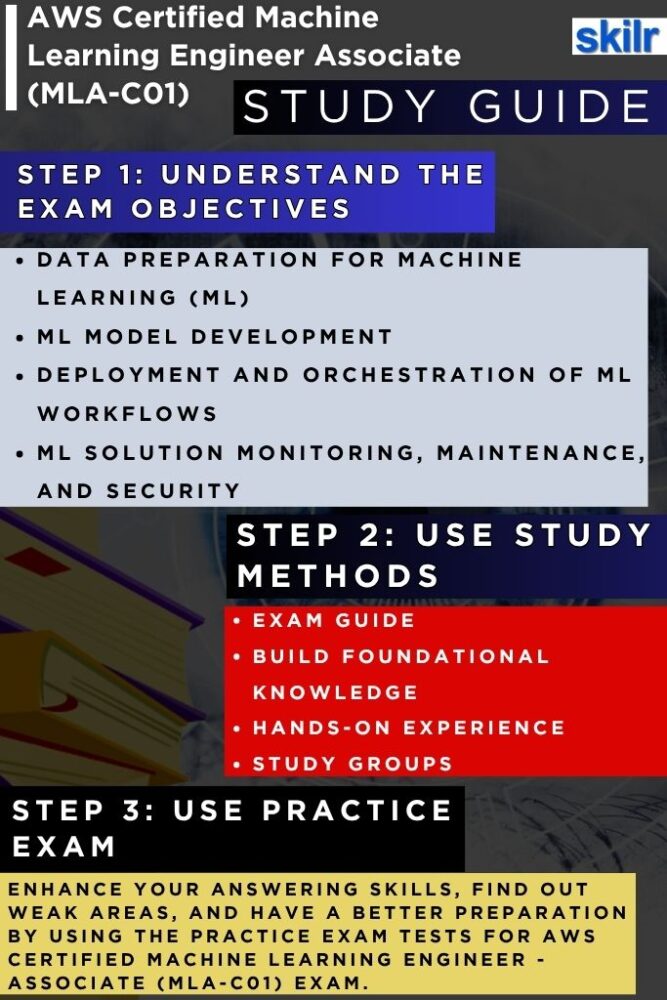
AWS Certified Machine Learning Engineer Associate (MLA-C01) Exam Study Guide

Step 1: Review the Exam Guide and Domains
Begin your preparation by studying the official AWS exam guide. This document outlines the exam’s domains, weightage, and objectives. For the MLA-C01 exam, focus on areas such as data preparation, model training, deployment, and monitoring. Each domain is directly tied to AWS services like Amazon SageMaker, AWS Glue, Amazon S3, and CloudWatch. Carefully reviewing these objectives helps you understand what to expect on the exam and ensures that your preparation is aligned with AWS’s expectations.
Step 2: Build Foundational Knowledge
Strengthen your core machine learning and AWS fundamentals before diving deeper. Ensure you are comfortable with common ML algorithms, hyperparameter tuning, and data engineering basics. From an AWS perspective, learn how services like SageMaker, EC2, IAM, and AWS storage services integrate within ML pipelines. Enroll in AWS digital training courses and tutorials to close any knowledge gaps. This foundation will make it easier to approach advanced ML engineering concepts later in your preparation.
Step 3: Gain Hands-On Experience
The MLA-C01 exam emphasizes practical, real-world application, so hands-on practice is critical. Use AWS Builder Labs, AWS Cloud Quest, and AWS Jam to experiment with ML workflows in interactive environments. Practice key tasks such as data ingestion, transformation, model training, deployment, and scaling. Focus on services like SageMaker for ML models, AWS Lambda for orchestration, and CloudFormation or IaC tools for automation. This experience will help you bridge theory with application, a core expectation of the exam.
Step 4: Reinforce Learning with Guided Practice
Consolidate your knowledge through structured practice and guided learning. Take exam readiness courses where instructors walk through exam-style questions and provide test-taking strategies. Use flashcards and domain-specific quizzes to reinforce retention. Explore AWS SimuLearn modules for simulated exam environments. Joining study groups or discussion forums can also help clarify complex topics and expose you to different perspectives and problem-solving approaches. This step ensures that your understanding is both deep and exam-focused.
Step 5: Test Readiness and Final Preparation
In the final phase, evaluate your readiness with full-length practice tests. These exams will help you simulate the real test environment, track your timing, and identify weak areas. Carefully review both correct and incorrect answers to strengthen your reasoning. Revisit challenging topics and continue hands-on labs to solidify applied skills. Fine-tune your exam strategy, time management, and confidence so that you are fully prepared to pass the MLA-C01 exam with ease.
