
The AB-730: AI Business Professional exam assesses your ability to apply AI-driven productivity tools effectively within real-world business environments. This certification is tailored for professionals who use generative AI to boost efficiency, enhance decision-making, and deliver tangible business results—without requiring software development or coding skills. The emphasis is on the practical, ethical, and strategic adoption of AI in everyday workplace scenarios.
– Target Audience
This certification is intended for business professionals, managers, administrators, analysts, and knowledge workers who rely on AI-powered tools to streamline workflows, improve communication, and support business operations. The exam focuses on applying AI within standard business contexts, rather than from a technical or engineering standpoint.
– Recommended Experience and Skill Set
Candidates should have hands-on experience with generative AI productivity tools, particularly those available in the Microsoft ecosystem. Relevant experience includes:
- Microsoft 365 Copilot to improve efficiency across Microsoft applications
- Researcher for collecting insights and summarizing complex information
- Analyst for interpreting data and assisting with business decisions
You are expected to understand how to use AI responsibly to save time, improve work quality, and generate insights that align with organizational objectives.
– Business-Oriented Use of AI
The exam evaluates your capability to:
- Increase daily productivity using AI tools
- Enable informed, data-driven decision-making
- Achieve business goals through intelligent content creation and analysis
- Apply AI ethically and appropriately in professional environments
This certification does not require knowledge of AI model development, training, or deployment.
– Microsoft 365 Knowledge Expectations
A solid foundational understanding of Microsoft 365 is required, including the ability to confidently work with core applications such as:
- Outlook for professional email communication and scheduling
- Word for creating, editing, and refining business documents
- Microsoft Teams for collaboration, meetings, and teamwork
- PowerPoint for building clear and compelling presentations
- Excel for organizing data, performing analysis, and deriving insights
– Familiarity with Common Business Workflows
Candidates should be comfortable with routine business activities, including:
- Writing and refining professional emails
- Creating structured reports and presentations
- Producing and enhancing visual and image-based content
- Organizing, managing, and summarizing documents and information
Exam Details
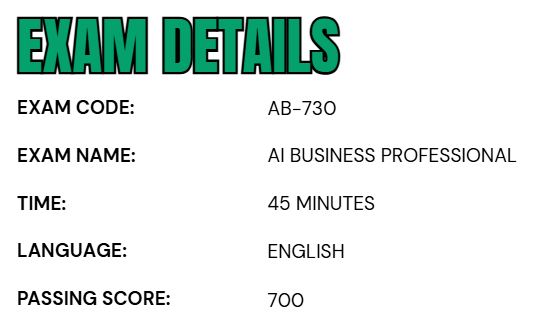
- Exam AB-730: AI Business Professional is an entry-level Microsoft certification intended for business users and administrators who want to demonstrate their ability to use AI-enabled tools effectively in a professional environment.
- The assessment duration is 45 minutes and is currently available in English.
- It is delivered as a proctored exam to maintain fairness and exam integrity.
- Based on the exam format, candidates may encounter interactive or scenario-based tasks as part of the evaluation.
- To earn the certification, candidates must achieve a passing score of 700 or above, confirming a solid foundational understanding of AI principles and their practical application across business and administrative workflows.
Course Outline
The AB-730: AI Business Professional exam evaluates candidates across the following key subject areas:
1. Learn about the generative AI fundamentals (25–30%)
Understanding generative AI capabilities across Microsoft 365 experiences
- Understand how Copilot works to keep your organization’s information private and secure
- Understanding how the context, like your work files, web data, or the app you’re using, can affect Copilot responses
- Understanding the difference between a chat experience and an agent experience
- Understand the use case for creating your own agent
- Understanding the differences in features and capabilities of the Copilot experience in various Microsoft 365 apps
Identifying responsible AI and data protection practices
- Identifying common risks, including fabrications, prompt injection, and over-reliance
- Selecting verification steps appropriate to the task, including citation checks and human review
- Recognizing and mitigating risks to sensitive data
- Understanding how data protection restricts prompt results
2. Learn the process of managing prompts and conversations by using AI (35–40%)
Creating and managing prompts in Microsoft 365 Copilot
- Understanding how to create an effective prompt
- Selecting appropriate resources to reference in a prompt
- Save a prompt
- Scheduling a prompt
- Sharing a prompt
Managing conversations in Copilot
- Understanding how to find previous conversations
- Deleting a chat
- Renaming a chat
- Adding a conversation to a notebook
Creating and managing Microsoft 365 Copilot agents
- Understanding when to use Agent Store versus creating a new agent
- Creating an agent by using a template
- Configuring an agent that has knowledge
- Configuring agent settings such as instructions, capabilities and suggested prompts
- Sharing an agent with team members

3. Understand about drafting and analyzing business content by using AI (25–30%)
Drafting business documents and communications
- Creating a new document from a prompt
- Generating a document from an existing document
- Generating a management summary based on a document
- Moving data and insights between Microsoft 365 apps
Managing meetings and collaboration
- Describing how to use Copilot for meetings
- Describing how to use Copilot Pages for collaboration
- Describing how Copilot uses memory and instructions
Exam AB-730: AI Business Professional FAQs
Microsoft Exam Policies
Microsoft enforces a comprehensive set of exam policies to uphold fairness, consistency, and integrity across all certification programs. Candidates are strongly encouraged to understand these policies before scheduling an exam. Two key areas of focus are the Retake Policy and the Scoring Methodology.
– Retake Policy
Microsoft’s exam retake policy applies to role-based, specialty, and fundamentals certifications and is designed to encourage adequate preparation between attempts.
- If a candidate does not pass on the first attempt, a mandatory 24-hour waiting period is required before retaking the exam.
- For each additional attempt, a 14-day waiting period must be observed.
- Candidates may attempt an exam up to five times within a 12-month period, measured from the date of the first attempt.
If all five attempts are used without achieving a passing score, the candidate must wait 12 months from the initial attempt date before becoming eligible to retake the exam. Once an exam has been successfully passed, it cannot be retaken unless the related certification has expired. Exam fees, where applicable, are charged for each retake.
– Scoring Methodology
Microsoft certification exams use a scaled scoring system ranging from 1 to 1,000, with a minimum passing score of 700 for most technical certifications. Because scores are scaled, they do not correspond to a fixed percentage of correct answers. Instead, the final score reflects the candidate’s overall performance, accounting for factors such as question difficulty, exam version, and competency weighting.
Microsoft Office certification exams also use a 1 to 1,000 scale, although the required passing score may vary depending on the specific exam. This scoring approach ensures consistent, fair, and accurate evaluation of skills across different exam formats and difficulty levels.
Microsoft AB-730 Exam Study Guide
1. Understanding the Official Exam Guide
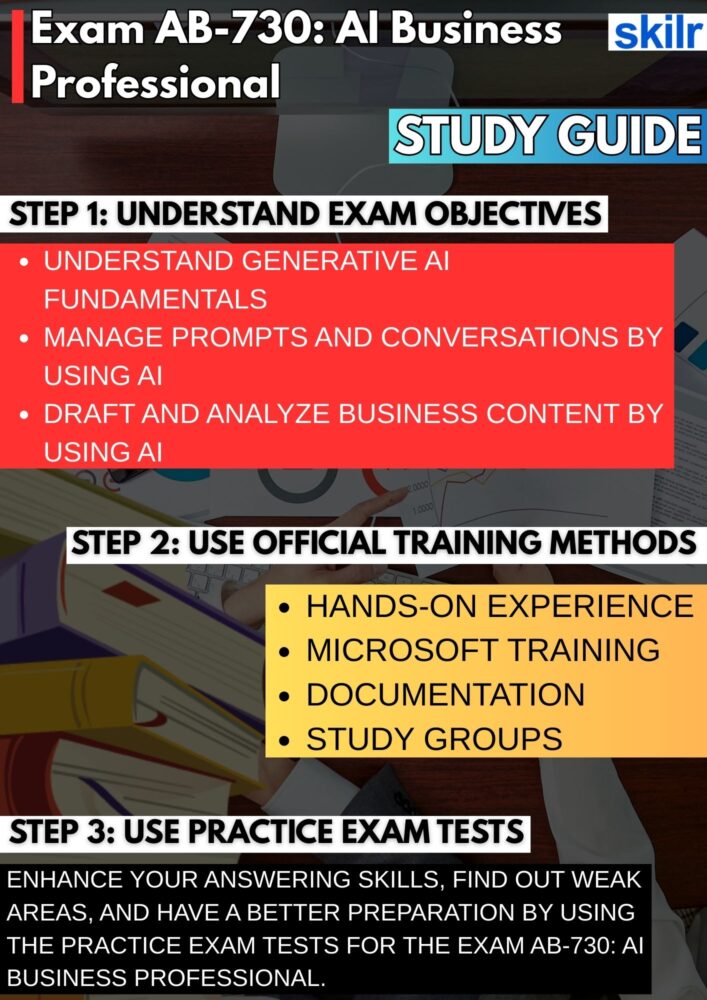
A strong preparation journey begins with a careful review of the official Exam AB-730 skills outline provided by Microsoft. This defines the exam domains, outlines the competencies being measured, and indicates the relative importance of each topic area. Gaining clarity on the scope of the exam allows candidates to align their learning efforts with Microsoft’s expectations and avoid spending time on areas outside the exam focus. The exam guide should be used as a foundational reference throughout preparation, helping candidates structure their study plan, track progress, and ensure balanced coverage of all objectives.
2. Gaining Practical Experience with AI Productivity Tools
Hands-on experience is essential for building confidence and competence for the exam. Candidates are encouraged to work consistently with AI-powered productivity tools, particularly those within the Microsoft 365 ecosystem, to understand how AI enhances everyday business tasks. Regular interaction with tools such as Microsoft 365 Copilot, Researcher, and Analyst allows candidates to explore how AI supports content creation, information summarization, data interpretation, and workflow efficiency. Practical exposure not only strengthens conceptual understanding but also improves the ability to apply AI responsibly and effectively in real workplace scenarios.
3. Applying AI in Real-World Business Contexts
To deepen understanding, AI tools should be applied within realistic and relevant business situations. Candidates should practice using AI to create professional documents, develop presentations, analyze spreadsheets, and support decision-making processes. Equal emphasis should be placed on evaluating the accuracy, relevance, and appropriateness of AI-generated output. Understanding ethical considerations, data sensitivity, and responsible AI usage is critical, as the exam assesses judgment and business awareness rather than technical execution.
4. Leveraging Official Microsoft Training Resources
Microsoft offers structured training resources that align directly with the objectives of Exam AB-730. These learning paths provide comprehensive coverage of AI fundamentals, responsible AI principles, productivity enhancement, and business-focused AI scenarios. Completing official training ensures that candidates develop both theoretical understanding and practical skills that match the exam framework. These resources also help reinforce how AI tools are intended to be used in professional environments, supporting consistent and exam-relevant preparation.
– AB-730T00-A: Transform Business Workflows with Generative AI
The AB-730T00-A: Transform Business Workflows with Generative AI course plays a key role in exam preparation. It is designed to help professionals understand how generative AI can be used to improve daily operations, streamline workflows, and deliver measurable business value. The course provides practical exposure to Microsoft 365 Copilot, demonstrating how AI can assist with content development, information analysis, collaboration, and decision support. With a strong focus on real-world business use cases and no requirement for coding or technical expertise, this course is well suited for professionals across various business functions seeking to confidently adopt AI in their roles.
5. Studying Microsoft Documentation and Best Practices
In addition to formal training, candidates should review official Microsoft documentation related to AI-enabled features in Microsoft 365 applications. Documentation offers detailed explanations of tool behavior, feature capabilities, limitations, and usage guidelines. Staying informed about best practices and responsible AI principles helps candidates understand how AI should be applied in professional settings. This knowledge is particularly valuable for exam questions that assess practical decision-making and appropriate AI usage rather than theoretical concepts.
6. Learning Through Professional Communities and Collaboration
Engaging with professional communities and study groups can further enhance preparation. Collaboration with peers provides opportunities to discuss complex topics, clarify uncertainties, and gain insights from different perspectives. Community interaction also helps candidates stay motivated and aware of common exam patterns, challenges, and preparation strategies shared by others who are pursuing the same certification.
7. Validating Exam Readiness Through Practice and Review
Before scheduling the exam, candidates should evaluate their readiness by completing practice assessments. Practice exams help familiarize candidates with the question style, scenario-based format, and time constraints of the actual exam. Reviewing incorrect answers and revisiting weaker areas allows for targeted improvement. Combining practice tests with hands-on revision ensures a well-rounded and confident approach when attempting the exam.
