


The Microsoft Certified: Dynamics 365 Customer Experience Analyst certification validates your ability to configure, customize, and extend Dynamics 365 Sales solutions that enhance business processes and improve customer engagement. As a candidate, you play a key role in transforming sales operations through automation, intelligence, and data-driven insights powered by Dynamics 365 and the Microsoft Power Platform.
– Key Responsibilities and Capabilities
As a Dynamics 365 Customer Experience Analyst, you are responsible for:
- Configuring standard and premium features within Dynamics 365 Sales.
- Implementing collaboration tools to enhance team productivity.
- Customizing Dynamics 365 Sales to align with business requirements.
- Managing and configuring security models for data protection and compliance.
- Extending Dynamics 365 functionality using Microsoft Power Platform components such as Power Apps and Power Automate.
- Deploying the Dynamics 365 App for Outlook to improve sales integration.
- Designing and implementing customer journeys using Dynamics 365 Customer Insights – Journeys.
- Creating unified customer profiles in Dynamics 365 Customer Insights – Data from multiple data sources.
– Required Skills and Knowledge
Candidates should possess a solid understanding of Dynamics 365 and the Power Platform ecosystem, including:
- Experience configuring model-driven apps in Microsoft Power Apps.
- Knowledge of accounts, contacts, activities, leads, and opportunities.
- Understanding of model-driven app components such as forms, views, charts, and dashboards.
- Familiarity with personal settings within model-driven apps.
- Experience with Dataverse solutions, including tables, columns, and relationships.
- Understanding of Dataverse security features, such as business units, security roles, and row ownership.
- Familiarity with Power Automate cloud flow concepts, including connectors, triggers, and actions.
- Knowledge of Dynamics 365 Sales Insights and Copilot capabilities that enhance the sales process.
- Understanding of how Dynamics 365 Customer Insights – Journeys and Customer Insights – Data personalize and support sales activities.
– Core Knowledge Areas
You should be proficient in the following areas to succeed in the MB-280 exam:
- Dynamics 365 Sales – configuration, customization, and advanced features.
- Microsoft Dataverse – data modeling, security, and relationships.
- Microsoft Power Apps – model-driven app creation and management.
- Microsoft Power Automate – automation using cloud flows.
- Dynamics 365 Customer Insights – Journeys – designing targeted sales and marketing journeys.
- Dynamics 365 Customer Insights – Data – building unified customer profiles and leveraging insights for decision-making.
– Who Should Take the MB-280 Exam
This certification is ideal for professionals who:
- Work as Dynamics 365 Customer Experience Analysts or plan to specialize in Dynamics 365 Sales.
- Have experience or interest in Sales process automation, CRM configuration, or customer engagement.
- Understand the seller’s perspective and aim to optimize the user experience through technology.
- Are involved in Dynamics 365 Sales implementations or planning to deploy customer experience solutions.
- Want to leverage AI-driven insights and Microsoft Copilot features to improve sales efficiency.
Typical roles include:
- Dynamics 365 Functional Consultant
- CRM Analyst / Administrator
- Sales Process Automation Specialist
- Business Applications Consultant
- Customer Experience Analyst
Exam Details

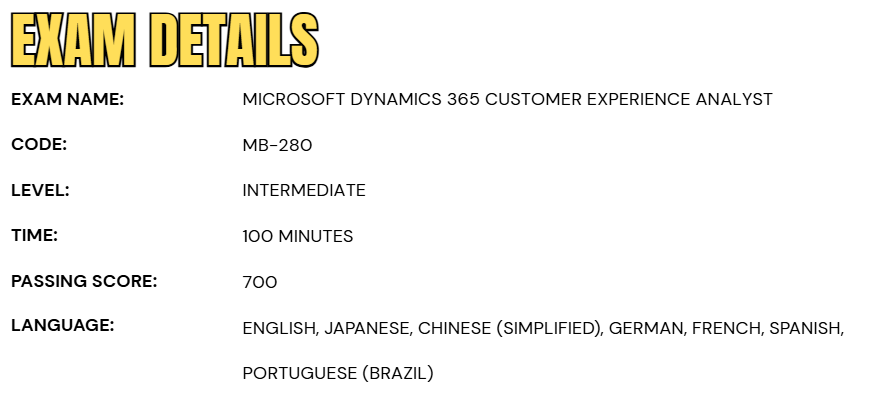
- The Exam MB-280: Microsoft Dynamics 365 Customer Experience Analyst is designed for professionals who specialize in analyzing, optimizing, and implementing customer experience solutions using Microsoft Dynamics 365 Sales and related applications.
- This is an intermediate-level certification exam intended for individuals working in roles such as Business Analysts and Functional Consultants.
- The exam is ideal for those with experience in business applications, customer relationship management (CRM), marketing and sales, and solution design within the Dynamics 365 ecosystem.
- Candidates are given 100 minutes to complete the assessment, which may include both objective and interactive components. The exam is proctored, ensuring a secure and standardized testing environment.
- The MB-280 exam is available in multiple languages, including English, Japanese, Chinese (Simplified), German, French, Spanish, and Portuguese (Brazil), making it accessible to a global audience.
- To successfully pass the exam, candidates must achieve a minimum score of 700 or higher.
Course Outline
The exam covers the following topics:
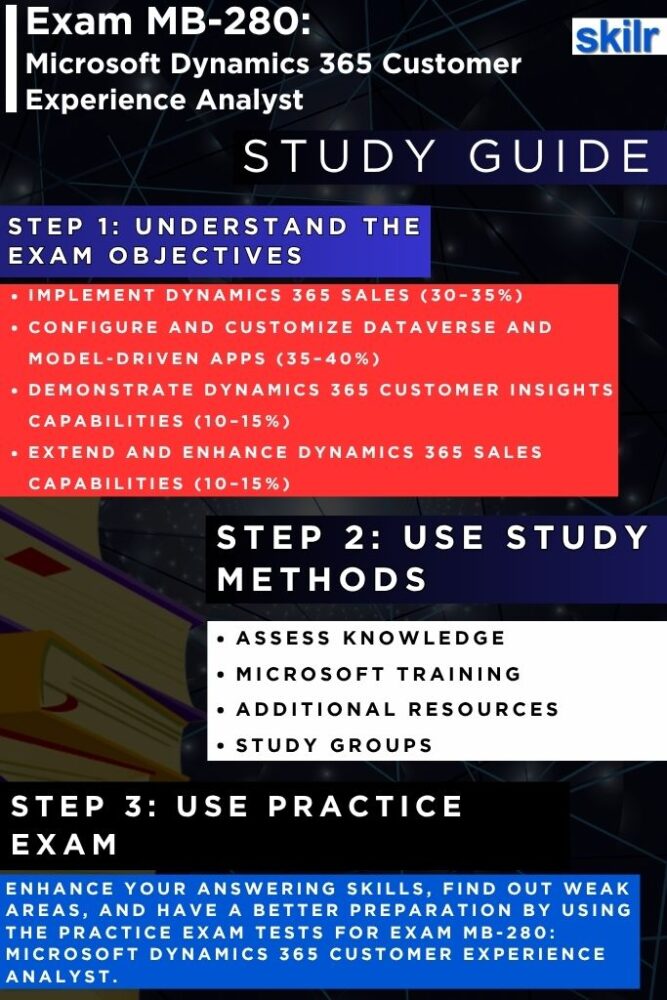
1. Implement Dynamics 365 Sales (30–35%)
Configure core functionality of Dynamics 365 Sales
- Enable and configure predictive lead and opportunity scoring (Microsoft Documentation: Configure predictive lead scoring)
- Configure the lead qualification experience (Microsoft Documentation: Customize the lead qualification experience)
- Configure the opportunity pipeline view (Microsoft Documentation: Configure the opportunity pipeline view)
- Interpret the Sales Pipeline chart (Microsoft Documentation: Understand the sales pipeline chart and its phases)
- Configure and deploy the Sales mobile app (Microsoft Documentation: Use the Dynamics 365 Sales mobile app)
- Configure Copilot in Sales capabilities (Microsoft Documentation: Turn on and set up Copilot in Dynamics 365 Sales)
- Demonstrate sales order processing, including quotes, orders, and invoices
- Configure lead and opportunity status reasons (Microsoft Documentation: Qualify and convert a lead to opportunity)
- Configure opportunity close (Microsoft Documentation: Customize the Opportunity Close form)
- Configure automatic creation rules for leads (Microsoft Documentation: Set up rules to automatically create or update records in the legacy app)
- Create and manage sales territories (Microsoft Documentation: Set up sales territories)
- Configure product catalog settings (Microsoft Documentation: Configure product catalog settings)
- Differentiate the product catalog components (Microsoft Documentation: Set up a product catalog)
- Manage the product lifecycle, including creating, revising, cloning, and retiring (Microsoft Documentation: Manage product lifecycle overview, Publish, revise, revert, retire, and activate products (product lifecycle))
- Customize the enhanced experience for adding products (Microsoft Documentation: Enable or disable the enhanced experience for adding products)
- Create product bundles (Microsoft Documentation: Set up product bundles to sell multiple items together)
- Configure product families (Microsoft Documentation: Set up product families)
- Create price lists, discount lists, and product pricing (Microsoft Documentation: Define product pricing with price lists and price list items)
Configure goals and forecasting
- Create and edit goals (Microsoft Documentation: Create or edit goals)
- Configure rollup queries (Microsoft Documentation: Define goal rollup queries)
- Manage forecasts (Microsoft Documentation: View a forecast)
- Build forecasts from templates
Configure and use Sales Insights
- Configure and use the assistant (Microsoft Documentation: Configure the assistant)
- Differentiate standard and premium Sales Insights features (Microsoft Documentation: Enable and configure Sales Insights features)
- Configure relationship analytics and improve relationship health (Microsoft Documentation: Improve customer relationship with relationship analytics)
- Recommend conversation intelligence settings
- Configure the Sales accelerator for an organization and users (Microsoft Documentation: Personalize sales accelerator)
- Customize the workspace
- Manage the sales pipeline by using the work list (Microsoft Documentation: Prioritize sales pipeline with work lists)
- Configure the Sales accelerator record types (Microsoft Documentation: Configure the sales accelerator, Manage access and record types)
- Create and manage sequences (Microsoft Documentation: Manage conditional workflows with sequences)
- Create and manage assignment rules (Microsoft Documentation: Create and activate assignment rules)
- Configure lead and opportunity segments (Microsoft Documentation: Working with segments)
- Configure work assignment (Microsoft Documentation: Configure assignment methods and rules for queues)
- Connect sequences to records (Microsoft Documentation: Connect a sequence to records)
2. Configure and customize Dataverse and model-driven apps (35–40%)
Perform tasks and manage settings in the Power Platform Environment Settings app
- Create and manage email templates (Microsoft Documentation: Create templates for email)
- Create and manage Word templates (Microsoft Documentation: Create a template)
- Create and manage Excel templates (Microsoft Documentation: Create and deploy Excel templates)
- Configure duplicate detection (Microsoft Documentation: Create and manage duplicate detection rules using solutions)
Configure Dataverse table components
- Create or modify a table
- Create or modify fields
- Configure relationship behaviors (Microsoft Documentation: Configure table relationship cascading behavior)
- Configure auditing of data (Microsoft Documentation: Manage Dataverse auditing)
- Configure connections and connection roles (Microsoft Documentation: Configure connection roles)
- Configure business rules (Microsoft Documentation: Create a business rule for a table)
- Configure formula and rollup columns (Microsoft Documentation: Work with formula columns, Formula, calculated, and rollup columns using code)
- Implement business process flows (Microsoft Documentation: Business process flows overview)
- Use the Dataverse connector in a cloud flow (Microsoft Documentation: Overview of how to integrate Power Automate flows with Dataverse)
- Differentiate form and view types (Microsoft Documentation: Type of model-driven app forms in Power Apps, Overview of types of views and how to create them)
- Configure the timeline control (Microsoft Documentation: Set up the timeline control)
- Embed Power BI dashboard, reports, and tiles (Microsoft Documentation: Embed Power BI content using a sample embed for your customers application, Embed a dashboard tile)
- Create and configure model-driven apps
- Differentiate between types of Power Apps
- Create and configure visualizations for model-driven apps
Manage security
- Implement hierarchy security
- Manage security roles (Microsoft Documentation: Security roles and privileges)
- Create and manage owner and access teams
- Share a model-driven app (Microsoft Documentation: Share a model-driven app)
- Evaluate security privileges by using access checker (Microsoft Documentation: Check user access to a row)
- Manage Microsoft Entra ID groups in Dataverse (Microsoft Documentation: Manage group teams)
- Diagnose user access issues (Microsoft Documentation: Troubleshoot user access issues for different environments)
- Create and manage column security profiles and column-level security (Microsoft Documentation: Column-level security to control access)
3. Demonstrate Dynamics 365 Customer Insights capabilities (10–15%)
Configure core functionality of Dynamics 365 Customer Insights – Journeys
- Create and personalize marketing emails by using templates and email editor (Microsoft Documentation: Create and design a marketing email message)
- Create a journey
- Create marketing forms
- Create and manage text messages in journeys (Microsoft Documentation: Create outbound text messages)
- Create marketing segments (Microsoft Documentation: Working with segments)
- Create journeys using unified profiles and segments from Dynamics 365 Customer Insights – Data (Microsoft Documentation: Create segments using unified profiles and customer measures from Customer Insights – Data)
- Configure consent management including Compliance Profiles and Consent Center (Microsoft Documentation: Stay compliant with privacy regulations)
- Differentiate segments in Dynamics 365 Sales, Customer Insights – Journeys, and Customer Insights – Data (Microsoft Documentation: Use segments from Dynamics 365 Customer Insights – Data)


Create and manage events
- Create an event
- Create and manage event registration forms
- Manage registration, waitlists, and attendees (Microsoft Documentation: Set up and manage an event waitlist)
4. Extend and enhance Dynamics 365 Sales capabilities (10–15%)
Implement collaboration features
- Configure document management (Microsoft Documentation: Configure document management)
- Configure Teams calling and dialer (Microsoft Documentation: Configure Microsoft Teams dialer)
- Configure Teams collaboration (Microsoft Documentation: Microsoft Teams collaboration)
Manage sales data and interactions in Outlook
- Perform common tasks including tracking records, creating records, adding sales literature and knowledge articles, and applying email templates
- Customize the Dynamics 365 App for Outlook (Microsoft Documentation: Set up and customize Dynamics 365 App for Outlook)
Microsoft MB-280 Exam FAQs

Microsoft Certification Exam Policies
Microsoft maintains a clear and transparent framework of certification exam policies to uphold fairness, consistency, and integrity throughout its certification process. These policies apply to all exam delivery formats, including online proctored exams and those administered at authorized testing centers.
– Exam Retake Policy
If a candidate does not pass an exam on the first attempt, they must wait a minimum of 24 hours before retaking it. For all subsequent attempts, a 14-day waiting period is required between each attempt. Candidates may attempt the same exam a maximum of five times within a 12-month period. Once an exam has been passed, no further retakes are permitted unless the certification has expired and must be renewed. Each retake is subject to the standard exam fee.
– Rescheduling and Cancellation Policy
Candidates can reschedule or cancel their exam appointments at no cost if the change is made at least six business days prior to the scheduled exam date. If rescheduling or cancellation occurs within five business days of the exam, a fee may apply. Candidates who cancel within 24 hours of the scheduled exam time or fail to appear for the exam will forfeit the full exam fee.
Microsoft MB-280 Exam Study Guide

1. Assess Your Knowledge Through Real-World Experience
The first step in your preparation is to evaluate your current experience with Microsoft Dynamics 365 Sales and the Power Platform. Hands-on exposure is essential for mastering this certification. You should be comfortable configuring and customizing Dynamics 365 solutions, managing security models, and using Power Platform tools like Power Automate and Power Apps to extend functionality.
Practical experience with customer data, sales insights, and AI-powered features will deepen your understanding of how Dynamics 365 supports business growth. Try to engage in real-world projects or sandbox environments where you can design customer journeys, automate workflows, and integrate analytics-driven solutions. This kind of experience ensures you can apply theoretical concepts effectively in a business context.
2. Understand the Exam Objectives and Structure
Before diving into study materials, it’s crucial to review the official exam objectives published by Microsoft. The MB-280 exam evaluates several domains, including configuration of Dynamics 365 Sales features, implementation of collaboration tools, customization through Power Platform, and the use of Customer Insights for data-driven decision-making.
Understanding these objectives allows you to plan your study strategy effectively and allocate more time to high-weighted sections. The exam emphasizes your ability to design, implement, and optimize customer experience solutions—so ensure you can confidently apply these skills across different scenarios.
3. Expand Your Skills with Microsoft Training
To strengthen your understanding of Dynamics 365 and related technologies, take advantage of Microsoft Learn’s official training resources. These self-paced learning paths include modules specifically aligned with the MB-280 exam. They combine interactive exercises, guided lessons, and conceptual overviews that help reinforce technical and functional knowledge.
You may also consider instructor-led training or workshops offered by certified Microsoft Learning Partners for a more structured approach. These sessions provide practical demonstrations, real-world examples, and opportunities to interact with experienced trainers. Using official resources ensures your learning remains aligned with the latest Microsoft updates and best practices. However, the training course for this exam includes:
– Course MB-280-A: Dynamics 365 Customer Experience Analyst
This training program comprises a comprehensive four-course series (MB-280T01–T04) specifically aligned with the Exam MB-280: Microsoft Dynamics 365 Customer Experience Analyst certification. Over the span of five intensive days, participants will develop the skills and knowledge required to configure and manage the Dynamics 365 Customer Experience model-driven applications, including Dynamics 365 Sales and Dynamics 365 Customer Insights.
The course is designed for IT and marketing professionals seeking to enhance their expertise in leveraging model-driven applications, Dynamics 365 Sales, Dynamics 365 Customer Insights, and Microsoft 365 Copilot for Sales to drive business performance and improve customer engagement.
Participants are expected to have a foundational understanding of Microsoft Power Apps and basic data modeling concepts. Familiarity with the Dynamics 365 Customer Experience suite, particularly Dynamics 365 Sales and Dynamics 365 Customer Insights, is recommended to maximize the learning outcomes of this training series.
4. Get Familiar with the Exam Sandbox Experience
Microsoft offers an Exam Sandbox to help candidates experience the interface and environment of the real certification test. The sandbox allows you to practice navigating between different question types, including case studies, drag-and-drop items, and scenario-based tasks.
Exploring the sandbox before your actual exam can significantly reduce stress on test day. It helps you understand how to manage your time effectively and become comfortable with the digital tools used in the exam interface. This familiarity often translates into smoother performance during the live assessment.
5. Join Study Groups and Certification Communities
Collaborating with others can be a powerful part of your exam preparation. Join Microsoft certification study groups, forums, and online communities such as the Microsoft Learn Community or relevant LinkedIn groups. Engaging in discussions with peers and certified professionals allows you to share insights, clarify doubts, and gain fresh perspectives on complex topics.
These communities often provide valuable study materials, practice questions, and personal success stories that can motivate and guide you throughout your learning journey. Learning in a community also helps you stay consistent and accountable to your preparation goals.
6. Take Practice Tests to Measure Readiness
Once you’ve covered the study material, evaluate your readiness by taking practice exams. These mock tests simulate real exam conditions and help you identify areas where you may need further review. Analyze your performance after each attempt, focusing on the questions you found challenging. Revisit those topics using Microsoft Learn modules or documentation to fill knowledge gaps. Regular practice not only boosts confidence but also enhances your ability to manage time and stress during the actual exam.
7. Review, Revise, and Prepare for Success
In the final phase of your preparation, focus on consolidating your learning rather than covering new material. Revisit key Dynamics 365 Sales configurations, Power Platform integrations, and Customer Insights functionalities. Review how these tools interconnect to enhance customer engagement, sales automation, and data-driven insights.
Dedicate time to understanding real-world applications rather than memorizing concepts. Ensure you can visualize how Dynamics 365 tools support the full sales cycle—from lead generation to customer retention. By combining practical experience, structured learning, and consistent practice, you’ll be well prepared to pass the MB-280 exam and advance your career as a certified Microsoft Dynamics 365 Customer Experience Analyst.
