
The Google Cloud Digital Leader certification validates an individual’s ability to explain the foundational concepts of cloud computing and articulate how Google Cloud’s core products and services can help organizations achieve their strategic objectives. This certification is ideal for individuals from both technical and non-technical backgrounds who wish to demonstrate a broad understanding of cloud technologies and their business value.
– Who Should Pursue This Certification?
This certification is designed for:
- Business professionals, decision-makers, or newcomers to cloud computing.
- Individuals seeking to understand how Google Cloud supports digital transformation.
- Team members who collaborate with technical stakeholders and want to enhance cloud fluency.
– What the Exam Evaluates
The Cloud Digital Leader exam tests your knowledge across several key areas:
- Digital Transformation with Google Cloud: Understanding how cloud technologies enable business innovation and efficiency.
- Data-Driven Innovation: Exploring how Google Cloud supports data collection, processing, and transformation.
- Artificial Intelligence and Machine Learning: Recognizing the potential of AI/ML services to create new business value.
- Modernizing Infrastructure and Applications: Examining how cloud-native technologies help organizations evolve their IT landscape.
- Security and Trust: Demonstrating how Google Cloud ensures data protection, compliance, and secure operations.
- Operational Scalability: Understanding the tools and practices for efficient cloud operations and management at scale.
– Recommended Background
While no technical background is strictly required, candidates will benefit from having:
- Experience working alongside IT or cloud professionals
- Familiarity with general business objectives and digital strategies
- An interest in how cloud technologies support enterprise-level transformation
Exam Details

- The Google Cloud Digital Leader certification exam is a 90-minute assessment available in multiple languages, including English, Japanese, Spanish, Portuguese, and French.
- The exam consists of 50 to 60 multiple-choice questions designed to evaluate a candidate’s understanding of cloud concepts and the strategic use of Google Cloud technologies.
- Candidates can choose to take the exam either through an online-proctored environment or at an authorized onsite testing center.
- The certification remains valid for a period of three years from the date of passing.
- There are no formal prerequisites to take this exam, making it accessible to individuals from both technical and non-technical backgrounds.
Course Outline
The exam covers the following topics:
Section 1: Digital Transformation with Google Cloud (17%)
1.1 Why Cloud Technology is Transforming Business
- Explain why and how the cloud is revolutionizing businesses. (Google Documentation: What is Digital Transformation?)
- Define the terms: cloud, cloud technology, data, digital transformation, cloud-native, open source, open standard. (Google Documentation: What is cloud native?)
- Describe the differences between cloud technology and traditional or on-premises technology.
- Explain the benefits of cloud technology to a business’ digital transformation: this technology is scalable, flexible, agile, secure, cost-effective and offers strategic value. (Google Documentation: Advantages and Disadvantages of Cloud Computing)
- Describe the primary benefits of on-premises infrastructure, public cloud, private cloud, hybrid cloud, and multicloud and differentiate between them. (Google Documentation: What is multicloud?)
- Describe the main business transformation benefits of Google Cloud: intelligence, freedom, collaboration, trust, and sustainability. (Google Documentation: Why Google Cloud)
- Describe the implications and risks for organizations that do not adopt new technology. (Google Documentation: Advantages and Disadvantages of Cloud Computing)
- Describe the drivers and challenges that lead organizations to undergo a digital transformation. (Google Documentation: What is Digital Transformation?)
- Describe the transformation cloud and how it accelerates an organization’s digital transformation through app and infrastructure modernization, data democratization, people connections, and trusted transactions. (Google Documentation: Reinventing the future with a transformation cloud)
1.2 Fundamental Cloud Concepts
- Explain general cloud concepts. (Google Documentation: Google Cloud overview)
- Describe how transitioning to a cloud infrastructure affects flexibility, scalability, reliability, elasticity, agility, and total cost of ownership (TCO). Apply these concepts to various business use cases.
- Explain how an organization’s transition from an on-premises environment to the cloud shifts their capital expenditures (CapEx) to operational expenditures (OpEx), and how that affects their total cost of ownership (TCO).
- Identify when private, hybrid, or multicloud infrastructures best apply to different business use cases. (Google Documentation: Distributed, hybrid, and multicloud overview)
- Define basic network infrastructure terminology, including: IP address; internet service provider (ISP); domain name server (DNS), regions, and zones; fiber optics; subsea cables; network edge data centers, latency; and bandwidth. (Google Documentation: Google Cloud Networking overview)
- Discuss how Google Cloud supports digital transformation with global infrastructure and data centers connected by a fast, reliable network. (Google Documentation: Google Cloud infrastructure)
1.3 Cloud Computing Models and Shared Responsibility
- Discuss the benefits and tradeoffs of using infrastructure as a service (IaaS); platform as a service (PaaS); and software as a service (SaaS). (Google Documentation: PaaS vs. IaaS vs. SaaS vs. CaaS)
- Define IaaS, PaaS, and SaaS. (Google Documentation: PaaS vs. IaaS vs. SaaS vs. CaaS)
- Compare and contrast the benefits and tradeoffs of IaaS, PaaS, and SaaS including total cost of ownership (TCO), flexibility, shared responsibilities, management level, and necessary staffing and technical expertise.
- Determine which computing model (IaaS, PaaS, SaaS) applies to various business scenarios and use cases.
- Describe the cloud shared responsibility model. Compare which responsibilities are the cloud provider’s, and which responsibilities are the customer’s for on-premises and cloud computing models (IaaS, PaaS, SaaS). (Google Documentation: Shared responsibilities and shared fate on Google Cloud)
Section 2: Exploring Data Transformation with Google Cloud (16%)
2.1 The Value of Data
- Describe the intrinsic role that data plays in an organizations’ digital transformation. (Google Documentation: What is Digital Transformation?)
- Explain how data generates business insights, drives decision making, and creates new value. (Google Documentation: What is Big Data?)
- Differentiate between basic data management concepts, in particular: databases; data warehouses; data lakes. (Google Documentation: What is a Data Lake?)
- Explain how organizations can create value by using their current data, collecting new data, and sourcing data externally. (Google Documentation: Integrate your data sources with Data Catalog, What is Data Governance?)
- Describe how the cloud unlocks business value from all types of data, including structured data and previously untapped unstructured data. (Google Documentation: What is a data cloud?)
- Discuss the main data value chain concepts and terms.
- Explain how data governance is essential to a successful data journey. (Google Documentation: What is Data Governance?)
2.2 Google Cloud Data Management Solutions
- Determine which Google Cloud data management products are applicable to different business use cases.
- Differentiate between Google Cloud data management options including data type and common business use case, including: Cloud Storage; Cloud Spanner; Cloud SQL; Cloud Bigtable; BigQuery; Firestore. (Google Documentation: Google Cloud database options, explained)
- Define key data management concepts and terms, including: relational; non-relational; object storage; structured query language (SQL); NoSQL. (Google Documentation: What is a NoSQL database?)
- Describe the benefits of using BigQuery as a serverless, managed data warehouse and analytics engine that can be used in a multicloud environment. (Google Documentation: BigQuery overview)
- Differentiate between storage classes in Cloud Storage regarding cost and frequency of access, including: Standard; Nearline; Coldline; Archive. (Google Documentation: Storage classes)
- Describe the ways that an organization can migrate or modernize their current database in the cloud. (Google Documentation: Migration and modernization tools)
2.3 Making Data Useful and Accessible
- Discuss how smart analytics, business intelligence tools, and streaming analytics can add value in different business use cases. (Google Documentation: What is Business Intelligence?, What is streaming analytics?)
- Describe how Looker democratizes access to data by empowering individuals to self-serve business intelligence and create insights. (Google Documentation: Analyze governed data, deliver business insights, and build AI-powered applications)
- Discuss the value of analyzing and visualizing data from BigQuery in Looker to create real-time reports, dashboards, and integrating data into workflows. (Google Documentation: Analyze data with Looker Studio, Analyze data with BI Engine and Looker)
- Describe how streaming analytics in real time makes data more useful and generates business value. (Google Documentation: What is streaming analytics?, Streaming analytics)
- Describe the main Google Cloud products that modernize data pipelines, including Pub/Sub and Dataflow. (Google Documentation: Dataflow overview, Work with Dataflow data pipelines)
Section 3: Innovating with Google Cloud Artificial Intelligence (16%)
3.1 AI and ML Fundamentals
- Discuss the main AI and ML concepts, and explain how ML can create business value. (Google Documentation: Machine learning workflow)
- Define artificial intelligence (AI) and machine learning (ML).
- Differentiate the capabilities of AI and ML from data analytics and business intelligence. (Google Documentation: Artificial intelligence (AI) vs. machine learning (ML))
- Discuss the types of problems that ML can solve. (Google Documentation: What is Machine Learning (ML)?, Problem-solving with ML: automatic document classification)
- Explain the business value ML creates, including: ability to work with large datasets; scaling business decisions; and unlocking unstructured data.
- Explain why high-quality, accurate data is essential for successful ML models.
- Discuss the importance of explainable and responsible AI (Google Documentation: Responsible AI)
3.2 Google Cloud’s AI and ML solutions
- Discuss the range of Google Cloud AI and ML solutions and products available, and how to select the most appropriate solution for different business use cases. (Google Documentation: AI and machine learning solutions)
- Explain which decisions and tradeoffs organizations need to consider when selecting Google Cloud AI/ML solutions and products, including: speed; effort; differentiation; required expertise.
- Discuss which Google Cloud AI and ML solutions and products might apply given different business use cases, including: pre-trained APIs; AutoML; build custom models. (Google Documentation: AI and machine learning products, AutoML)
3.3 Building and using Google Cloud AI and ML solutions
- Explain how Google Cloud’s pre-trained API, AutoML, and custom AI/ML products can create business value. (Google Documentation: AutoML)
- Discuss how BigQuery ML lets users create and execute machine learning models in BigQuery by using standard SQL queries. (Google Documentation: Create machine learning models in BigQuery ML, Introduction to AI and ML in BigQuery)
- Select which Google Cloud pre-trained API best applies to different business use cases, including: Natural Language API, Vision API, Cloud Translation API, Speech-to-Text API, and Text-to-Speech API. (Google Documentation: Natural Language AI, Translate docs, audio, and videos in real time with Google AI)
- Explain how an organization can create business value by using their own data to train custom ML models with AutoML.
- Discuss how building custom models by using Google Cloud’s Vertex AI can create opportunities for business differentiation. (Google Documentation: Introduction to Vertex AI)
- Recognize TensorFlow as an end-to-end open source set of tools for building and training machine learning models and that Cloud Tensor Processing Unit (TPU) is Google’s proprietary hardware optimized for TensorFlow and ML performance. (Google Documentation: Accelerate AI development with Google Cloud TPUs)

Section 4: Modernize Infrastructure and Applications with Google Cloud (17%)
4.1 Cloud modernization and migration
- Explain why modernization and migration to the cloud are important steps in an organization’s transformation journey, and how each application might have a different path. (Google Documentation: Modernization path for .NET applications on Google Cloud)
- Discuss benefits of infrastructure modernization and application modernization by using Google Cloud. (Google Documentation: Infrastructure modernization)
- Define the main cloud migration terms, including: workload; retire; retain; rehost; lift and shift; replatform; move and improve; refactor; reimagine. (Google Documentation: Migrate to Google Cloud: Get started)
4.2 Computing in the cloud
- Discuss the options for and advantages of running compute workloads in the cloud. (Google Documentation: Choose a Compute Engine deployment strategy for your workload)
- Define the main cloud compute terms, including: virtual machines (VMs); containerization; containers; microservices; serverless computing; preemptible VMs; Kubernetes, autoscaling, load balancing. (Google Documentation: Load balancing and scaling)
- Describe the benefits and business value of running compute workloads in the cloud. (Google Documentation: Advantages and Disadvantages of Cloud Computing)
- Explain the choices and constraints between different compute options. (Google Documentation: Choosing the right compute option in GCP: a decision tree)
- Discuss the business value of using Compute Engine to create and run virtual machines on Google’s infrastructure. (Google Documentation: Compute Engine)
- Discuss the business value of choosing a rehost migration path for specialized legacy applications.
4.3 Serverless computing
- Discuss the advantages of serverless computing in application modernization. (Google Documentation: Serverless)
- Explain the benefits of serverless computing. (Google Documentation: What is serverless computing?)
- Discuss the business value of using serverless computing Google Cloud products, including: Cloud Run; App Engine; Cloud Functions. (Google Documentation: Cloud Functions overview)
4.4 Containers in the cloud
- Discuss the advantages of using containers in application modernization. (Google Documentation: Benefits of migrating to containers)
- Discuss the advantages of modern cloud application development. (Google Documentation: Advantages and Disadvantages of Cloud Computing)
- Differentiate between virtual machines and containers. (Google Documentation: Containers vs VMs (virtual machines): What are the differences?)
- Discuss the main benefits of containers and microservices for application modernization. (Google Documentation: Cloud Application Modernization, What is Microservices Architecture?)
- Discuss the business value of using Google Cloud products to deploy containers, including: Google Kubernetes Engine (GKE); Cloud Run. (Google Documentation: Use GKE and Cloud Run together)
4.5 The value of APIs
- Explain the business value of application programming interfaces (APIs). (Google Documentation: What is API management?)
- Define application programming interface (API). (Google Documentation: Google Cloud APIs)
- Explain how organizations can create new business opportunities by exposing and monetizing public-facing APIs.
- Discuss the business value of using Apigee API Management. (Google Documentation: What is Apigee?)
4.6 Hybrid and multi-cloud
- Discuss the business reasons for choosing hybrid or multi-cloud strategies and how Anthos enables these strategies. (Google Documentation: What is multicloud?)
- Discuss the reasons and use cases for why organizations choose a hybrid cloud or multi-cloud strategy. (Google Documentation: What is a Hybrid Cloud?)
- Describe the business value of using Anthos as a single control panel for the management of hybrid or multicloud infrastructure.
Section 5: Trust and Security with Google Cloud (17%)
5.1 Trust and security in the cloud
- Discuss fundamental cloud security concepts. (Google Documentation: Google security overview)
- Describe today’s top cybersecurity threats and business implications.
- Differentiate between cloud security and traditional on-premises security. (Google Documentation: Cloud network security)
- Describe the importance of control, compliance, confidentiality, integrity, and availability in a cloud security model. (Google Documentation: Google security overview)
- Define key security terms and concepts.
5.2 Google’s trusted infrastructure
- Explain the business value of Google’s defense-in-depth multilayered approach to infrastructure security. (Google Documentation: Infrastructure Security in Google Cloud)
- Describe the benefits of Google designing and building its own data centers, using purpose-built servers, networking, and custom security hardware / software. (Google Documentation: Google infrastructure security design overview)
- Describe the role of encryption in securing an organization’s data and the ways that it can protect data exposed to risks in different states. (Google Documentation: Default encryption at rest)
- Differentiate between authentication, authorization, and auditing. (Google Documentation: Authentication and authorization)
- Describe the benefits of using two-step verification (2SV) and IAM. (Google Documentation: Identity and Access Management (IAM))
- Describe how an organization can protect against network attacks using Google products, including distributed denial-of-service (DDoS) using Google Cloud Armor. (Google Documentation: Configure advanced network DDoS protection)
- Define Security Operations (SecOps) in the cloud and describe its business benefits. (Google Documentation: Google Security Operations overview)
5.3 Google Cloud’s trust principles and compliance
- Describe how Google Cloud earns and maintains customer trust in the cloud. (Google Documentation: Creating trust through transparency)
- Discuss how Google Cloud’s trust principles are a commitment to our shared responsibility for protecting and managing an organization’s data in the cloud. (Google Documentation: Creating trust through transparency)
- Describe how sharing transparency reports and undergoing independent third-party audits support customer trust inGoogle.
- Describe why data sovereignty and data residency may be requirements and how Google Cloud offers organizations the ability to control where their data is stored. (Google Documentation: Implement data residency and sovereignty requirements)
- Describe how Google Cloud compliance resource center and Compliance Reports Manager support industry and regional compliance needs. (Google Documentation: Compliance Reports Manager)
Section 6: Scaling with Google Cloud Operations (17%)
6.1 Financial governance and managing cloud costs
- Discuss how Google Cloud supports an organization’s financial governance and ability to control their cloud costs. (Google Documentation: Cost Management)
- Discuss how using cloud financial governance best practices provides predictability and control for cloud resources.
- Define important cloud cost-management terms and concepts.
- Discuss the benefits of using the resource hierarchy to control access. (Google Documentation: Resource hierarchy)
- Describe the benefit of controlling cloud consumption using resource quota policies and budget threshold rules. (Google Documentation: Create, edit, or delete budgets and budget alerts)
- Discuss how organizations can visualize their cost data by using Cloud Billing Reports. (Google Documentation: View your billing reports and cost trends)
6.2 Operational excellence and reliability at scale
- Discuss the fundamental concepts of modern operations, reliability, and resilience in the cloud. (Google Documentation: Google Cloud Architecture Framework: Reliability)
- Describe the benefits of modernizing operations by using Google Cloud.
- Define important cloud operations terms.
- Describe the importance of designing resilient, fault-tolerant, and scalable infrastructure and processes for high availability and disaster recovery. (Google Documentation: Architecting disaster recovery for cloud infrastructure outages)
- Define key cloud reliability, DevOps, and SRE terms.
- Describe how organizations benefit from using Google Cloud Customer Care to support their cloud adoption. (Google Documentation: Google Cloud Customer Care)
- Describe the life of a support case during the Google Cloud Customer Care process. (Google Documentation: Customer Care procedures)
6.3 Sustainability with Google Cloud
- Discuss how Google Cloud helps organizations meet sustainability goals and reduce environmental impact. (Google Documentation: Cloud sustainability)
- Describe Google Cloud’s commitment to sustainability and reducing environmental impact.
- Discuss how Google Cloud provides products to support organizations’ sustainability goals.
Google Cloud Digital Leader Exam FAQs
Exam Policies
To uphold the integrity, consistency, and credibility of all Google Cloud certifications, clearly defined exam policies are implemented. Some key policies include:
– Renewal Policy
Candidates obtaining a certification for the first time, or whose previous certification has expired, are required to take the standard exam. For renewal candidates, Google Cloud offers two options: the shorter renewal exam or the standard exam. You may begin the renewal process up to 180 days before your certification’s expiration date. Once you choose a specific exam path—renewal or standard—you must remain on that path until you successfully pass the exam or your certification expires.
– Scoring Policy
Google Cloud certification exams are designed to evaluate whether candidates meet the established competency standards. Exam results are reported solely as pass or fail; numerical or percentile scores are not disclosed. These exams are not intended for diagnostic purposes or to compare candidate performance. This policy ensures fairness, maintains standardization, and prevents any misinterpretation of exam outcomes.
Google Cloud Digital Leader Exam Study Guide
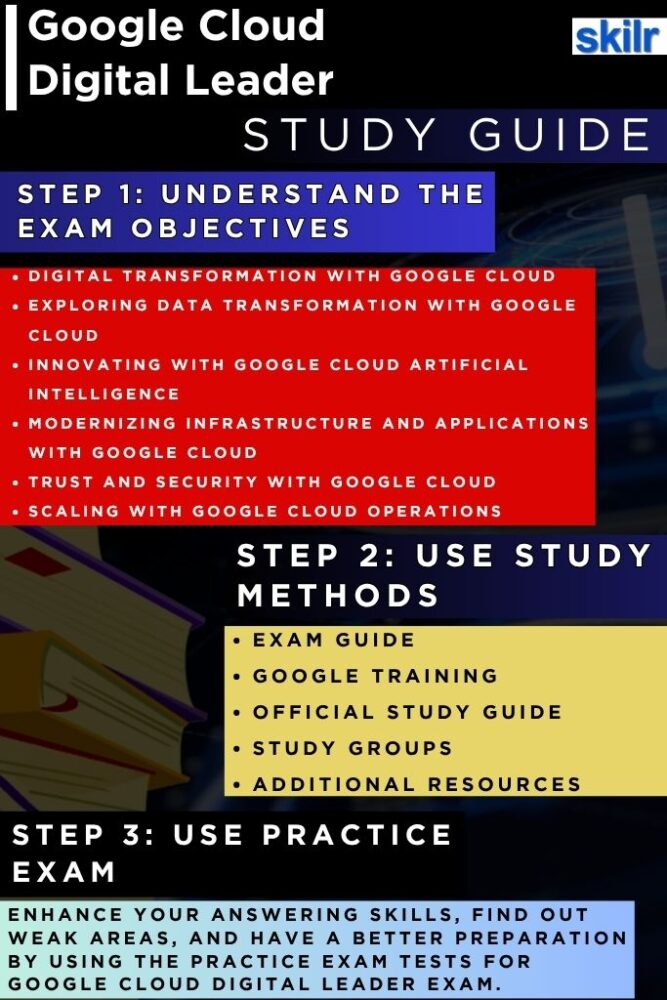
Step 1: Understand the Exam Objectives
The first step toward effective preparation is gaining a clear understanding of the exam’s structure, purpose, and key objectives. The Google Cloud Digital Leader Exam is designed for business professionals, technology managers, and decision-makers who need to understand how cloud technology can create value for organizations. The exam assesses your ability to articulate the business advantages of Google Cloud solutions rather than testing hands-on technical skills. Its areas typically include:
- The fundamentals of cloud computing and digital transformation
- Core Google Cloud products and services such as Compute Engine, BigQuery, Cloud Storage, and Cloud Run
- The role of data, AI, and ML in driving innovation and decision-making
- Concepts of cost optimization, security, and compliance in cloud environments
By studying the exam guide provided by Google Cloud, you can align your preparation with each domain’s learning objectives. This understanding helps you focus on the strategic applications of Google Cloud rather than deep technical configurations.
Step 2: Expand Your Knowledge with Official Training
After familiarizing yourself with the objectives, the next step is to deepen your knowledge using structured Google Cloud training programs. The official course is a recommended starting point. This training offers comprehensive lessons that cover both foundational and advanced cloud concepts. This includes:
– Cloud Digital Leader Training
The Google Cloud Digital Leader Training provides a structured learning path that builds a strong foundation in cloud technology, data analytics, and AI/ML, emphasizing their role in driving digital transformation through Google Cloud solutions. It also prepares learners for the Google Cloud Digital Leader Certification Exam. Designed for IT professionals, engineers, project managers, business leaders, and decision-makers, this program equips participants to actively contribute to cloud-focused initiatives within their organizations.
The training covers key areas such as cloud fundamentals, Google Cloud products and services, IT modernization, and data-driven innovation. Upon completion, participants will be able to confidently explain core cloud concepts, identify Google Cloud solutions that enable digital transformation, and recognize opportunities to modernize infrastructure and applications using Google Cloud technologies.
Step 3: Join Study Groups and the Cloud Digital Leader Community
Studying in isolation can limit your perspective, especially for an exam that emphasizes business and strategic thinking. Joining study groups or online communities can be highly beneficial. These groups—available on LinkedIn, Reddit, Discord, and Google Cloud Community forums—connect you with peers, instructors, and certified professionals who share insights, discuss complex topics, and provide valuable exam preparation strategies.
Engaging in collaborative learning helps you identify areas where your understanding might be incomplete and gives you access to real-world examples of how organizations leverage Google Cloud. Group discussions often lead to clearer comprehension of abstract concepts, such as cost management models, shared responsibility frameworks, and AI-driven decision support.
Additionally, participating in webinars and online sessions hosted by Google Cloud experts can expose you to evolving trends, new product updates, and case studies that strengthen your overall grasp of the ecosystem.
Step 4: Take Practice Tests and Evaluate Your Readiness
After completing your learning path, it’s essential to assess your knowledge and exam readiness through practice tests and mock assessments. These tools simulate the real exam experience and help you become comfortable with the format, pacing, and question style. Practice tests not only highlight your strong areas but also identify knowledge gaps that require more attention. Reviewing the explanations for both correct and incorrect answers enables you to reinforce key concepts and understand how Google Cloud principles apply in different business scenarios.
Google provides sample questions that reflect the exam’s reasoning and structure. Complement these with third-party mock exams from reputable platforms such as Coursera, Whizlabs, or Udemy. Taking multiple practice tests under timed conditions will improve your confidence and help you manage time effectively on exam day.
Step 5: Explore Additional Resources for Comprehensive Learning
Finally, expand your understanding beyond formal coursework by engaging with additional learning materials and real-world resources. Reviewing Google Cloud’s official documentation, whitepapers, and case studies allows you to explore how organizations in various industries—finance, healthcare, retail, and manufacturing—use Google Cloud to solve business challenges.
Stay up to date with the latest developments through the Google Cloud Blog and the Google Cloud YouTube Channel, where experts share product updates, tutorials, and success stories. Reading business-focused materials on topics such as AI strategy, data analytics, and cloud migration frameworks can further enhance your conceptual understanding and analytical thinking.
To reinforce your preparation, consider creating a personal study plan that includes a mix of reading, training, community engagement, and practice tests. This structured approach ensures balanced learning, helping you not only pass the exam but also apply cloud concepts confidently in your professional role.
