
The Google Professional Cloud Database Engineer certification validates your expertise in designing, managing, and optimizing scalable database solutions on Google Cloud. Professionals in this role are responsible for building and maintaining databases that support complex applications, ensuring data integrity, performance, and availability.
A Professional Cloud Database Engineer typically has five years of overall database and IT experience, including two years of hands-on experience with Google Cloud. They possess the skills to translate business and technical requirements into secure, reliable, and cost-efficient database architectures.
– What the Exam Measures
The exam evaluates your ability to:
- Design scalable and highly available cloud database architectures.
- Manage solutions that span multiple database technologies and services.
- Migrate existing data solutions to Google Cloud efficiently.
- Deploy and maintain high-performance, resilient database systems in production environments.
– Prerequisites
There are no formal prerequisites for taking this certification exam.
– Recommended Experience
- At least 5 years of experience in database administration and IT.
- A minimum of 2 years of hands-on experience working with Google Cloud database solutions, including services such as Cloud SQL, Cloud Spanner, Bigtable, and Firestore.
– Who Should Take This Exam
This certification is ideal for:
- Database Administrators managing on-premise or cloud-based systems transitioning to Google Cloud.
- Cloud Engineers specializing in database operations, optimization, and migration.
- Data Architects designing scalable, secure, and cost-efficient database infrastructures.
- IT Professionals seeking to validate their expertise in Google Cloud database technologies and advance their cloud career path.
Exam Details
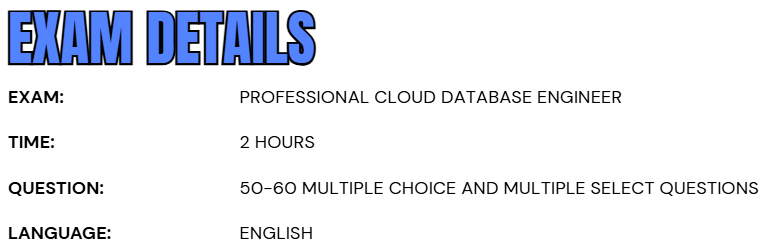
- The Google Professional Cloud Database Engineer exam is designed to assess a candidate’s ability to design, manage, and optimize database solutions on Google Cloud.
- The exam has a duration of 2 hours and is available in English.
- It consists of 50–60 multiple-choice and multiple-select questions that evaluate both conceptual understanding and practical application of Google Cloud database services.
- Candidates have the flexibility to choose their exam delivery method:
- They can either take the online-proctored exam remotely from a secure location or opt for the onsite-proctored exam at an authorized testing center.
Course Outline
The exam covers the following topics:
Section 1: Learn About designing innovative, scalable, and highly available cloud database solutions (32%)
1.1 Analyzing relevant variables to perform database capacity and usage planning. Considerations include:
- Performing solution sizing based on current environment workload metrics and future requirements (Google Documentation: Migrate to Google Cloud: Assess and discover your workloads)
- Evaluating performance and cost tradeos of dierent database congurations (e.g.,
machine types, storage types) - Size database compute and storage based on performance requirements (Google Documentation: Configure disks to meet performance requirements)
1.2 Evaluating database high availability and disaster recovery options given the requirements. Considerations include:
- Evaluating tradeoffs between multi-region, regional, and zonal database deployment strategies (Google Documentation: Geography and regions, Multi-regional deployment on Compute Engine)
- Defining maintenance windows and notifications based on application availability requirements (Google Documentation: Maintenance windows and exclusions)
1.3 Determining how applications will connect to the database. Considerations include:
- Configuring networking, key management, encryption, and security
- Justifying the use of session pooler services (Google Documentation: Sessions)
- Assessing auditing policies for managed services (Google Documentation: Organization Policy audit logging)
1.4 Evaluating appropriate database solutions on Google Cloud. Considerations include:
- Differentiating between managed and unmanaged database services (e.g., self-managed, bare metal, Google-managed, Google Cloud native and partner database oerings)
- Distinguishing between SQL and NoSQL business requirements (e.g., structured, semi-structured, unstructured, vector)
- Analyzing the cost of running database solutions in Google Cloud (comparative analysis) (Google Documentation: Comparative analysis of Google Cloud deployment archetypes)
- Assessing application and database dependencies (Google Documentation: Migrate to Google Cloud: Assess and discover your workloads)
- Identifying solutions to support regulatory and compliance requirements
- Understanding implications of organizational policies on database strategy
- Considering solutions that span multiple database technologies (e.g. federation, exports, hybrid deployments)
- Leveraging database technologies to support generative AI and LLM use cases
Section 2: Learn how to manage a solution that can span multiple database technologies (25%)
2.1 Determining database connectivity and access management considerations. Considerations include:
- Determining Identity and Access Management (IAM) policies for database connectivity and access control (Google Documentation: Identity and Access Management (IAM))
- Managing database users, including authentication and access (Google Documentation: Manage users with built-in authentication, Manage users with IAM database authentication)
2.2 Configuring database monitoring and troubleshooting options. Considerations include:
- Assessing slow running queries, database locking – identify missing indexes (Google Documentation: Use Query Insights to improve query performance)
- Monitoring and investigating database vitals – RAM, CPU storage, I/O, and audit logging (Google Documentation: Cloud Logging overview)
- Monitoring and updating quotas (Google Documentation: View and manage quotas)
- Investigating database resource contention (Google Documentation: Troubleshooting resource contention issues, Introspection tools overview)
- Setting up alerts for errors and performance metrics (Google Documentation: Create metric-threshold alerting policies)
2.3 Designing database backup and recovery solutions. Considerations include:
- Given requirements, recommending backup and recovery options (automatic scheduled backups) (Google Documentation: Backups overview, Create and manage on-demand and automatic backups)
- Configuring export and import data for databases (Google Documentation: Exporting and Importing Entities)
- Designing for RTO, RPO, and PITR (Google Documentation: Disaster recovery planning guide)
- Managing data retention
2.4 Optimizing database cost and performance in Google Cloud. Considerations include:
- Assess scaling up and scaling out options (Google Documentation: Autoscaling groups of instances)
- Scaling database instances based on current and upcoming workload (Google Documentation: Scaling based on schedules)
- Defining replication strategies (Google Documentation: Replication)
- Continuously assessing and optimizing the cost of running a database solution
- Optimizing queries for cost and performance
2.5 Automating common database tasks. Considerations include:
- Performing database maintenance (e.g., rebuilding indexes, data exports) (Google Documentation: About maintenance on Cloud SQL instances)
- Scheduling database exports (Google Documentation: Scheduling an Export)
- Managing upgrades for Google Cloud-managed databases
- Monitoring database SLA/SLOs

Section 3: Understand about migrating data solutions (23%)
3.1 Designing and implementing data migration and replication. Considerations include:
- Developing and executing migration strategies and plans, including zero/near-zero downtime, extended outage, and fallback (Google Documentation: Migrate to Google Cloud: Best practices for validating a migration plan)
- Reversing replication from Google Cloud to source (Google Documentation: Reverse and resume a replication)
- Planning and performing database migration, including fallback plans and DDL/DML conversion
- Determining the correct database migration tools for a given scenario (e.g., databases hosted outside of Google Cloud) (Google Documentation: Overview of Database Migration Service)
Section 4: Learn how to deploy scalable and highly available databases in Google Cloud (20%)
4.1 Applying concepts to implement scalable and highly available databases in Google Cloud. Considerations include:
- Provisioning high available database solutions in Google Cloud (Google Documentation: Enable and disable high availability)
- Testing high availability and disaster recovery strategies (Google Documentation: About disaster recovery (DR) in Cloud SQL)
- Setting up multi-regional replication for databases (Google Documentation: Regional and multi-region configurations)
- Deploying and scaling read replicas
- Automating database instance provisioning (Google Documentation: Create instances)
- Configuring monitoring for highly available databases
Google Professional Cloud Database Engineer Exam FAQs
Exam Policies
Google Cloud maintains a set of clear, consistent, and transparent exam policies to ensure a fair, secure, and reliable certification experience for all candidates. These policies govern how exams are conducted, scored, and renewed, safeguarding the integrity and credibility of Google Cloud certifications.
– Recertification and Renewal
To keep your Google Cloud certification active, you must recertify every three years by retaking and passing the corresponding exam. This ensures that certified professionals stay up to date with evolving technologies, best practices, and new Google Cloud features. Candidates can begin the recertification process up to 60 days before their certification expiration date to ensure uninterrupted credential validity. Recertifying within this window allows professionals to retain their Series ID and maintain a continuous certification record.
Renewal Eligibility Periods:
- Foundational and Associate Certifications: You may begin recertification 180 days before your certification expires.
- Professional Certifications: You may begin recertification 60 days before your certification expires.
Any renewal attempts made before the applicable eligibility window may be declined, and exam fees may be forfeited.
– Exam Scoring
Google Cloud certification exams are pass/fail assessments designed to verify whether candidates meet the required competency standards for their respective roles. Numerical scores or detailed feedback are not provided, as the exams focus on validating professional proficiency rather than ranking performance. This scoring method emphasizes Google Cloud’s commitment to objective and fair evaluation, ensuring that successful candidates demonstrate real-world knowledge, skill, and readiness to perform in their professional roles.
Google Professional Cloud Database Engineer Exam Study Guide
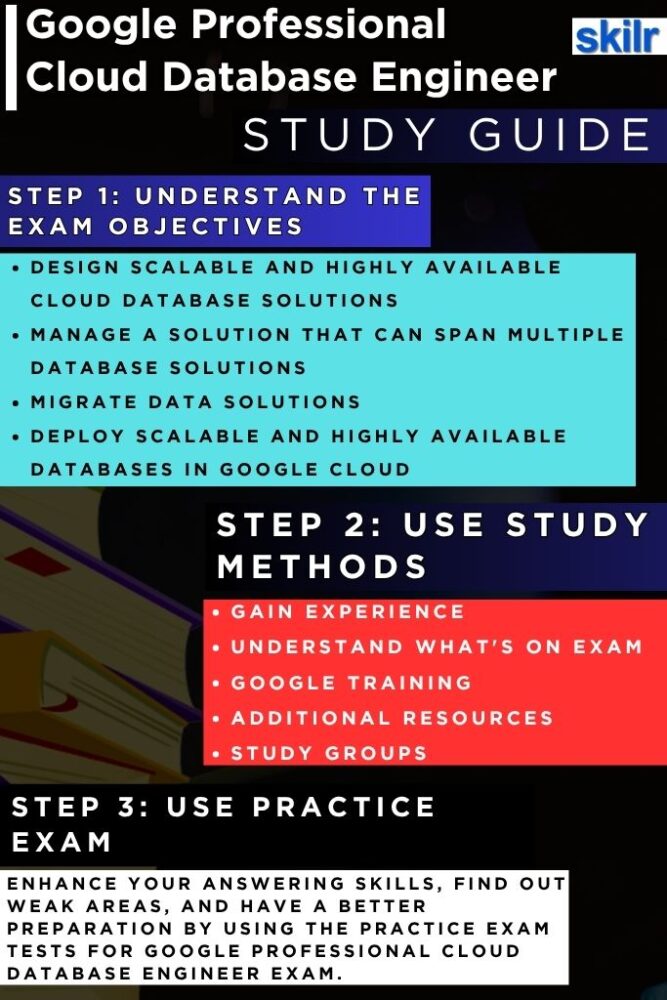
Step 1: Gain Real-World Experience
The best foundation for success in the Google Professional Cloud Database Engineer exam is practical, hands-on experience. Work directly with Google Cloud services such as Cloud SQL, Cloud Spanner, Bigtable, and Firestore to understand how different databases function in real deployment scenarios. Try building, scaling, and troubleshooting databases used by real-world applications. Exposure to data migration, backup and recovery, and performance tuning will help you develop the applied knowledge required to handle the types of challenges tested in the exam.
Step 2: Understand the Exam Objectives
Before diving into study materials, it’s essential to have a clear understanding of what the exam actually measures. The exam focuses on assessing your ability to design scalable database solutions, manage hybrid or multi-database environments, and migrate on-premise data to Google Cloud. It also evaluates your understanding of security, availability, and performance optimization. Reviewing the official exam guide will help you identify core topics and allocate your study time effectively, ensuring you are well-prepared across all tested areas.
Step 3: Strengthen Your Knowledge Through Training
Google provides a range of training paths that align with the certification objectives. Start with foundational courses that explain how databases are designed and deployed on Google Cloud, then progress to advanced content covering migration planning, database security, and performance management. Hands-on labs through Google Cloud Skills Boost allow you to apply your learning in practical settings. This mix of structured theory and interactive practice helps you build a strong command of both conceptual understanding and real implementation. For better understanding, Google provides learning path which includes:
– Database Engineer Learning Path
This learning path offers a carefully curated set of on-demand courses, interactive labs, and skill badges designed to build practical, hands-on expertise with Google Cloud technologies essential for the Database Engineer role. Upon completing this path, you can continue advancing your cloud proficiency by exploring our extensive catalog of 700+ additional labs and courses to further enrich your professional development journey.
Step 4: Learn Collaboratively with Study Groups
Joining study groups or online communities can greatly enhance your preparation experience. Engaging with others pursuing the same certification allows you to share strategies, discuss difficult topics, and gain new insights from different perspectives. Study sessions also help maintain accountability and motivation throughout your preparation journey. Discussing real-world use cases with peers and professionals deepens your understanding of how database engineering concepts apply to actual business environments.
Step 5: Take Practice Tests and Evaluate Progress
Mock exams are a critical part of your preparation strategy. They familiarize you with the question patterns, difficulty levels, and time management required for the actual test. After completing each practice test, analyze your results carefully to identify weak areas that need more focus. Use this feedback to revisit documentation or perform targeted hands-on exercises. Consistent practice not only boosts confidence but also improves accuracy and speed during the real exam.
Step 6: Explore Additional Learning Resources
Beyond official courses, explore Google Cloud’s extensive documentation and solution guides to expand your understanding of key database services. Review Google Cloud database options to learn when to use Cloud SQL, Spanner, Bigtable, or Firestore for specific workloads. Study database modernization strategies to understand how legacy systems can be re-architected for cloud environments.
Additionally, go through database migration best practices and tools like Database Migration Service (DMS) to grasp the end-to-end process of securely and efficiently moving data to Google Cloud. These resources help you develop a holistic view of modern database engineering on Google Cloud—essential for both the exam and your professional growth.
