
The Google Professional Cloud DevOps Engineer certification validates your expertise in implementing efficient processes and practices that enhance software delivery and system reliability. As a certified professional, you’ll use Google Cloud–recommended methodologies and tools to streamline the entire system development lifecycle—from code deployment to operations—while maintaining the balance between delivery speed, reliability, and performance optimization.
– Role of a Professional Cloud DevOps Engineer
A Professional Cloud DevOps Engineer is responsible for:
- Designing and maintaining scalable, reliable, and efficient production systems.
- Managing automation across CI/CD pipelines and infrastructure.
- Applying Site Reliability Engineering (SRE) principles to ensure system stability.
- Implementing observability practices for monitoring and troubleshooting.
- Ensuring cost optimization and performance efficiency through FinOps practices.
They play a critical role in enabling continuous delivery, operational excellence, and business agility within cloud environments.
– Key Skills Measured in the Exam
The Professional Cloud DevOps Engineer exam assesses your ability to:
- Bootstrap and maintain a Google Cloud organization.
- Design and implement CI/CD pipelines for both applications and infrastructure.
- Apply SRE principles to ensure reliability and scalability.
- Implement observability and monitoring for proactive issue detection.
- Optimize performance and troubleshoot issues in cloud systems.
In addition, the exam also evaluates knowledge of:
- Data residency and compliance considerations.
- CI/CD pipelines for machine learning workloads.
- FinOps methodologies for cost-performance balance.
- Tasks related to new Google Cloud tools, such as Gemini Cloud Assist and Gemini Code Assist.
– Prerequisites
There are no formal prerequisites to take the exam.
– Recommended Experience
Google recommends that candidates have:
- 3+ years of industry experience, including
- 1+ year of experience designing and managing production systems on Google Cloud.
This background ensures familiarity with CI/CD workflows, cloud operations, monitoring, automation, and incident response best practices.
– Who Should Take This Exam
This certification is ideal for:
- DevOps Engineers seeking to validate their Google Cloud expertise.
- Site Reliability Engineers (SREs) aiming to expand their automation and observability skills.
- Cloud Engineers and System Administrators transitioning into DevOps roles.
- Software Engineers involved in deployment automation and performance optimization.
- IT Professionals responsible for maintaining reliable and cost-efficient cloud environments.
Exam Details
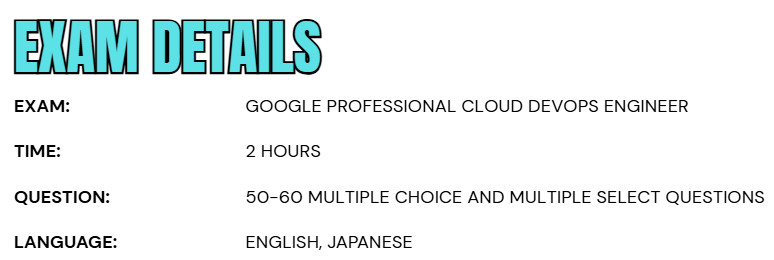
- The Google Professional Cloud DevOps Engineer exam is designed to evaluate your ability to implement DevOps practices using Google Cloud technologies.
- The exam has a duration of two hours and is available in English and Japanese.
- It consists of approximately 50–60 multiple-choice and multiple-select questions, assessing both theoretical understanding and practical application of DevOps concepts within Google Cloud environments.
- You can choose to take the exam through one of two delivery options: either as an online-proctored exam from a remote location or as an onsite-proctored exam at an authorized testing center. This flexibility allows candidates to select the format that best suits their convenience and testing environment preferences.
Course Outline
The exam covers the following topics:
Topic 1: : Understand bootstrapping and maintaining a Google Cloud organization (20%)
1.1 Designing the overall resource hierarchy for an organization. Considerations include:
- Organizing resources (e.g., application-centric, projects, folders) (Google Documentation: Creating and managing Folders)
- Shared networking (e.g., Shared VPC, VPC Network Peering, Private Service Connect) (Google Documentation: Shared VPC)
- Multi-project monitoring and logging
- Identity and Access Management (IAM) roles and organization-level policies (Google Documentation: IAM overview)
- Creating and managing service accounts (Google Documentation: Create a service account)
- Data residency
1.2 Managing infrastructure. Considerations include:
- Infrastructure-as-code tooling and managed services (e.g., Infrastructure Manager,
- Cloud Foundation Toolkit, Config Connector, GitOps, Terraform, Helm) (Google Documentation: Config Connector overview, Infrastructure as Code on Google Cloud)
- Making infrastructure changes using Google-recommended practices and blueprints
- Automation with scripting (e.g., Python, Go)
1.3 Designing a CI/CD architecture stack in Google Cloud, hybrid, and multi-cloud environments. Considerations include:
- Continuous integration (CI) with Cloud Build (Google Documentation: Cloud Build, Cloud Build documentation)
- Continuous delivery (CD) with Cloud Deploy, including Kustomize and Skaffold (Google Documentation: Cloud Build documentation)
- Artifact Registry configuration
- Widely used third-party tooling (e.g., Git, Jenkins, Argo CD, Packer, kpt)
- Security of CI/CD tooling (Google Documentation: Building a secure CI/CD pipeline using Google Cloud built-in services)
1.4 Managing multiple environments (e.g., staging, production). Considerations include:
- Managing ephemeral environments
- Managing configuration and policy
- Managing Google Kubernetes Engine (GKE) clusters across an enterprise (e.g., fleets) (Google Documentation: Create a GKE cluster and deploy a workload using Terraform, Modern CI/CD with GKE: Build a CI/CD system)
- Safe and secure patching and upgrading practices
1.5 Enabling secure cloud development environments. Considerations include:
- Configuring and managing cloud development environments (e.g., Cloud Workstations, Cloud Shell)
- Bootstrapping environments with required tooling (e.g., custom images, IDE, Cloud SDK)
- Leveraging AI to assist with development and operations (e.g., Gemini Code Assist, Gemini Cloud Assist, Gemini CLI)
Topic 2: Learn about building and implementing CI/CD pipelines, including continuous testing, for application, infrastructure, and machine learning workloads (25%)
2.1 Designing pipelines. Considerations include:
- CI/CD of applications and infrastructure
- Artifact management with Artifact Registry (Google Documentation: Artifact Registry overview)
- Deployment to hybrid and multi-cloud environments (e.g., GKE) (Google Documentation: GKE Multi-Cloud documentation)
- CI/CD pipeline triggers (Google Documentation: Cloud Build triggers)
- Configuring deployment processes (e.g., approval flows) (Google Documentation: Setting up a CI/CD pipeline for your data-processing workflow)
2.2 Implementing and managing pipelines. Considerations include:
- Auditing and tracking deployments (e.g., Artifact Registry, Cloud Build, Cloud Deploy, Cloud Audit Logs) (Google Documentation: Artifact Registry audit logging, Cloud Audit Logs overview)
- Deployment strategies (e.g., canary, blue/green, rolling, traffic splitting, feature flags)
- and defining success metrics based on application or ML pipeline telemetry
- Troubleshooting and mitigating deployment issues (Google Documentation: Troubleshooting deployments)
2.3 Managing pipeline configuration and secrets. Considerations include:
- Key management (e.g., Cloud Key Management Service)
- Configuration and secret management (e.g., Secret Manager, Certificate Manager, Parameter Manager, Workload Identity Federation)
- Build versus runtime secret injection
2.4 Securing the deployment pipeline. Considerations include:
- Artifact Analysis and vulnerability scanning
- Software supply chain security (e.g., Binary Authorization, Supply-chain Levels for Software Artifacts [SLSA] framework)
- IAM policies based on environment
Section 3: Understand about applying site reliability engineering practices (18%)
3.1 Balancing change, velocity, and reliability of the service. Considerations include:
- Defining SLIs (e.g., availability, latency), SLOs, and SLAs (Google Documentation: Choose your service level indicators (SLIs), SRE fundamentals: SLIs, SLAs and SLOs)
- Error budgets (e.g., Cloud Service Mesh definitions) (Google Documentation: Concepts in service monitoring)
- Opportunity cost of risk and reliability (e.g., number of “nines”)

3.2 Managing service lifecycle. Considerations include:
- Service management (e.g., planning, deployment, maintenance, retirement)
- Capacity planning (e.g., quotas, limits, reservations, Dynamic Workload Scheduler) (Google Documentation: Quotas & limits)
- Autoscaling (e.g., managed instance groups, Cloud Run, GKE) (Google Documentation: Autoscaling groups of instances)
3.3 Mitigating incident impact on users. Considerations include:
- Draining/redirecting traffic (Google Documentation: Enable connection draining)
- Adding capacity (Google Documentation: Scale capacity)
- Rollback strategies
Topic 4: Learn about implementing observability practices and troubleshooting issues (25%)
4.1 Instrumenting and collecting telemetry. Considerations include:
- Collecting and importing logs (e.g., Ops Agent, OpenTelemetry, Cloud Audit Logs, VPC Flow Logs, Cloud Service Mesh)
- Optimizing logs (e.g., filtering, sampling, exclusions, cost management, source considerations)
- Collecting metrics (e.g., from applications, platforms, networking, Cloud Service Mesh, Google Cloud Managed Service for Prometheus, hybrid/multi-cloud environments)
- Creating synthetic monitors to proactively probe application endpoints and workflows
- Creating custom metrics, including log-based metrics
4.2 Managing and analyzing logs. Considerations include:
- Analyzing logs using the Logs Explorer and the Logging query language
- Exporting and retaining logs (e.g., routing to BigQuery, Pub/Sub, Cloud Storage)
- Handling sensitive data (e.g., using log processors to redact personally identifiable information [PII], protected health information [PHI])
- Using Gemini Cloud Assist for AI-powered log analysis
4.3 Managing metrics, dashboards, and alerts. Considerations include:
- Analyzing metrics using the Metrics Explorer
- Managing dashboards (e.g., creating, filtering, sharing, playbooks, PromQL)
- Configuring alerting and alerting policies (e.g., SLIs, SLOs, cost control)
- Integrating with third-party alerting tools (e.g., webhooks, PagerDuty, Rootly)
- Leveraging Gemini Cloud Assist for metrics interpretation
4.4 Capturing and analyzing distributed traces. Considerations include:
- Utilizing tracing frameworks (e.g., OpenTelemetry)
- Analyzing trace waterfalls and spans
- Correlating trace IDs with structured logs
- Employing Gemini Cloud Assist for trace analysis
4.5 Troubleshooting issues. Considerations include:
- Infrastructure issues
- CI/CD pipeline issues
- Application issues
- Observability issues
- Performance and latency issues
Topic 5: Understand about optimizing performance and cost (12%)
5.1 Collecting performance information in Google Cloud. Considerations include:
- Application performance monitoring
- Active Assist insights and recommendations
5.2 Implementing FinOps practices for optimizing resource utilization and costs. Considerations include:
- Observability costs
- Spot virtual machines (VMs)
- Optimizing resource usage for cost and efficiency
- Infrastructure cost planning (e.g., committed-use discounts, sustained-use discounts, network tiers)
- Leveraging Google Cloud recommenders (e.g., cost, security, performance, manageability, reliability)
- Optimizing individual workload costs (e.g., GKE, Cloud Run, Compute Engine)
Google Professional Cloud DevOps Engineer Exam FAQs
Exam Policies
Google Cloud maintains a set of standardized, transparent, and fair exam policies to ensure every candidate has an equitable and secure certification experience. These policies outline the procedures for how exams are conducted, evaluated, and upheld over time, thereby preserving the integrity, reliability, and global credibility of Google Cloud certifications.
– Recertification
To maintain an active Google Cloud certification, professionals are required to recertify every three years by retaking and passing the corresponding exam. This ensures that certified individuals remain up to date with evolving technologies, best practices, and platform enhancements. Candidates may initiate the recertification process up to 60 days before their certification expires, ensuring a seamless renewal process and uninterrupted credential validity.
– Exam Scoring
Google Cloud certification exams follow a pass/fail scoring system, which is designed to evaluate whether a candidate meets the established competency standards for their specific role. Numerical scores or detailed performance feedback are not disclosed, as the primary purpose of the exam is to confirm proficiency—not to rank candidates or compare their results.
This approach reinforces Google Cloud’s commitment to objective and consistent evaluation, ensuring that each certification reflects authentic knowledge, applied skill, and professional readiness rather than relative performance metrics.
Google Professional Cloud DevOps Engineer Exam Study Guide
Step 1: Gain Real-World Experience
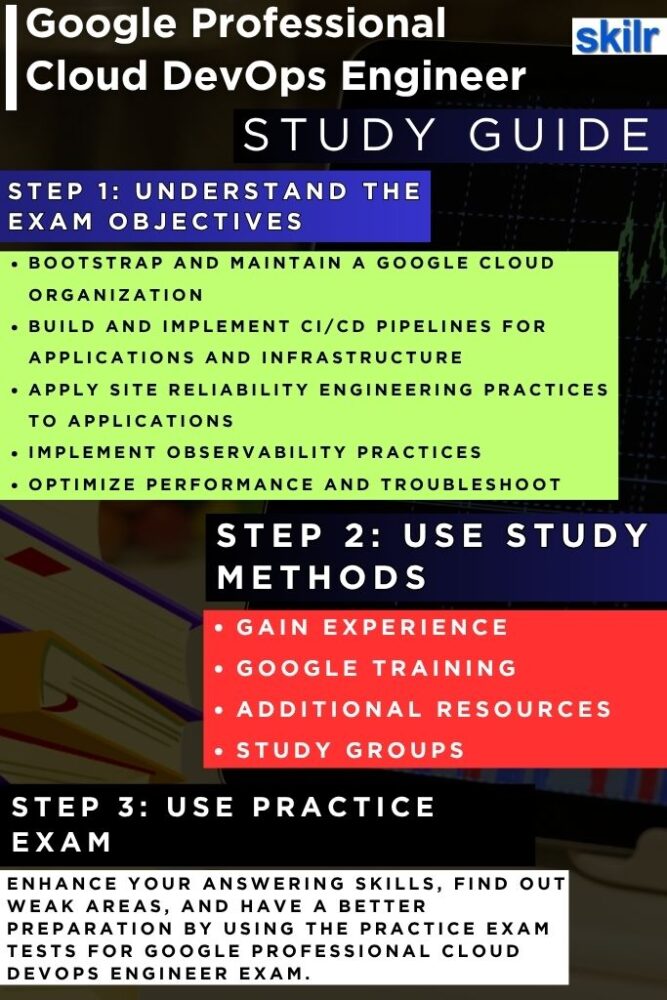
Begin your preparation by gaining substantial hands-on experience working with Google Cloud technologies. The Google Professional Cloud DevOps Engineer certification emphasizes practical application over theory, so focus on implementing real DevOps workflows in live or simulated environments. Work on automating infrastructure using tools such as Cloud Build, Cloud Deploy, and Terraform, and practice setting up continuous integration and delivery pipelines for both applications and infrastructure.
Experiment with monitoring and observability using Cloud Monitoring, Cloud Logging, and Error Reporting to understand how systems behave under real operational conditions. The more you work with deployment automation, scaling, fault recovery, and system optimization, the stronger your understanding of Google Cloud’s DevOps ecosystem will become.
Step 2: Understand the Exam Objectives
A critical step in effective preparation is developing a clear understanding of what the exam measures. The Professional Cloud DevOps Engineer exam evaluates how well you can design, implement, and maintain scalable and reliable systems on Google Cloud. It covers areas such as organization setup, CI/CD pipeline creation, application of site reliability engineering principles, implementation of observability practices, and system optimization for performance and cost.
It also includes topics like data residency considerations, CI/CD for machine learning workloads, and emerging practices such as FinOps for managing cloud costs efficiently. By familiarizing yourself with these objectives, you can focus your study plan on the skills and concepts that directly align with the exam’s competency framework.
Step 3: Expand Your Skills and Knowledge with Training
Once you understand what’s required, invest time in structured learning through Google Cloud’s official training courses, hands-on labs, and case studies. Explore interactive courses that teach key DevOps principles, such as infrastructure as code, automated deployments, service monitoring, and incident management.
Practical lab environments allow you to simulate real production challenges, such as rolling updates, automated rollbacks, and system scaling. Complement these with theoretical learning on topics like continuous delivery principles, security automation, and reliability design. This combination of structured study and applied practice ensures that your technical knowledge translates into job-ready skills that match Google’s standards. However, for better understanding Google offers official learning path for this exam which is:
– DevOps Engineer, SRE Learning Path
This learning path offers a carefully curated sequence of on-demand courses, interactive labs, and skill badges designed to build practical, hands-on expertise with Google Cloud technologies. It equips you with the technical proficiency and real-world experience required to perform effectively as a Google Cloud DevOps Engineer, helping you master the tools and methodologies essential for automating, deploying, monitoring, and optimizing cloud-based systems.
Step 4: Join Study Groups and Engage with the DevOps Community
Studying alongside others pursuing the same certification can significantly enhance your preparation. Joining study groups, online forums, or community-driven discussions helps you exchange knowledge, share troubleshooting experiences, and clarify complex concepts. Peer collaboration also exposes you to different problem-solving approaches and practical examples from real-world DevOps implementations. Engaging with communities such as Google Cloud’s Qwiklabs, Reddit’s DevOps discussions, or professional networks like LinkedIn groups provides valuable insights and continuous motivation. These collaborative experiences can deepen your understanding of Google Cloud DevOps concepts beyond the textbook level.
Step 5: Take Practice Tests and Evaluate Your Readiness
As your knowledge grows, begin testing your skills through mock exams and sample questions that mirror the actual exam structure. Practice tests help you evaluate not only your technical readiness but also your time management and analytical approach under exam pressure. After each test, analyze your results thoroughly to identify knowledge gaps or recurring weak areas. Revisiting those topics and refining your understanding ensures you enter the exam with both confidence and precision. Consistent practice under timed conditions strengthens your ability to interpret complex scenarios quickly and choose the most effective solutions.
Step 6: Explore Additional Resources for In-Depth Learning
Beyond formal study materials, enrich your preparation by exploring Google’s broader ecosystem of resources and industry frameworks. The DevOps Research and Assessment (DORA) reports provide evidence-based insights into high-performing DevOps practices and metrics, while Site Reliability Engineering (SRE) resources from Google delve into reliability, automation, and incident management.
Additionally, Google Cloud documentation offers comprehensive technical details about services, APIs, and architecture patterns, and Google Cloud solutions present real-world implementations of DevOps at scale. Integrating these resources into your study plan helps you move beyond exam preparation—developing a deeper, industry-aligned understanding of what makes DevOps successful on Google Cloud.
