

The Google Professional Data Engineer certification validates your expertise in designing, building, and managing scalable data infrastructure on Google Cloud. Certified professionals play a crucial role in enabling data-driven decision-making by collecting, transforming, storing, and delivering data efficiently across diverse business applications.
A Professional Data Engineer is responsible for building robust, high-performing, and secure data solutions while ensuring compliance with business and regulatory requirements. This role demands proficiency in data processing, enrichment, query generation, and optimization, as well as a deep understanding of data storage and pipeline orchestration within the Google Cloud ecosystem.
– What the Exam Assesses
The exam evaluates your ability to:
- Design data processing systems that are scalable, reliable, and secure.
- Ingest and process data efficiently from various sources.
- Store data using appropriate database and storage solutions.
- Prepare and utilize data for analysis and business insights.
- Maintain and automate data workloads for performance and cost optimization.
– Prerequisites
There are no formal prerequisites for this certification.
– Recommended Experience
Google recommends having:
- At least 3+ years of industry experience, including
- 1+ year of hands-on experience designing and managing data solutions using Google Cloud technologies such as BigQuery, Dataflow, Pub/Sub, and Dataproc.
– Who Should Take This Exam
This certification is ideal for:
- Data Engineers responsible for building and maintaining data infrastructure on Google Cloud.
- Data Analysts and Data Scientists who want to deepen their understanding of data pipelines and processing systems.
- Cloud Engineers and Solution Architects aiming to specialize in data management and analytics solutions.
- Professionals transitioning into cloud data engineering roles seeking to validate their Google Cloud expertise.
Exam Details
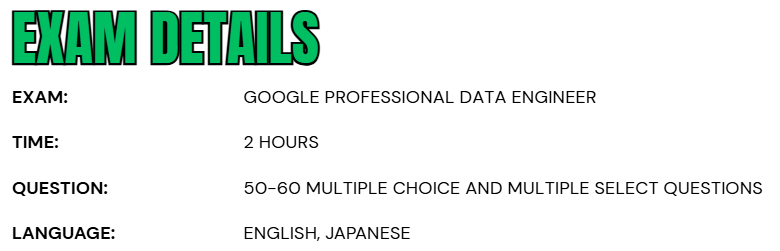
- The Google Professional Data Engineer Exam is a 2-hour certification assessment designed to validate your ability to design, build, and manage data processing systems on Google Cloud.
- The exam consists of 40 to 50 multiple-choice and multiple-select questions, evaluating both conceptual knowledge and practical application skills.
- Candidates can take the exam either through an online-proctored setup from a remote location or at an onsite-proctored testing center, ensuring flexibility in exam delivery.
- The certification is available in English and Japanese, catering to a global audience of professionals.
- Once earned, the Google Professional Data Engineer certification remains valid for two years, after which recertification is required to maintain active status.
Course Outline
The exam covers the following topics:
Section 1: Understand designing data processing systems (22%)
1.1 Designing for security and compliance. Considerations include:
- Identity and Access Management (e.g., Cloud IAM and organization policies) (Google Documentation: Identity and Access Management)
- Data security (encryption and key management) (Google Documentation: Default encryption at rest)
- Privacy (e.g., strategies to handle personally identifiable information)
- Regional considerations (data sovereignty) for data access and storage (Google Documentation: Implement data residency and sovereignty requirements)
- Legal and regulatory compliance
- Designing the project, dataset, and table architecture to ensure proper data governance
- Multi-environment use cases (development vs. production)
1.2 Designing for reliability and fidelity. Considerations include:
- Preparing and cleaning data (e.g., Dataprep, Dataflow, and Cloud Data Fusion, prompting LLMs for query generation) (Google Documentation: Cloud Data Fusion overview)
- Monitoring and orchestration of data pipelines (Google Documentation: Orchestrating your data workloads in Google Cloud)
- Disaster recovery and fault tolerance (Google Documentation: What is a Disaster Recovery Plan?)
- Making decisions related to ACID (atomicity, consistency, isolation, and durability) compliance and availability
- Data validation
1.3 Designing for flexibility and portability. Considerations include
- Mapping current and future business requirements to the architecture
- Designing for data and application portability (e.g., multi-cloud and data residency requirements) (Google Documentation: Implement data residency and sovereignty requirements, Multicloud database management: Architectures, use cases, and best practices)
- Data staging, cataloging, profiling, and discovery (data governance) (Google Documentation: Data Catalog overview)
1.4 Designing data migrations. Considerations include:
- Analyzing current stakeholder needs, users, processes, and technologies and creating a plan to get to desired state
- Planning migration to Google Cloud (e.g., BigQuery Data Transfer Service, Database Migration Service, Transfer Appliance, Google Cloud networking, Datastream) (Google Documentation: Migrate to Google Cloud: Transfer your large datasets, Database Migration Service)
Section 2: Learn About ingesting and processing the data (25%)
2.1 Planning the data pipelines. Considerations include:
- Defining data sources and sinks (Google Documentation: Sources and sinks)
- Defining data transformation and orchestration logic (Google Documentation: Introduction to data transformation)
- Networking fundamentals
- Data encryption (Google Documentation: Data encryption options)
2.2 Building the pipelines. Considerations include:
- Data cleansing
- Identifying the services (e.g., Dataflow, Apache Beam, Dataproc, Cloud Data Fusion, BigQuery, Pub/Sub, Apache Spark, Hadoop ecosystem, and Apache Kafka) (Google Documentation: Dataflow overview, Programming model for Apache Beam)
- Transformation:
- Batch (Google Documentation: Get started with Batch)
- Streaming (e.g., windowing, late arriving data)
- Processing logic
- AI data enrichment
- Data acquisition and import (Google Documentation: Exporting and Importing Entities)
- Integrating with new data sources (Google Documentation: Integrate your data sources with Data Catalog)
2.3 Deploying and operationalizing the pipelines. Considerations include:
- Job automation and orchestration (e.g., Cloud Composer and Workflows) (Google Documentation: Choose Workflows or Cloud Composer for service orchestration, Cloud Composer overview)
- CI/CD (Continuous Integration and Continuous Deployment)

Section 3: Understand about storing the data (20%)
3.1 Selecting storage systems. Considerations include:
- Analyzing data access patterns (Google Documentation: Data analytics and pipelines overview)
- Choosing managed services (e.g., BigQuery, BigLake, AlloyDB, Bigtable, Spanner, Cloud SQL, Cloud Storage, Firestore, Memorystore)
- Planning for storage costs and performance (Google Documentation: Optimize cost: Storage)
- Lifecycle management of data (Google Documentation: Options for controlling data lifecycles)
3.2 Planning for using a data warehouse. Considerations include:
- Designing the data model (Google Documentation: Data model)
- Deciding the degree of data normalization (Google Documentation: Normalization)
- Mapping business requirements
- Defining architecture to support data access patterns (Google Documentation: Data analytics design patterns)
3.3 Using a data lake. Considerations include
- Managing the lake (configuring data discovery, access, and cost controls) (Google Documentation: Manage a lake, Secure your lake)
- Processing data (Google Documentation: Data processing services)
- Monitoring the data lake (Google Documentation: What is a Data Lake?)
3.4 Designing for a data platform. Considerations include:
- Building a data platform based on requirements by using Google Cloud tools (e.g., Dataplex, Dataplex Catalog, BigQuery, Cloud Storage)
- Building a federated governance model for distributed data systems
Section 4: Understand about preparing and using data for analysis (15%)
4.1 Preparing data for visualization. Considerations include:
- Connecting to tools
- Precalculating fields (Google Documentation: Introduction to materialized views)
- BigQuery features for business intelligence (e.g., BI Engine, materialized views)
- Troubleshooting poor performing queries (Google Documentation: Diagnose issues)
- Security, data masking, Identity and Access Management (IAM), and Cloud Data Loss Prevention (Cloud DLP) (Google Documentation: IAM roles)
4.2 Preparing data for AI and ML. Considerations include:
- Preparing data for feature engineering, training and serving machine learning models (e.g., BigQueryML)
- Preparing unstructured data for embeddings and retrieval-augmented generation (RAG)
4.3 Sharing data. Considerations include:
- Defining rules to share data (Google Documentation: Secure data exchange with ingress and egress rules)
- Publishing datasets (Google Documentation: BigQuery public datasets)
- Publishing reports and visualizations
- BigQuery sharing (Analytics Hub) (Google Documentation: Introduction to Analytics Hub)
Section 5: Learn about maintaining and automating data workloads (18%)
5.1 Optimizing resources. Considerations include:
- Minimizing costs per required business need for data (Google Documentation: Migrate to Google Cloud: Minimize costs)
- Ensuring that enough resources are available for business-critical data processes (Google Documentation: Disaster recovery planning guide)
- Deciding between persistent or job-based data clusters (e.g., Dataproc) (Google Documentation: Dataproc overview)
5.2 Designing automation and repeatability. Considerations include:
- Creating directed acyclic graphs (DAGs) for Cloud Composer (Google Documentation: Write Airflow DAGs, Add and update DAGs)
- Scheduling and orchestrating jobs in a repeatable way
5.3 Organizing workloads based on business requirements. Considerations include:
- Capacity management (e.g., BigQuery Editions and reservations)
- Interactive or batch query jobs (Google Documentation: Run a query)
5.4 Monitoring and troubleshooting processes. Considerations include:
- Observability of data processes (e.g., Cloud Monitoring, Cloud Logging, BigQuery admin panel) (Google Documentation: Observability in Google Cloud, Introduction to BigQuery monitoring)
- Monitoring planned usage
- Troubleshooting error messages, billing issues, and quotas (Google Documentation: Troubleshoot quota errors, Troubleshoot quota and limit errors)
- Manage workloads, such as jobs, queries, and compute capacity (reservations) (Google Documentation: Workload management using Reservations)
5.5 Maintaining awareness of failures and mitigating impact. Considerations include:
- Designing system for fault tolerance and managing restarts (Google Documentation: Designing resilient systems)
- Running jobs in multiple regions or zones (Google Documentation: Serve traffic from multiple regions, Regions and zones)
- Preparing for data corruption and missing data (Google Documentation: Verifying end-to-end data integrity)
- Data replication and failover (e.g., Cloud SQL, Redis clusters) (Google Documentation: High availability and replicas)
Google Professional Data Engineer Exam FAQs

Exam Policies
Google Cloud maintains a set of standardized, transparent, and fair policies to ensure every candidate enjoys a consistent and secure certification experience. These policies govern how exams are conducted, evaluated, and maintained, upholding the integrity, reliability, and credibility of Google Cloud certifications across the industry.
– Recertification
To maintain an active Google Cloud certification, professionals are required to recertify every three years by successfully retaking the relevant exam. This ensures that certified individuals remain up to date with current technologies, evolving best practices, and platform innovations.
Candidates may begin the recertification process up to 60 days before their certification expires, providing ample time to renew without interruption. Google Cloud offers two renewal options: candidates can choose to take either the shorter renewal exam or the standard full exam during this period. Once a candidate selects a path—renewal or standard—they must continue with that choice until they pass or their certification expires.
– Exam Scoring
Google Cloud certification exams follow a pass/fail scoring system, designed to assess whether candidates meet the established competency benchmarks for the specific role. Numerical scores or detailed performance feedback are not disclosed, as the exam’s purpose is to validate proficiency rather than to compare individuals. This approach emphasizes objective evaluation and fairness, ensuring that certification results accurately reflect a candidate’s true understanding and professional capability in real-world Google Cloud environments.
Google Professional Data Engineer Exam Study Guide
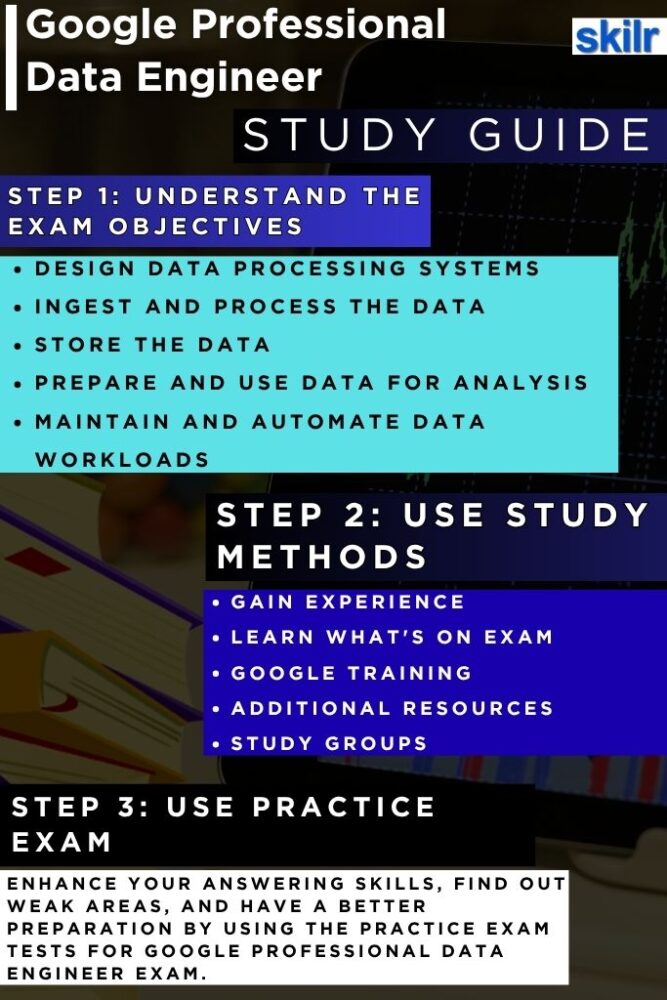
1. Gain Real-World Experience on Google Cloud
Before attempting the Google Professional Data Engineer exam, it’s essential to develop hands-on experience with real-world data solutions. Begin by working on practical projects that simulate enterprise-level workloads—such as building ETL pipelines, real-time streaming systems, or analytics dashboards. Focus on creating end-to-end data workflows using Google Cloud services like Pub/Sub, Dataflow, Dataproc, BigQuery, and Cloud Storage. Experiment with various ingestion, transformation, and storage patterns, and pay attention to performance, scalability, and cost optimization.
Additionally, implement IAM best practices and monitoring through Cloud Logging and Cloud Monitoring to ensure your solutions are both secure and observable. Real-world exposure not only deepens your technical knowledge but also enhances your ability to evaluate trade-offs—an essential skill tested in the exam.
2. Understand the Exam Objectives Thoroughly
The first structured step in your preparation is to familiarize yourself with the official exam objectives outlined in the Google Cloud Exam Guide. These objectives form the foundation of your study roadmap. The exam measures your ability to design data processing systems, ingest and process data, store and prepare data for analysis, and maintain and automate data workloads. Each domain aligns with practical tasks a professional data engineer performs daily.
Create a personal study matrix or checklist where you can track your proficiency in each objective. As you study, identify your weaker areas—whether it’s streaming analytics, data governance, or machine learning integration—and allocate extra time to strengthen those skills. Understanding the scope of the exam ensures that your study time is efficient, focused, and aligned with Google’s evaluation standards.
3. Expand Your Knowledge Through Training and Courses
Google Cloud provides comprehensive training paths and hands-on labs that are invaluable for structured learning. Start with the official Google Cloud Professional Data Engineer Learning Path, which includes video lectures, skill badges, and labs on data engineering fundamentals. Engage deeply with concepts like data pipeline design, batch and streaming architectures, machine learning integration, and data governance. Platforms such as Qwiklabs and Google Cloud Skills Boost offer scenario-based labs where you can practice implementing data pipelines, configuring IAM policies, and managing datasets in BigQuery.
Alongside official training, consider supplementing your preparation with whitepapers, case studies, and architecture blogs that discuss real-world use cases. The more you expose yourself to Google’s recommended best practices, the more confident and exam-ready you’ll become. This also cover a learning path which is:
– Data Engineer Learning Path
This comprehensive program is designed to equip you with the essential skills and practical knowledge required to advance your career and prepare for the Google Cloud Professional Data Engineer Certification, an industry-recognized credential administered by Google Cloud.
Throughout this program, you will gain a deep understanding of the core principles and real-world applications of Big Data and Machine Learning within the Google Cloud ecosystem. You will learn to utilize BigQuery for interactive data analysis, leverage Cloud SQL and Dataproc to migrate existing MySQL and Hadoop/Pig/Spark/Hive workloads to Google Cloud, and distinguish between the various data processing solutions available on the platform.
By combining theoretical concepts with hands-on experience, this program enables you to apply your learning in real-world scenarios using Google Cloud’s advanced tools — including Dataflow, TensorFlow, and real-time data processing services — to develop scalable, data-driven solutions.
4. Collaborate, Discuss, and Learn in Study Groups
Joining or forming a study group can dramatically enhance your understanding of complex topics. Collaborating with peers allows you to exchange ideas, clarify doubts, and gain different perspectives on Google Cloud services and design decisions. Conduct group discussions around case studies or architecture diagrams, and practice explaining solutions in a structured, concise manner—this mirrors the decision-making reasoning you’ll need for the exam.
Some study groups simulate mock exams or whiteboard sessions, where participants take turns answering scenario-based questions or designing system architectures collaboratively. Sharing notes, best practices, and even common mistakes from labs helps reinforce learning and improves recall. Collective learning fosters accountability and boosts your confidence for exam day.
5. Test Your Readiness with Practice Exams
Once you’ve built a solid foundation, begin taking practice tests to measure your readiness. Practice exams simulate the real testing environment, both in timing and complexity. They help you understand question phrasing, identify knowledge gaps, and improve time management. After each test, analyze your incorrect answers carefully—trace them back to specific exam objectives and revisit those topics in documentation or labs.
Remember that the real exam includes both multiple-choice and multiple-select questions, where more than one option may be correct. Therefore, focus on understanding why certain options are right and why others are not. Practicing under timed conditions also trains you to maintain composure and make efficient decisions under pressure, ensuring a smoother performance on exam day.
6. Utilize Additional Resources and Review the Official Guide
To reinforce your preparation, make extensive use of Google Cloud’s official documentation and architecture guides. The documentation provides in-depth technical insights into services like BigQuery, Dataflow, Pub/Sub, and Dataproc—covering configurations, limitations, and best practices. Review the Google Cloud Solutions Library, which offers real-world design patterns and use cases across industries. These examples help you understand how to align technical solutions with business and regulatory requirements, a critical aspect of the exam.
Finally, carefully go through the official guide which outlines key topics, sample questions, and exam expectations. This guide serves as your final reference point before scheduling the exam. Combining documentation, architectural best practices, and guided preparation ensures a holistic understanding of Google Cloud data engineering principles.
