



The Google Professional Machine Learning Engineer certification validates your expertise in designing, building, and operationalizing scalable AI and ML solutions using Google Cloud technologies. It assesses your ability to apply both traditional machine learning and generative AI techniques to solve real-world business challenges efficiently and responsibly.
– Role of a Professional Machine Learning Engineer
A Professional Machine Learning Engineer is responsible for developing, evaluating, deploying, and optimizing AI-driven solutions using Google Cloud’s advanced tools and services. This role requires the ability to handle large, complex datasets, design reusable and scalable ML pipelines, and apply responsible AI practices throughout the project lifecycle. Key areas of expertise include:
- Building and operationalizing generative AI solutions based on foundational models.
- Designing repeatable and automated pipelines for data preparation and model deployment.
- Implementing MLOps best practices to manage and monitor models in production.
- Collaborating across teams to ensure sustainable and compliant AI systems.
Professionals in this role must have strong programming skills, particularly in Python and SQL, and familiarity with data engineering, infrastructure management, and application development on Google Cloud.
– Exam Coverage and Focus Areas
The Professional Machine Learning Engineer Exam evaluates your ability to design and operationalize ML systems across multiple domains, including generative AI. It emphasizes practical, end-to-end problem-solving and requires a solid grasp of Google Cloud’s AI ecosystem.
You will be tested on your ability to:
- Architect low-code AI solutions using Google Cloud tools like Vertex AI and Model Garden.
- Collaborate across teams to manage datasets, features, and ML models.
- Transform prototypes into scalable ML models suitable for production.
- Deploy and serve models while maintaining performance and reliability.
- Automate ML pipelines using orchestration and monitoring tools.
- Evaluate and optimize generative AI solutions effectively.
Note: The exam does not directly test coding skills, but candidates should be comfortable interpreting Python and SQL code snippets.
– Who Should Take This Exam
This certification is ideal for professionals who:
- Work in data science, machine learning, or AI engineering roles.
- Have experience with Google Cloud services and want to validate their expertise.
- Aim to transition into machine learning architecture or AI operations roles.
- Are involved in building or managing ML pipelines, models, or generative AI applications.
- Seek to enhance their credibility in designing scalable and responsible AI solutions.
– Prerequisites and Recommended Experience
- Prerequisites: None.
- Recommended Experience: At least 3+ years of industry experience, including 1 or more years designing and managing ML or AI solutions using Google Cloud technologies.
Exam Details

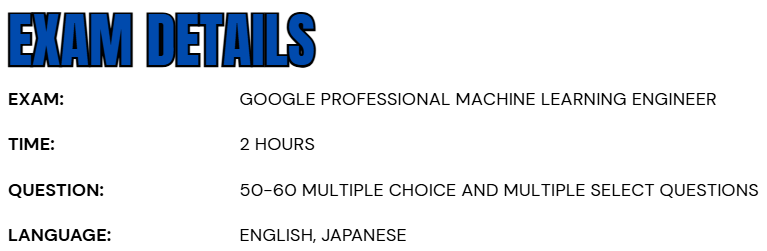
- The Google Professional Machine Learning Engineer Exam is a two-hour assessment designed to evaluate your ability to design, build, and manage machine learning and AI solutions using Google Cloud technologies.
- The exam consists of approximately 50 to 60 multiple-choice and multiple-select questions, testing both conceptual understanding and practical application of ML principles.
- Candidates can choose between two delivery options based on their convenience. You may take the exam online through a remote, proctored environment after reviewing the specific system and testing requirements, or opt for an in-person exam at an authorized testing center near your location.
- Currently, the exam is available in English and Japanese, allowing candidates to select the preferred language for their test experience.
Course Outline
The exam covers the following topics:
Section 1: Architecting low-code ML solutions (13%)
1.1 Developing ML models by using BigQuery ML. Considerations include:
- Building the appropriate BigQuery ML model (e.g., linear and binary classification, regression, time-series, matrix factorization, boosted trees, autoencoders) based on the business problem (Google Documentation: BigQuery ML model evaluation overview)
- Feature engineering or selection by using BigQuery ML (Google Documentation: Perform feature engineering with the TRANSFORM clause)
- Generating predictions by using BigQuery ML (Google Documentation: Use BigQuery ML to predict penguin weight)
1.2 Building AI solutions by using ML APIs or foundational models. Considerations include:
- Building applications by using ML APIs from Model Garden (Google Documentation: Integrating machine learning APIs)
- Building applications by using industry-specific APIs (e.g., Document AI API, Retail API) (Google Documentation: Document AI)
- Implementing retrieval augmented generation (RAG) applications by using Vertex AI Agent Builder
1.3 Training models by using AutoML. Considerations include:
- Preparing data for AutoML (e.g., feature selection, data labeling, Tabular Workflows on AutoML) (Google Documentation: Tabular Workflow for End-to-End AutoML)
- Using available data (e.g., tabular, text, speech, images, videos) to train custom models (Google Documentation: Introduction to Vertex AI)
- Using AutoML for tabular data (Google Documentation: Create a dataset and train an AutoML classification model)
- Creating forecasting models using AutoML (Google Documentation: Forecasting with AutoML)
- Configuring and debugging trained models (Google Documentation: Monitor and debug training with an interactive shell)
Section 2: Collaborating within and across teams to manage data and models (14%)
2.1 Exploring and preprocessing organization-wide data (e.g., Cloud Storage, BigQuery, Cloud Spanner, Cloud SQL, Apache Spark, Apache Hadoop). Considerations include:
- Organizing different types of data (e.g., tabular, text, speech, images, videos) for efficient training (Google Documentation: Best practices for creating tabular training data)
- Managing datasets in Vertex AI (Google Documentation: Use managed datasets)
- Data preprocessing (e.g., Dataflow, TensorFlow Extended [TFX], BigQuery)
- Creating and consolidating features in Vertex AI Feature Store (Google Documentation: Introduction to feature management in Vertex AI)
- Privacy implications of data usage and/or collection (e.g., handling sensitive data such as personally identifiable information [PII] and protected health information [PHI]) (Google Documentation: De-identifying sensitive data)
- Ingesting different data sources (e.g., text documents) into Vertex AI for inference
2.2 Model prototyping using Jupyter notebooks. Considerations include:
- Choosing the appropriate Jupyter backend on Google Cloud (e.g., Vertex AI Workbench, Colab Enterprise, notebooks on Dataproc) (Google Documentation: Create a Dataproc-enabled instance)
- Applying security best practices in Vertex AI Workbench (Google Documentation: Vertex AI access control with IAM)
- Using Spark kernels
- Integration code source repositories (Google Documentation: Cloud Source Repositories)
- Developing models in Vertex AI Workbench by using common frameworks (e.g., TensorFlow, PyTorch, sklearn, Spark, JAX) (Google Documentation: Introduction to Vertex AI Workbench)
- Leveraging a variety of foundational and open-source models in Model Garden
2.3 Tracking and running ML experiments. Considerations include:
- Choosing the appropriate Google Cloud environment for development and experimentation (e.g., Vertex AI Experiments, Kubeflow Pipelines, Vertex AI TensorBoard with TensorFlow and PyTorch) given the framework (Google Documentation: Introduction to Vertex AI Pipelines, Best practices for implementing machine learning on Google Cloud)
- Evaluating generative AI solutions
Section 3: Scaling prototypes into ML models (18%)
3.1 Building models. Considerations include:
- Choosing ML framework and model architecture (Google Documentation: Best practices for implementing machine learning on Google Cloud)
- Modeling techniques given interpretability requirements (Google Documentation: Introduction to Vertex Explainable AI)
3.2 Training models. Considerations include:
- Organizing training data (e.g., tabular, text, speech, images, videos) on Google Cloud (e.g., Cloud Storage, BigQuery)
- Ingestion of various file types (e.g., CSV, JSON, images, Hadoop, databases) into training (Google Documentation: How to ingest data into BigQuery so you can analyze it)
- Training using different SDKs (e.g., Vertex AI custom training, Kubeflow on Google Kubernetes Engine, AutoML, tabular workflows) (Google Documentation: Custom training overview)
- Using distributed training to organize reliable pipelines (Google Documentation: Distributed training)
- Hyperparameter tuning (Google Documentation: Overview of hyperparameter tuning)
- Troubleshooting ML model training failures (Google Documentation: Troubleshooting Vertex AI)
- Fine-tuning foundational models (e.g., Vertex AI, Model Garden)
3.3 Choosing appropriate hardware for training. Considerations include:
- Evaluation of compute and accelerator options (e.g., CPU, GPU, TPU, edge devices) (Google Documentation: Introduction to Cloud TPU)
- Distributed training with TPUs and GPUs (e.g., Reduction Server on Vertex AI, Horovod) (Google Documentation: Distributed training)
Section 4: Serving and scaling models (20%)
4.1 Serving models. Considerations include:
- Batch and online inference (e.g., Vertex AI, Dataflow, BigQuery ML, Dataproc) (Google Documentation: Batch prediction components)
- Using different frameworks (e.g., PyTorch, XGBoost) to serve models (Google Documentation: Export model artifacts for prediction and explanation)
- Organizing a model registry (Google Documentation: Introduction to Vertex AI Model Registry)
- A/B testing different versions of a model
4.2 Scaling online model serving. Considerations include:
- Vertex AI Feature Store (Google Documentation: Introduction to feature management in Vertex AI)
- Vertex AI public and private endpoints (Google Documentation: Use private endpoints for online prediction)
- Choosing appropriate hardware (e.g., CPU, GPU, TPU, edge) (Google Documentation: Introduction to Cloud TPU)
- Scaling the serving backend based on the throughput (e.g., Vertex AI Prediction, containerized serving) (Google Documentation: Serving Predictions with NVIDIA Triton)
- Tuning ML models for training and serving in production (e.g., simplification techniques, optimizing the ML solution for increased performance, latency, memory, throughput) (Google Documentation: Best practices for implementing machine learning on Google Cloud)


Section 5: Automating and orchestrating ML pipelines (22%)
5.1 Developing end-to-end ML pipelines. Considerations include:
- Data and model validation (Google Documentation: Data validation errors)
- Ensuring consistent data pre-processing between training and serving (Google Documentation: Pre-processing for TensorFlow pipelines with tf.Transform on Google Cloud)
- Hosting third-party pipelines on Google Cloud (e.g., MLFlow) (Google Documentation: MLOps: Continuous delivery and automation pipelines in machine learning)
- Identifying components, parameters, triggers, and compute needs (e.g., Cloud Build, Cloud Run) (Google Documentation: Deploying to Cloud Run using Cloud Build)
- Orchestration framework (e.g., Kubeflow Pipelines, Vertex AI Pipelines, Cloud Composer) (Google Documentation: Introduction to Vertex AI Pipelines)
- Hybrid or multicloud strategies (Google Documentation: Build hybrid and multicloud architectures using Google Cloud)
- System design with TFX components or Kubeflow DSL (e.g., Dataflow) (Google Documentation: Architecture for MLOps using TensorFlow Extended, Vertex AI Pipelines, and Cloud Build)
5.2 Automating model retraining. Considerations include:
- Determining an appropriate retraining policy
- Continuous integration and continuous delivery (CI/CD) model deployment (e.g., Cloud Build, Jenkins) (Google Documentation: MLOps: Continuous delivery and automation pipelines in machine learning)
5.3 Tracking and auditing metadata. Considerations include:
- Tracking and comparing model artifacts and versions (e.g., Vertex AI Experiments, Vertex ML Metadata) (Google Documentation: Track Vertex ML Metadata, Introduction to Vertex AI Experiments)
- Hooking into model and dataset versioning (Google Documentation: Model versioning with Model Registry)
- Model and data lineage (Google Documentation: Use data lineage with Google Cloud systems)
Section 6: Monitoring ML solutions (13%)
6.1 Identifying risks to ML solutions. Considerations include:
- Building secure ML systems (e.g., protecting against unintentional exploitation of data or models (e.g., hacking)
- Aligning with Google’s Responsible AI practices (e.g., monitoring for bias) (Google Documentation: Responsible AI, Understand and configure Responsible AI for Imagen)
- Assessing AI solution readiness (e.g., fairness, bias)
- Model explainability on Vertex AI (e.g., Vertex AI Prediction) (Google Documentation: Introduction to Vertex Explainable AI)
6.2 Monitoring, testing, and troubleshooting ML solutions. Considerations include:
- Establishing continuous evaluation metrics (e.g., Vertex AI Model Monitoring, Explainable AI) (Google Documentation: Introduction to Vertex AI Model Monitoring, Model evaluation in Vertex AI)
- Monitoring for training-serving skew (Google Documentation: Monitor feature skew and drift)
- Monitoring for feature attribution drift (Google Documentation: Monitor feature attribution skew and drift)
- Monitoring model performance against baselines, simpler models, and across the time dimension
- Monitoring for common training and serving errors
Google Professional Machine Learning Engineer Exam FAQs

Exam Policies
Google Cloud maintains a set of transparent, standardized, and globally consistent exam policies to ensure fairness, security, and credibility across all its certification programs. These policies define how each exam is administered, evaluated, and managed, safeguarding the integrity and global trustworthiness of Google Cloud certifications.
– Recertification
To ensure certified professionals remain current with the evolving Google Cloud ecosystem, recertification is required every three years. This process involves retaking and passing the same certification exam to reaffirm one’s knowledge of the latest technologies, best practices, and platform updates. Candidates may start their recertification up to 60 days before the existing credential expires, ensuring a seamless renewal process and uninterrupted certification status.
– Exam Scoring
Google Cloud exams follow a pass/fail evaluation model designed to confirm whether candidates meet the defined competency standards for their specific role. The scoring system is structured to assess overall proficiency rather than rank performance. Therefore, numerical scores and detailed feedback are not provided. This objective and uniform approach guarantees that every Google Cloud certification accurately represents a professional’s practical expertise and job readiness.
Google Professional Machine Learning Engineer Exam Study Guide

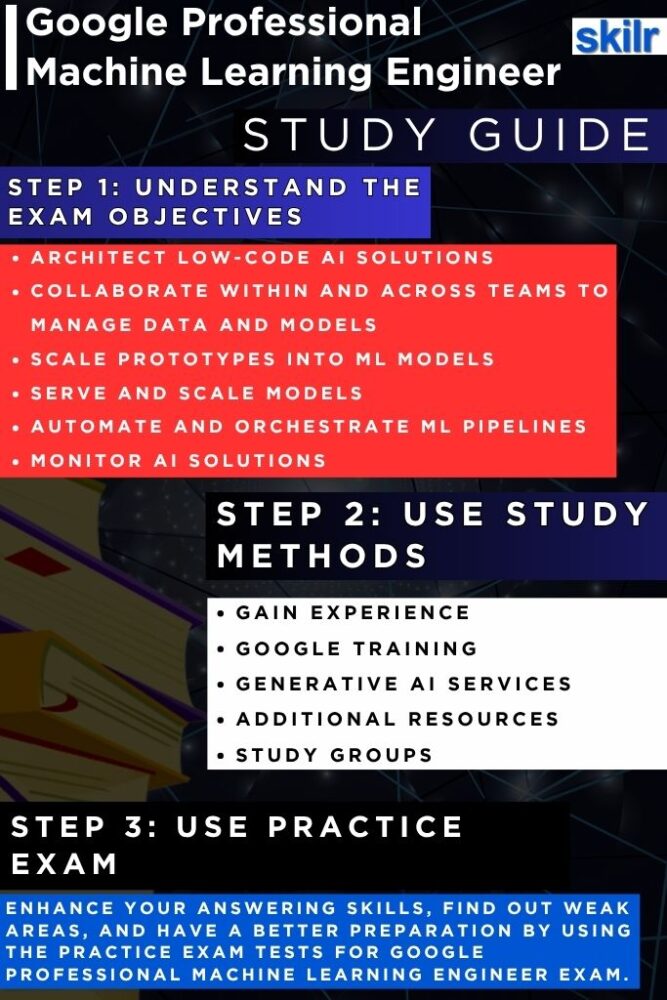
1. Gain Real-World Experience
Before attempting the certification, build hands-on experience by working on real-world ML projects that involve designing, deploying, and managing end-to-end machine learning pipelines. Focus on using Google Cloud tools such as Vertex AI, BigQuery ML, and TensorFlow to develop models and operationalize AI solutions. Practical exposure to data preprocessing, feature engineering, model tuning, and deployment workflows will give you the applied skills necessary to tackle exam scenarios confidently.
2. Understand the Exam Objectives
Start by reviewing the official exam guide to understand the domains, objectives, and skills tested. The exam assesses your ability to architect and implement scalable ML solutions, apply responsible AI principles, and manage generative AI models on Google Cloud. Pay close attention to the key competency areas, including data preparation, feature engineering, model training, pipeline automation, and model monitoring. Familiarity with these topics ensures a targeted and efficient preparation plan.
3. Expand Your Skills with Structured Training
Google Cloud offers a range of official training courses designed to help candidates develop the technical depth required for the exam. Enroll in specialized learning paths for machine learning engineering, generative AI, and data pipelines. These programs emphasize practical implementation through labs and exercises, helping you understand how to integrate and optimize AI workflows in a production environment using Google Cloud services. The training paths include:
– Machine Learning Engineer Training Path
This learning path offers a carefully curated selection of on-demand courses, interactive labs, and skill badges designed to help you gain practical, hands-on experience with Google Cloud technologies essential for the Machine Learning Engineer role. By completing this path, you’ll build the foundational expertise needed to design and implement scalable AI solutions. Once finished, you can advance your career by pursuing the Google Cloud Professional Machine Learning Engineer certification, marking the next step in your professional development journey.
– Introduction to Generative AI
This learning path offers a comprehensive introduction to generative AI, covering core concepts such as the fundamentals of large language models (LLMs) and the principles of responsible AI. It is designed to help you understand how generative AI technologies function, their real-world applications, and the ethical considerations essential for developing and deploying AI responsibly.
– Generative AI for Developers
This Generative AI learning path is designed with a technical focus for application developers, machine learning engineers, and data scientists seeking to deepen their expertise in AI-driven development. It builds upon foundational knowledge and emphasizes practical implementation of generative AI technologies. Completing the Introduction to Generative AI learning path is highly recommended before starting this advanced track.
4. Learn Google Cloud’s Generative AI Services
A significant portion of the exam includes generative AI topics. Strengthen your understanding of Google Cloud’s Vertex AI platform and generative AI tools, including:
- Model Garden – for exploring and evaluating pre-trained foundation models.
- Vertex AI Agent Builder (Partners) – to design conversational agents and integrate AI solutions into applications.
- Vertex AI Search Integration – for embedding search capabilities within AI-powered applications.
These services demonstrate how generative AI can be applied responsibly and efficiently to real-world business scenarios.
5. Collaborate and Learn in Study Groups
Join Google Cloud study groups or online communities where professionals share insights, discuss use cases, and exchange exam preparation tips. Engaging in collaborative discussions helps reinforce concepts, exposes you to different problem-solving approaches, and clarifies doubts that may arise during self-study. Peer-based learning also helps you stay motivated and consistent throughout your preparation journey.
6. Take Practice Tests and Mock Exams
Once you’ve covered the core topics, evaluate your readiness through practice exams and sample questions. These tests simulate the real exam environment, helping you manage time effectively and identify areas that need more focus. Analyze your results thoroughly to refine your understanding of ML concepts, Google Cloud tools, and generative AI implementation.
7. Deepen Knowledge with Official Study Resources
For comprehensive learning, use the Official Google Cloud Certified Professional Machine Learning Engineer Study Guide. This resource offers real-world case studies and practical examples demonstrating how to design, train, deploy, and operationalize secure ML applications using tools like Vertex AI, TensorFlow, Kubeflow, and AutoML. It also guides you in choosing between pre-trained and custom models, understanding trade-offs, and applying best practices for performance and scalability. Additionally, explore Google Cloud documentation for deeper insights into key services, architectures, and implementation strategies relevant to the exam.
