
The Salesforce Certified Agentforce Specialist exam is tailored for professionals responsible for managing and implementing Agentforce solutions within their organizations. This certification validates a candidate’s ability to design, build, and manage AI agents using Salesforce’s Agentforce platform, ensuring these agents deliver intelligent, personalized, and context-aware interactions.
Earning this certification demonstrates that you can effectively leverage AI agent capabilities to streamline workflows, enhance customer engagement, and drive business outcomes through intelligent automation.
– Key Skills Validated
Certified Agentforce Specialists exhibit deep proficiency in:
- Building and customizing AI agents using standard and custom topics, as well as agent actions.
- Prompt engineering — creating, managing, and grounding prompts for optimal AI responses using Prompt Builder.
- Data integration — utilizing the Agentforce Data Library and Data Cloud retrievers to ground AI responses with structured and unstructured data.
- Lifecycle management — testing and deploying agents via the Agentforce Testing Center, and managing production rollouts.
- Security and monitoring — overseeing adoption, ensuring compliance, and maintaining secure user experiences.
- Interoperability — understanding Model Context Protocol (MCP), agent-to-agent communication, and Agent API usage for advanced integrations.
– Who Should Take the Exam
This certification is ideal for:
- Salesforce professionals who design, configure, or manage AI-driven automation.
- Business analysts and solution architects looking to translate business challenges into Agentforce-based solutions.
- Administrators and AI specialists responsible for maintaining intelligent agents within Salesforce environments.
- Technical consultants and implementation partners seeking to validate their ability to deploy scalable, intelligent agent solutions for clients.
– Core Competencies Covered
Successful candidates will demonstrate their ability to:
- Engage with stakeholders to identify AI opportunities and use cases for Agentforce.
- Design intelligent, context-aware agents aligned with specific business processes.
- Use grounding techniques to improve response accuracy and relevancy.
- Manage testing, deployment, and monitoring of agents across environments.
- Integrate AI agents with Salesforce tools and external systems to ensure seamless interoperability.
– Knowledge Areas Not Required
Candidates are not expected to:
- Configure or fine-tune large language models (LLMs).
- Possess advanced programming skills in Apex or Python.
- Have deep expertise in external AI platforms or transformer architectures.
- Conduct ROI calculations or white space analyses.
- Have experience with Salesforce clouds such as Marketing Cloud, Heroku, MuleSoft, Tableau, Commerce Cloud, Slack, or Quip.
Exam Details
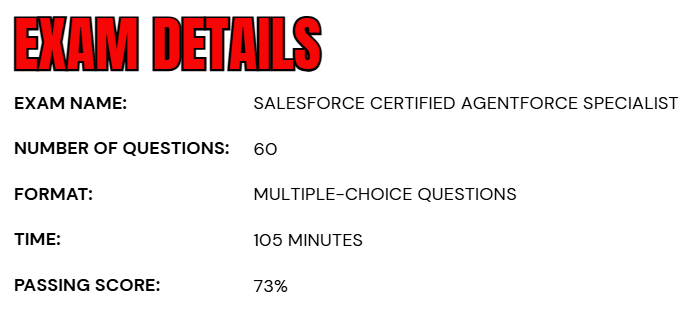
- The Salesforce Certified Agentforce Specialist exam consists of 60 multiple-choice questions, along with up to five unscored questions included for research and data collection purposes.
- These unscored questions are randomly distributed throughout the exam and do not affect the final score.
- Candidates are given a total of 105 minutes to complete the exam, which requires a minimum passing score of 73% to qualify for certification.
- The exam can be taken as a proctored assessment, either onsite at an authorized testing center or online through a secure virtual environment, offering flexibility to test-takers worldwide.
- During the exam, no hard-copy or digital reference materials are permitted, ensuring the evaluation is based solely on a candidate’s knowledge and practical understanding.
- There are no formal prerequisites to register for this certification, making it accessible to both new and experienced Salesforce professionals who wish to validate their skills in building and managing AI agents within the Agentforce ecosystem.
Course Outline
The Salesforce Certified Agentforce Specialist exam evaluates a candidate’s proficiency and practical understanding across the following key knowledge areas and objectives.
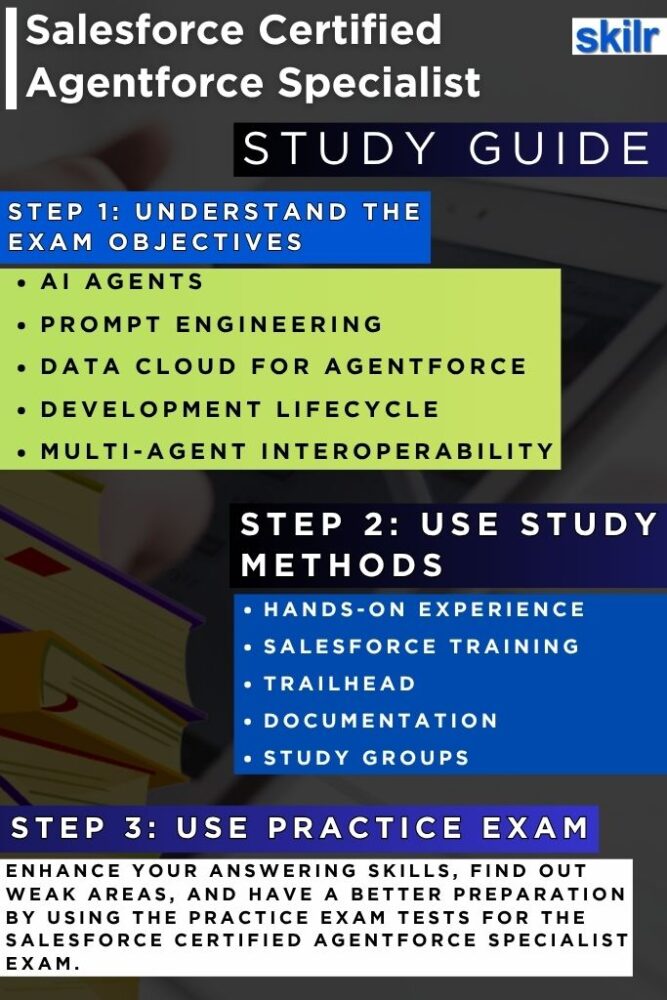
1. AI Agents: 35%
- Given a use case, manage deterministic behavior for the agent using filters and variables.
- Explaining how an agent works and how the reasoning engine powers Agentforce.
- Given a scenario, select and configure standard topics, custom topics, standard agent actions, and custom agent actions based on agent types.
- Explaining how to manage Agentforce security, including the concept of the Agent User and how it applies to an Employee Agent, Service Agent, or Sales Agent.
- Given a scenario, identify when to use an Employee agent, Service agent, or Sales agent.
- Explaining the process for connecting agents to various channels such as digital experience, email, and Slack.
2. Prompt Engineering: 20%
- Given business requirements, identify when it’s appropriate to use Prompt Builder.
- Identifying the right user roles to manage and execute prompt templates.
- Identifying the considerations for creating a prompt template using field generation and flex types.
- Given a scenario, identify the appropriate grounding technique.
- Explaining the process for creating, activating, and executing prompt templates.
- Explaining how to use best practices for writing effective prompts.
3. Data Cloud for Agentforce: 20%
- Explaining the considerations of Agentforce Data Library and its types.
- Given a scenario, improve an agent’s response with unstructured data using chunking and indexing.
- Identifying the considerations for retrievers in Data Cloud such as individual and ensemble.
- Given a scenario, identifying the considerations for search type such as keyword, vector, and hybrid.

4. Development Lifecycle: 20%
- Given a scenario, test an agent using Agentforce Testing Center.
- Identifying the considerations for deploying an agent from sandbox to production.
- Explaining the process for managing and monitoring agent adoption.
5. Multi-Agent Interoperability: 5%
- Explaining the purpose of Model Context Protocol (MCP) and its use cases.
- Explaining the purpose of agent to agent protocol.
- Given a scenario, identifying when it’s appropriate to use Agent API.
Salesforce Certified Agentforce Specialist Exam FAQs
Salesforce Exam Candidate Code of Conduct
All individuals pursuing a Salesforce certification are required to adhere to the Credential and Certification Program Agreement, which emphasizes fairness, transparency, and the integrity of the exam process. Candidates are encouraged to prepare using official Salesforce learning resources, participate actively in the Trailblazer Community, and conduct themselves with professionalism and honesty throughout their certification journey.
Any unethical or prohibited behavior—such as sharing confidential exam content, obtaining or providing unauthorized assistance, or violating Salesforce exam rules—is strictly forbidden. Violations can lead to serious consequences, including exam invalidation, credential suspension or revocation, and permanent disqualification from the Salesforce Certification Program. The credibility and value of Salesforce certifications rely on every candidate’s commitment to these standards.
Salesforce Exam Policy
The Salesforce Exam Policy outlines essential procedures for scheduling, rescheduling, canceling, and taking certification exams, whether online or at a physical testing center. Compliance with these policies ensures a fair and consistent experience for all candidates.
- Onsite (Testing Center) Exams:
- Candidates taking exams at a Pearson VUE testing center may reschedule or cancel their appointment up to 48 hours before the scheduled exam time through their Pearson VUE account. Requests made after this deadline are generally not accepted. Failure to appear for the exam without prior notice will result in a no-show status, and the full exam fee will be forfeited.
- Online Proctored Exams:
- For candidates taking a proctored online exam, rescheduling or cancellation is allowed up to 24 hours before the scheduled start time via Pearson VUE, without incurring additional fees. Requests made after this window may not be accommodated, and failure to comply with these rules could result in the loss of the exam fee.
Salesforce Certified Agentforce Specialist Exam Study Guide
Step 1: Gain Hands-On Experience
The foundation of preparing for the Salesforce Certified Agentforce Specialist exam is practical, hands-on experience. Working directly with Agentforce in real-world scenarios or sandbox environments allows candidates to understand how AI agents are configured, customized, and deployed across different business contexts. This practical exposure helps build a deep understanding of essential features such as creating and managing standard and custom topics, designing effective prompts, integrating data sources, and managing the agent lifecycle from development to deployment. By regularly engaging with these tools, candidates can develop the confidence and proficiency required to implement intelligent, context-aware AI agents effectively within an organization.
Step 2: Complete Salesforce Training Courses
Salesforce provides structured training courses that are specifically designed to align with the exam objectives for Agentforce. Completing these courses ensures candidates receive comprehensive guidance on both fundamental and advanced aspects of AI agent management. These courses cover practical scenarios, demonstrate best practices, and offer step-by-step instruction on topics like prompt engineering, grounding techniques, and data library integration. Structured training not only accelerates learning but also ensures candidates understand the rationale behind Agentforce features, enabling them to make informed decisions during the exam and in real-world implementation.
Step 3: Skill Up on Trailhead
Trailhead, Salesforce’s official learning platform, is an indispensable resource for exam preparation. By completing relevant modules on Agentforce, AI agents, and related functionalities, candidates can reinforce their knowledge through interactive exercises and guided challenges. Trailhead provides a combination of hands-on simulations, quizzes, and scenario-based exercises that allow learners to apply theoretical concepts in practical situations. Earning badges through these modules also provides motivation and a tangible record of skills gained, which can be valuable both for exam preparation and professional development.
Step 4: Engage with Study Groups and Communities
Participating in the Trailblazer Community, study groups, and online forums offers an opportunity to learn collaboratively and gain diverse insights. These communities serve as a platform to discuss challenges, share experiences, and explore solutions encountered during practical use of Agentforce. Candidates can benefit from real-world examples, ask questions about specific features, and discover tips and best practices that may not be highlighted in formal materials. Collaborative learning also helps in understanding how different organizations leverage Agentforce, providing broader perspectives that are often tested in scenario-based exam questions.
Step 5: Utilize Recommended Study Materials
Salesforce recommends specific study resources for preparing for this certification, including Cert Prep: Agentforce Specialist and earning Agentblazer Status. These resources are curated to align closely with the exam objectives, offering detailed guidance on the skills and knowledge required. Cert Prep materials provide structured content, review exercises, and practice questions that simulate the actual exam environment, while Agentblazer Status modules motivate candidates to achieve proficiency in Agentforce capabilities. Using these materials ensures that candidates cover all critical areas and develop a strategic approach to tackling the exam.
Step 6: Practice with Sample Exams and Tests
Taking practice exams is a critical step in preparation, as it familiarizes candidates with the format, timing, and style of questions on the real test. Practice tests allow candidates to identify areas of strength and weakness, focus their study efforts, and refine their problem-solving strategies. Repeated exposure to scenario-based questions also enhances decision-making skills and builds confidence, enabling candidates to answer questions more efficiently under time constraints. By simulating the exam environment, practice tests help reduce anxiety and prepare candidates for the pressure of the actual certification assessment.
Step 7: Review Official Documentation and Tip Sheets
Finally, a thorough review of official Salesforce documentation, tip sheets, and user guides ensures candidates have a comprehensive understanding of Agentforce capabilities and best practices. These resources provide in-depth technical details, examples, and explanations that are essential for answering complex, scenario-based questions accurately. Familiarity with documentation also helps candidates stay updated on new features, tools, and platform updates that may appear in the exam. Regularly consulting these materials complements hands-on experience and structured learning, creating a well-rounded knowledge base that is crucial for exam success.
