
The Salesforce Certified B2C Commerce Architect credential validates the expertise of professionals who design scalable, secure, and high-performing ecommerce solutions on the Salesforce B2C Commerce Cloud platform. This certification is intended for experienced professionals capable of building global ecommerce sites that support multiple brands and channels using proven architectural patterns and best practices.
To be eligible for this exam, candidates must first hold the Salesforce Certified B2C Commerce Developer credential, as it serves as a prerequisite and ensures foundational knowledge of the B2C Commerce platform. This advanced-level certification evaluates the candidate’s ability to architect robust, scalable, and high-performing ecommerce solutions using Salesforce B2C Commerce Cloud.
– Exam Purpose
The exam evaluates a candidate’s ability to design, guide, and oversee complex ecommerce implementations using Salesforce B2C Commerce Cloud. It focuses on how well candidates can:
- Promote architectural excellence by applying core principles such as modularity, reusability, and scalability across all layers — client, server, and CDN.
- Advise development teams on leveraging B2C Commerce best practices throughout the Software Development Lifecycle (SDLC).
- Design and implement storefront integrations that efficiently utilize available technologies and data sources.
- Ensure robust project execution by providing architectural direction and assisting project management during the site development lifecycle.
- Apply knowledge of commerce ecosystems to integrate essential business systems such as CRM, ERP, OMS, and PIM.
- Implement internationalization and multichannel strategies by using standard design patterns to support multiple regions, brands, and devices.
– Target Audience
A Salesforce Certified B2C Commerce Architect is typically an experienced professional with:
- At least 5 years of ecommerce experience and prior certification as a B2C Commerce Developer.
- Proven technical leadership experience in managing and guiding development teams.
- Practical understanding of Salesforce B2C Commerce architecture, including system and custom objects, SEO, analytics, and SFRA (Storefront Reference Architecture).
- Expertise in integrating retail IT systems such as CRM, ERP, OMS, PIM, and WMS.
- Experience architecting multi-site and multi-region solutions and applying performance and security measures aligned with ecommerce compliance standards.
- Familiarity with DNS principles, integration design, and data/code replication processes.
- Ability to create technical artifacts, perform code reviews, and develop proofs of concept to ensure design quality.
– Who Should Take the Exam
This certification is ideal for professionals who play a key role in designing and delivering advanced ecommerce solutions on Salesforce B2C Commerce Cloud. Suitable candidates include:
- Technical Leads responsible for managing development and integration processes.
- Solution Architects who design scalable and maintainable commerce architectures.
- Senior Developers transitioning into leadership or architectural roles.
- Technical Directors overseeing multi-brand or multi-channel ecommerce implementations.
- Professionals aiming to validate their ability to design enterprise-level ecommerce ecosystems that meet performance, scalability, and compliance standards.
Exam Details
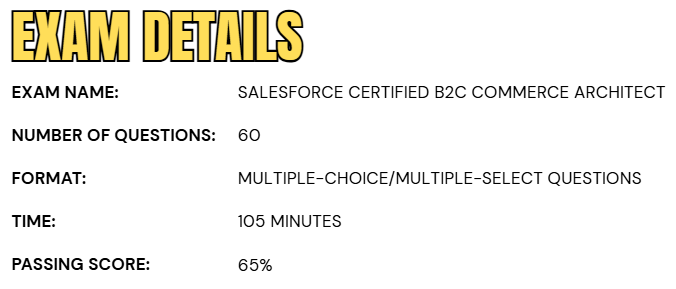
- The Salesforce Certified B2C Commerce Architect Exam consists of 60 multiple-choice or multiple-select questions, along with up to five unscored questions that are included to collect statistical performance data.
- These unscored questions are distributed randomly throughout the exam and do not influence the final score.
- Candidates are given 105 minutes to complete the test, and a minimum passing score of 65% is required to earn the certification.
- The exam can be taken in a proctored environment, either onsite at an authorized testing center or online through a remote proctoring service, offering flexibility for test-takers worldwide.
- During the exam, no hard-copy or online reference materials are allowed, ensuring that all responses reflect the candidate’s own knowledge and expertise.
Course Outline
The Salesforce Certified B2C Commerce Architect Exam assesses a candidate’s expertise and practical understanding across the following key knowledge areas and skill domains.
1. Understand Design/Discovery: 29%
- Given a customer’s business requirement, creating a technical specification that accurately reflects the business requirement.
- Given business and technical requirement details, creating standard technical artifacts that are complementary and accurate to the design and project needs.
- Given business and technical requirement details, reviewing implementation specifications for solutions, future growth, and gap analysis to stakeholders and provide analysis to defend if necessary.
- Given systems integration requirements and technical details, evaluating applicable versions of AppExchange solutions, third-party technical specifications, and API documentation for integrations.
- Given the systems that are interacting with the platform, evaluating the integration points, data type and volume, and data migration approach, plus diagram the system architecture.
2. Learn about Build: 19%
- Given a set of technical specifications, evaluating the implementation process to ensure the solution meets the business requirements.
- Given an implementation, validating that best practices are followed and guide their usage so that the end solution is secure, performant, and modular.
- Given a complex issue or set of issues, guide a development team in the steps toward resolution.
- Given an implementation and known key performance indicators (KPIs), supporting in load testing, evaluate results, and ensure the implementation meets expectations.
- Given a collection of cartridges and data, defining a process to compile and deploy to Salesforce environments.
3. Learn About Monitoring/Troubleshooting: 14%
- Given an implementation, evaluating the end-to-end needs for custom logging configuration and the ability to leverage Log Center, and investigate other tools required to identify potential and existing issues for governance, trust, and best practices.
- Given an implementation performance issue, demonstrating the ability to identify and address existing and potential performance issues, including quota violations, cache utilization, service timeouts, and optimization opportunities.
- Given an implementation issue, demonstrating the ability to identify root causes and recommend solutions.
- Given an implementation, evaluating and adjusting the system proactively to ensure a healthy, scalable system for current and future business operational needs.

4. Understand Integrations and Customizations: 22%
- Given a business requirement of integrating with a third-party web service, identify which protocol (SOAP/REST) and which approach (real-time vs. batch processing) should be used and then apply all security strategies and best practices that SFCC can support.
- Given a set of batch process requirements, leverage the productized Job Framework for batch process integration.
- Given a list of third-party AppExchange solutions, identify legacy code that still uses Pipelines and define an integration approach with Controllers.
- Given a set of real-time integration requirements, leverage the productized Service Framework for real-time integration.
5. Launch: 16%
- Given requirements for a site, set up aliases that follow SEO best practices and accurately land customers on the desired domain, locale, and currency.
- Given a site launch checklist, identify required rollback steps, plan post-production activities, and ensure all launch tasks are completed.
- Given a site launch, monitor launch activities that cover all system health indicators.
- Given dependencies between sources of site data, define jobs and data replication schedules.
- Given data migration scenarios, planning and supporting the data migration process.
Salesforce Certified B2C Commerce Architect Exam FAQs
Salesforce Exam Policy
The Salesforce Exam Policy establishes the official guidelines for scheduling, rescheduling, canceling, and completing certification exams—whether taken online or at an authorized testing center. Adhering to these rules ensures a fair, secure, and consistent certification experience for all candidates.
– Onsite (Testing Center) Exams
Candidates who choose to take their exam at a Pearson VUE testing center may reschedule or cancel their appointment up to 48 hours before the scheduled time through their Pearson VUE account. Requests submitted after this deadline are typically not accepted. Failure to appear for the exam without proper notice results in a no-show status, and the full exam fee will be forfeited.
– Online Proctored Exams
For candidates opting for an online proctored exam, rescheduling or cancellation is permitted up to 24 hours before the scheduled start time via the Pearson VUE platform, without incurring additional charges. Requests made after this period may not be accommodated, and failure to comply with these policies could lead to loss of the exam fee.
Salesforce Exam Candidate Code of Conduct
All individuals pursuing a Salesforce certification must comply with the Credential and Certification Program Agreement, which upholds the principles of fairness, integrity, and professionalism throughout the certification process. Candidates are encouraged to prepare using official Salesforce learning resources, engage with the Trailblazer Community, and maintain honest and ethical conduct at every stage of their certification journey.
Any form of unethical or prohibited behavior—including the sharing of confidential exam content, obtaining or providing unauthorized assistance, or violating exam rules—is strictly forbidden. Such actions may result in serious disciplinary measures, such as exam invalidation, credential suspension or revocation, and even permanent disqualification from the Salesforce Certification Program.
Salesforce Certified B2C Commerce Architect Exam Study Guide

Step 1: Build Hands-On Experience
The foundation of preparing for the Salesforce Certified B2C Commerce Architect Exam lies in gaining substantial hands-on experience with the Salesforce B2C Commerce Cloud platform. Candidates should actively participate in real-world ecommerce projects, focusing on designing multi-site, multi-brand architectures, implementing the Storefront Reference Architecture (SFRA), and integrating systems such as CRM, ERP, OMS, and PIM.
Practical experience allows aspirants to understand how architectural principles, modular design, and scalability considerations are applied across client, server, and CDN layers. This direct involvement not only reinforces theoretical knowledge but also develops the ability to troubleshoot, optimize performance, and apply best practices in live environments, which is critical for success in the exam.
Step 2: Complete Official Salesforce Training
Attending official Salesforce instructor-led training courses is an essential part of structured preparation. These sessions provide in-depth coverage of architectural concepts, design patterns, and technical best practices specific to B2C Commerce Cloud. Instructor-led courses offer the advantage of expert guidance, real-time clarifications, and exposure to scenario-based learning exercises that mirror the type of challenges encountered in both the exam and professional practice. Completing these courses ensures that candidates have a clear understanding of core concepts such as SDLC application, integration design, performance optimization, and security compliance, bridging any gaps left by hands-on experience alone. However, the training course includes:
– Manage and Merchandise a B2C Commerce Cloud Store – CCM101
The Manage and Merchandise a B2C Commerce Cloud Store (CCM101) course provides a deep dive into the operational and marketing aspects of managing a Salesforce B2C Commerce storefront. Conducted as a three- or five-day instructor-led program, this course focuses on how to efficiently maintain, update, and enhance existing commerce sites through the Commerce Cloud Business Manager interface. Participants learn to optimize search functionality, apply SEO techniques, execute marketing campaigns, and generate actionable performance reports to improve overall site efficiency and sales outcomes.
This program is designed for merchants, marketers, and content managers who manage or maintain Salesforce B2C storefronts. It emphasizes practical strategies for improving site content, personalizing customer experiences, and driving higher engagement and conversion rates. Learners also gain insights into aligning business objectives with platform capabilities to create a seamless, data-driven commerce experience.
– B2C Commerce Developer with SFRA – CCD102
The B2C Commerce Developer with SFRA (CCD102) course is a practical, four-day instructor-led program that equips participants with the skills to design and implement Salesforce B2C Commerce storefronts using the Storefront Reference Architecture (SFRA) framework. The course blends theoretical learning with hands-on exercises, allowing learners to explore the architecture, structure, and customization options of SFRA. Participants gain an in-depth understanding of how to work with the B2C Commerce scripting language, manipulate essential files, and apply programming best practices to build scalable, customer-focused storefronts.
This training is tailored for developers who are new to Salesforce Commerce Cloud or those with prior experience looking to transition into SFRA-based development. It offers a strong foundation in customizing storefronts, extending platform functionality, and optimizing user experiences. Learners are expected to have a minimum of two years of Java or JavaScript experience, along with working knowledge of jQuery and JSON.
Step 3: Skill Up Using Trailhead
Salesforce Trailhead remains an invaluable resource for exam preparation. Candidates should follow specialized Trailhead modules and learning paths related to B2C Commerce Cloud architecture. These modules provide interactive exercises, guided projects, and scenario-based challenges that reinforce both technical knowledge and practical application. Trailhead also allows candidates to explore platform features, system objects, analytics capabilities, and SEO considerations, which are frequently tested in the exam. By systematically progressing through relevant modules, candidates can strengthen their understanding of architecture design principles, integration strategies, and multi-channel implementation techniques.
Step 4: Engage in Study Groups and Communities
Collaborating with peers and experts through Trailblazer Community groups, online forums, and study circles is a highly effective way to deepen understanding. Participating in discussions about complex architectural scenarios, sharing real-world experiences, and asking questions allows candidates to gain insights beyond official resources. Interacting with certified professionals exposes aspirants to practical challenges, common pitfalls, and innovative solutions that enhance conceptual understanding. Such engagement encourages continuous learning and helps candidates internalize best practices for performance, security, and scalability within the B2C Commerce ecosystem.
Step 5: Review Official Documentation and Resources
A thorough review of Salesforce documentation, user guides, and tip sheets is critical to reinforce learning and clarify nuanced details. Candidates should focus on understanding technical specifications, system objects, standard design patterns, integration approaches, and compliance requirements. Reviewing official resources also provides insight into platform capabilities, including content delivery optimization, analytics implementation, and internationalization strategies. This step ensures that candidates not only memorize concepts but also comprehend their practical application, which is crucial for successfully tackling scenario-based questions in the exam.
Step 6: Take Practice Exams
Regularly attempting practice tests and sample questions helps candidates familiarize themselves with the exam structure, question types, and time management requirements. Practice exams allow candidates to identify knowledge gaps, test their understanding of key architectural principles, and reinforce learning through repetition. By simulating the testing environment, aspirants can build confidence and improve analytical and problem-solving skills, which are essential for answering complex scenario-based questions accurately during the actual exam.
Step 7: Consolidate Knowledge Through Reflection and Revision
The final phase of preparation involves reflecting on acquired knowledge and revisiting challenging topics. Candidates should analyze real-world applications of architectural principles, review notes from training and Trailhead, and consider lessons learned from practice exams. This consolidation process ensures that candidates can integrate best practices, troubleshoot complex architectures, and make informed design decisions. By combining hands-on experience, structured learning, community insights, and exam simulations, aspirants are fully equipped to demonstrate their expertise and achieve certification success.
