


The Salesforce Certified B2C Commerce Cloud Developer certification verifies your ability to design, code, and deploy ecommerce solutions using Salesforce B2C Commerce Digital. It focuses on real-world development tasks such as creating storefronts, integrating APIs, and maintaining performance across large-scale retail platforms. This credential is aimed at developers who want to prove their technical expertise in building and customizing scalable online stores within the Salesforce ecosystem.
The exam assesses how well you can use Salesforce’s B2C Commerce platform to deliver business-ready solutions. Candidates are tested on their ability to:
- Extend storefront functionality through custom code and reusable components.
- Apply Storefront Reference Architecture (SFRA) effectively in projects.
- Integrate third-party systems using asynchronous and synchronous methods.
- Optimize site performance and handle troubleshooting using development tools.
– Core Skills and Knowledge Areas
To succeed in the exam, you should be confident working across multiple layers of the B2C Commerce environment, including:
- SFRA Implementation: Building, customizing, and maintaining storefronts.
- Custom Cartridges: Developing modular features that can be reused across sites.
- JavaScript Controllers: Writing and editing logic to handle custom workflows.
- ISML Templates: Designing flexible front-end components for dynamic pages.
- Page Designer & Content Slots: Enhancing the look, usability, and adaptability of pages.
- Forms Framework: Managing user inputs with validation and secure storage.
- APIs & Integrations: Leveraging B2C Commerce APIs and OCAPI for custom logic and data exchange.
- Job Framework: Creating and scheduling automated jobs for importing or processing large datasets.
- Performance Optimization: Ensuring sites are scalable and responsive under heavy loads.
- Debugging Tools: Diagnosing and resolving configuration or coding issues efficiently.
– Recommended Experience
Salesforce recommends candidates have:
- Around one year of professional development experience, and
- Three to six months of hands-on exposure to B2C Commerce Cloud projects.
You should already understand how ecommerce systems are structured — from catalogs, pricing, and promotions to checkout and inventory — and be comfortable using Business Manager to manage these elements.
Experience with Node.js, Git, and REST-based APIs will also be beneficial for success in both the exam and real-world projects.
– Typical Job Roles
Professionals who pursue this certification often work in roles such as:
- Front-End Developer
- Full Stack Developer
- Web or Software Engineer
- JavaScript or Java Programmer
- Ecommerce Application Developer
- Technical Support Engineer
These roles require a mix of coding ability, architectural understanding, and platform-specific troubleshooting skills.
– Who Should Take This Exam
The Salesforce B2C Commerce Cloud Developer Exam is ideal for:
- Developers who design or maintain Salesforce Commerce Cloud storefronts.
- Salesforce partners and employees looking to validate their technical skills.
- Experienced programmers aiming to expand into the ecommerce development space.
- Professionals who want to strengthen their Salesforce career by demonstrating end-to-end expertise in building, integrating, and optimizing B2C Commerce applications.
Exam Details

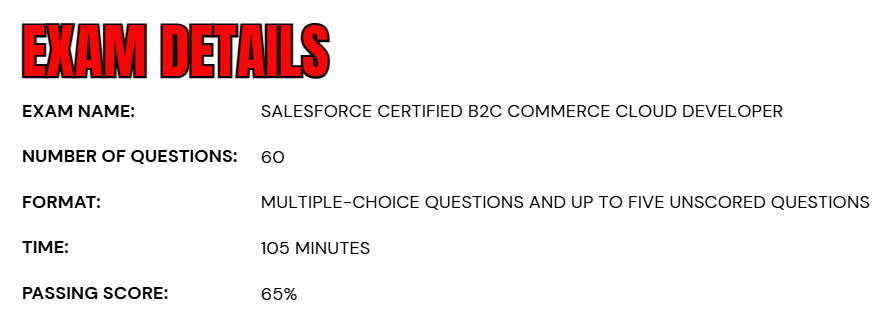
- The Salesforce B2C Commerce Cloud Developer Exam consists of 60 multiple-choice questions, along with up to five unscored items included for research and performance analysis purposes. These unscored questions are randomly distributed throughout the exam and do not affect your final score.
- Candidates are given 105 minutes to complete the test, which requires a minimum passing score of 65%.
- You can choose to take the exam either online with a remote proctor or in person at an authorized testing center.
- The exam is closed-book, meaning no reference materials—either printed or digital—are allowed during the session.
- There are no formal prerequisites, making it accessible to any developer with hands-on experience in Salesforce B2C Commerce Cloud who wishes to validate their technical expertise.
Course Outline
The Salesforce B2C Commerce Cloud Developer Exam evaluates a candidate’s expertise and practical abilities across the following key objectives.
1. Learn about B2C Commerce Setup: 11%
- Given a sandbox environment, configuring an IDE to use WebDAV to deploy cartridges to the correct version directories.
- Given a sandbox instance and data import files, importing files using the Business Manager Import/Export modules.
- Given the code for a storefront site, adding the correct sequence of cartridge names to the provided cartridge path.
- Given a sandbox environment, using the Business Manager to add a new site to the instance, configuring the default currency and taxation type according to business requirements.
- Given a recently created B2C site, assigning the storefront data configurations according to business requirements.
2. Working With a B2C Site: 12%
- Given a Business Manager task, working with the product data model to manage products and product search model, their categorization, and associated inventory and pricebooks.
- Given a configuration for tasks, such as payment and shipping information, use Business Manager to enable shoppers to complete storefront orders.
- Given a configuration task, using Business Manager to work with Content Assets, Page Designer, Content Slots, and Content Folders.
3. Understand Data Management Using Business Manager Usage: 24%
- Given a business requirement, modifying site search preferences and settings to enable searching for a specified term or product attribute.
- Given a business requirement, creating and configuring a new search refinement and sorting definition that can be used on the storefront.
- Given a debugging requirement or code, configuring the logging categories and access the logs in Business Manager.
- Given business requirements, extending the storefront to expose a new attribute on an existing system object type.
- Given a business need to store custom data, determine if a custom object is needed and create and configure as required.
- Given a problem or performance issue and data, use relevant tools to inspect code performance and determine and implement solutions (cache configuration, profilers, etc.) to resolve this issue.
- Given a specification and a sandbox instance, configuring OCAPI permissions for Data and Shop APIs.
- Given a service configuration, recognize how they are applicable to the development process.


4. Learn About Application Development: 53%
- Given a development task, code ISML templates that use functionality, such as local include, remote include, components, and other ISML tags.
- Using debugging best practices and techniques to troubleshoot scripts and controllers and verify outcomes.
- Given a requirement, creating and extending the functionality of a JavaScript controller that leverages models, decorators, factories, or helpers following API best practices, and renders a template or returns a JSON response.
- Given a business requirement and design for a new marketing page, develop page types and components to allow a marketer to build a page with the Page Designer tool.
- Given a requirement to accept, validate, and persist information from a storefront customer, modify the appearance of a form, add validation and cross-site request forgery (CSRF) protection, and use bindings to process fields.
- Given localization requirements, implementing and enhancing templates, form definitions, static files, properties files, and persistent object attributes to ensure that pages are displayed in the expected language.
- Given a logging task and existing configuration, write code that logs non-sensitive data to custom log files with different log levels.
- Integrate, deploy, and use a service instance based on a given requirement.
- Given a use case, extend functionality or capture an event using hook extension points.
- Given code that violates documented best practices, identify the issues and modify the code to conform with best practices including performance and scalability.
- Given a business requirement, using OCAPI Shop and Data APIs to enable interoperability with an external system.
- Given a business requirement to perform a scheduled task, developing jobs and code job scripts.
Salesforce Certified B2C Commerce Cloud Developer Exam FAQs
Salesforce Exam Candidate Code of Conduct
Every participant in the Salesforce Certification Program is expected to demonstrate the highest level of honesty, integrity, and professionalism throughout their certification journey. By registering for any Salesforce exam, candidates agree to the terms outlined in the Salesforce Credential and Certification Program Agreement, which defines the ethical standards and expected conduct during preparation, testing, and post-exam activities.
Candidates are encouraged to rely solely on official Salesforce study materials, engage responsibly within the Trailblazer Community, and adhere strictly to all exam rules, procedures, and security protocols. Any unethical behavior—such as requesting, sharing, or using confidential exam content, seeking unauthorized assistance, or violating test regulations—constitutes misconduct and will be taken seriously.
Such violations may result in disciplinary action, including exam cancellation, credential suspension or revocation, and in severe cases, permanent disqualification from the Salesforce Certification Program.
Salesforce Exam Policy
The Salesforce Exam Policy defines the official rules for scheduling, rescheduling, canceling, and completing certification exams—whether taken online or at an authorized testing center. These guidelines ensure fairness, consistency, and exam security for all candidates.
– Onsite (Testing Center) Exams
Candidates taking exams at Pearson VUE testing centers may reschedule or cancel their appointment up to 48 hours before the scheduled time via their Pearson VUE account. Requests made after this period are generally not accommodated. Failure to appear without prior notice is considered a no-show, resulting in the forfeiture of the exam fee.
– Online Proctored Exams
For online proctored exams, candidates can reschedule or cancel their test up to 24 hours before the scheduled start time through the Pearson VUE platform at no additional cost. Requests made after the deadline are typically denied, and candidates who miss their exam without prior rescheduling will lose the full exam fee.
Salesforce Certified B2C Commerce Cloud Developer Exam Study Guide

Step 1: Start with the Official Exam Guide
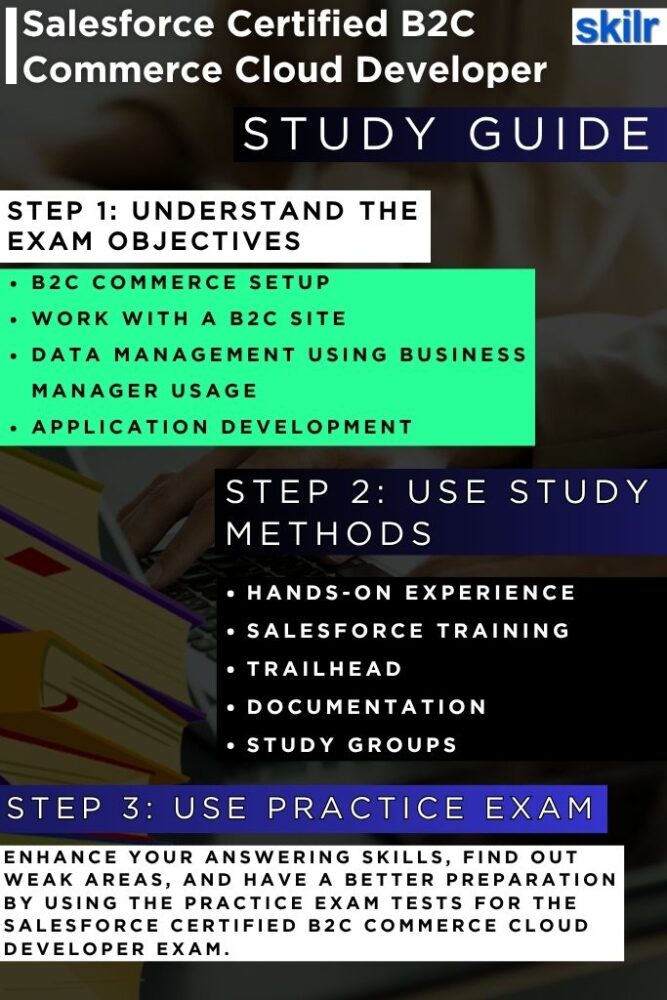
The foundation of your preparation for the Salesforce Certified B2C Commerce Cloud Developer Exam begins with a detailed review of the official exam guide provided by Salesforce. This document serves as your roadmap, outlining the core objectives, topic weightage, exam format, and the depth of knowledge expected from candidates.
By studying the guide thoroughly, you gain clarity on what skills are tested—ranging from implementing Storefront Reference Architecture (SFRA) to integrating APIs and managing site performance. Understanding these areas early helps you allocate time wisely, identify your strengths and weaknesses, and create a focused study plan aligned with Salesforce’s certification standards.
Step 2: Combine Hands-On Experience with Formal Learning
This certification demands more than theoretical knowledge—it requires real-world application. Candidates are encouraged to balance hands-on experience with structured learning through official Salesforce courses or Trailhead modules. Working directly on Salesforce B2C Commerce projects helps you understand how storefronts, product catalogs, price books, and promotions interact within the platform.
Meanwhile, formal training ensures that your skills align with best practices recommended by Salesforce. A strong combination of practical exposure and guided study gives you a deeper understanding of the development workflow, from designing custom cartridges and controllers to configuring site preferences and optimizing performance.
Step 3: Build Practical Expertise through Real Projects
Developing true expertise comes from applying your knowledge in realistic environments. You should actively engage in creating and customizing SFRA sites, developing ISML templates, and integrating OCAPI for data operations. Experiment with different configurations within Business Manager and explore features like Content Slots, Page Designer, and the Forms Framework to see how they enhance user experience. By solving real challenges—such as optimizing site load times, handling checkout flows, and managing inventory—you gain valuable insight into the platform’s inner workings. The more you build and troubleshoot, the more confident and exam-ready you become.
Step 4: Learn from Certified Experts
Connecting with experienced professionals who have mastered Salesforce Commerce Cloud can significantly accelerate your learning curve. Attend Trailhead Academy sessions, Salesforce webinars, or Trailblazer Community events to hear directly from experts about implementation challenges, best practices, and common pitfalls.
Learning from others’ experiences helps you approach complex concepts like cartridge structure, asynchronous integrations, and performance tuning with greater clarity. Experts often share practical advice that bridges the gap between textbook knowledge and real-world development, offering valuable insights you can’t always get from self-study.
Step 5: Attend Instructor-Led Training Sessions
If you prefer a more guided approach, enrolling in Salesforce’s instructor-led classes can be a game-changer. These sessions are designed to align precisely with the certification objectives, offering hands-on labs and demonstrations that reinforce key concepts. The structured format ensures you understand how different parts of B2C Commerce interact—from backend data management to front-end customization using SFRA.
Instructor-led training also gives you direct access to certified professionals who can clarify complex areas, provide personalized feedback, and guide you through advanced topics like OCAPI integrations and job framework implementation. However, the related training includes:
– B2C Commerce Developer with SFRA (CCD-102)
The B2C Commerce Developer with SFRA course is a 4-day instructor-led training that teaches developers how to build, customize, and extend Salesforce B2C Commerce storefronts using the Storefront Reference Architecture (SFRA) framework. It covers essential topics like working with controllers, models, templates, and scripts, along with understanding pipelines, ISML, and the B2C Commerce scripting language.
Participants also explore integration techniques, site performance optimization, and code management best practices. This course is ideal for developers who are either new to Salesforce B2C Commerce or transitioning from older frameworks like SiteGenesis. A background in Java or JavaScript, along with familiarity with jQuery and JSON, is recommended for success.
– Manage and Merchandise a B2C Commerce Cloud Store (CCM-101)
The Manage and Merchandise a B2C Commerce Cloud Store course is offered as a 3-day or 5-day instructor-led program designed for merchants, marketers, and site administrators. It provides a deep understanding of how to efficiently manage and enhance a Salesforce B2C Commerce storefront using Commerce Cloud Business Manager.
Learners explore topics such as catalog management, content creation, campaign setup, SEO strategy, and performance analytics. The course also focuses on leveraging online marketing tools, personalizing the customer experience, and generating actionable reports to improve business performance. By the end of the training, participants are equipped to run and optimize an e-commerce site that drives engagement, retention, and revenue growth.
Step 6: Leverage Trailhead and Community Resources
Salesforce’s Trailhead platform is one of the most powerful resources available to learners. It offers interactive modules, projects, and trails specifically tailored for B2C Commerce Cloud developers. Completing these hands-on exercises allows you to build practical knowledge while earning badges that track your progress.
Beyond Trailhead, engaging with the Trailblazer Community or specialized study groups connects you with like-minded developers preparing for the same exam. These communities serve as a space to ask questions, share experiences, and get clarification on difficult concepts. For more structured learning, Trailhead Academy also provides premium training programs taught by certified Salesforce instructors.
Step 7: Take Practice Tests and Review Documentation
As you near the end of your preparation, it’s essential to measure your readiness with practice exams. These mock tests simulate the real exam environment, helping you manage time effectively and familiarize yourself with question patterns. Reviewing your performance allows you to identify weak areas and focus on topics that require more attention.
Alongside practice tests, spend time exploring official Salesforce documentation, including developer guides, tip sheets, and user manuals. These resources offer detailed explanations of APIs, system behavior, and configuration options—knowledge that often appears in exam scenarios. Reviewing documentation also deepens your understanding of Salesforce’s recommended methods for troubleshooting and site optimization.
