


The Salesforce Certified CRM Analytics and Einstein Discovery Consultant certification validates a professional’s ability to design, implement, and optimize CRM Analytics and Einstein Discovery solutions at scale. This credential demonstrates proficiency in translating business requirements into powerful analytical experiences, guiding organizations through data preparation, dashboard development, predictive modeling, and actionable insights—all within the Salesforce ecosystem.
Candidates are assessed on their mastery of the Lightning Experience interface and their competence in building, managing, and supporting analytics assets across CRM Analytics (formerly Tableau CRM) and Einstein Discovery.
Furthermore, this certification measures end-to-end expertise across data management, analytics development, predictive intelligence, security implementation, and performance optimization. Professionals are expected to demonstrate hands-on skills in:
- Designing and constructing apps, datasets, dashboards, and stories
- Applying advanced SAQL and JSON to support queries and dashboard customization
- Managing permissions, governance processes, and sharing models
- Creating and deploying predictive and prescriptive insights with Einstein Discovery
- Supporting analytics across desktop and mobile environments
– Who Should Take the Exam
This certification is ideal for:
- Analytics consultants responsible for building data-driven solutions in Salesforce
- BI developers or data analysts transitioning into CRM Analytics and predictive intelligence
- Salesforce admins or solution architects who work extensively with reporting, dashboards, and data preparation
- Professionals with at least 1 year of hands-on experience using CRM Analytics or Einstein Discovery
- Anyone aiming to demonstrate advanced skills in dashboard creation, data modeling, predictive analytics, and enterprise-level analytics governance
– Front-End Capabilities
A certified CRM Analytics & Einstein Discovery Consultant should possess strong end-user design and dashboard development skills, including:
Dashboard & Visualization Expertise
- Choosing appropriate charts and visual elements based on business questions
- Applying UX and analytics best practices to craft intuitive dashboards
- Creating dashboards using bindings, interactions, and dynamic filtering
Query Development
- Building SOQL, SQL, and SAQL-based queries for advanced data manipulation
- Implementing selection and result bindings to support multi-step user interactions
App & Template Utilization
- Configuring Salesforce-provided templates and customizing them for various use cases
- Adding pages and embedding components to enhance dashboard functionality
Performance & Mobile Optimization
- Using Dashboard Inspector to troubleshoot and enhance performance
- Converting dashboards to mobile-friendly layouts
– Administrative Skills
This exam also assesses operational and governance-related competencies:
Identity, Access, and Permissions Management
- Using user provisioning for identity and access control
- Assigning permissions and managing access at app, dataset, and dashboard levels
Security & Governance
- Applying security predicates and dataset-level sharing inheritance
- Incorporating governance frameworks for monitoring and lifecycle management of analytics assets
Deployment & Integration
- Understanding deployment processes between sandboxes and production
- Embedding dashboards in Lightning pages or Experience Cloud with contextual filters
- Having awareness of CRM Analytics API use cases
– Back-End Expertise
The exam evaluates the candidate’s ability to manage data pipelines, prepare data for predictive insights, and build scalable analytical back-end systems:
Data Ingestion & Preparation
- Loading data using multiple ingestion methods
- Designing dataflows and recipes, including scheduling and automation
- Enabling and optimizing data sync (replication) and understanding its constraints
Data Transformation
- Adding derived fields through dataflows, recipes, or UI
- Managing recipe limitations and ensuring performance efficiency
Einstein Discovery Skills
- Exporting data from different sources to Discovery
- Preparing datasets for story creation
- Interpreting model statistics and algorithms to make meaningful recommendations
- Reviewing model performance using Model Manager
- Deploying models and surfacing predictions/prescriptions within Salesforce pages
– What You Are Not Expected to Know
This exam does not require expertise in the following areas:
- Apex programming
- SDK usage
- API development
- Data serialization formats
- Salesforce Data Pipelines or Data Cloud
- Data backup strategies
- Creating geoJSON maps
- Hierarchical or territory-based data security predicates
- Data scaffolding for missing values
Exam Details

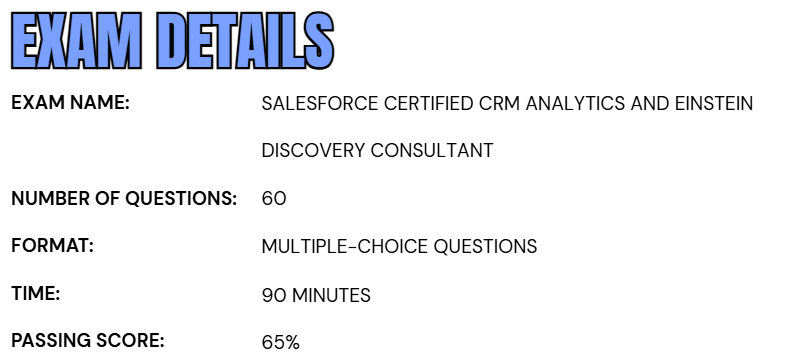
- The Salesforce CRM Analytics and Einstein Discovery Consultant Exam consists of 60 scored multiple-choice questions, with the possibility of up to five additional unscored questions that Salesforce may include for statistical testing.
- Candidates are given 90 minutes to complete the assessment, and a minimum score of 65% is required to pass.
- The exam can be taken either at an authorized testing center or through an online proctored setup, ensuring flexibility for test-takers.
- No external resources—whether printed or online—are permitted during the exam, maintaining a strictly controlled testing environment.
- There are no prerequisites, allowing anyone with relevant skills and experience to attempt the certification.
- The unscored questions, if present, do not affect the final result and are included solely to evaluate question performance; the exam duration already accounts for their inclusion.
Course Outline
The Salesforce Certified CRM Analytics and Einstein Discovery Consultant Exam evaluates a candidate’s expertise and practical abilities across the following key areas.
1. Understand Admin/Configuration: 17%
- Given business and access requirements, enabling CRM Analytics along with its features, encompassing permission sets and licenses.
- Given a scenario, using CRM Analytics to design a solution that accommodates data sync/dataflows/recipes limits.
- Given a situation, demonstrating knowledge of what can be accomplished with the CRM Analytics API.
- Given business requirements, migrating between different environments for deployment.
2. Learn about Data Layer: 23%
- Given data sources, using Data Manager to extract and load the data into the CRM Analytics application to create datasets.
- Given business needs and consolidated data, implementing refreshes for data syncs and dataflows/recipes while keeping limits and considerations in mind.
- Given business/user requirements, performing data transformations in dataflows/recipes.
- Given user requirements or ease of use strategies, managing dataset extended metadata (XMD) by editing labels, values, and colors.
- Implementing delivery management strategies in dataflows/recipes including versioning and conversion.
3. Overview of Security: 16%
- Given governance and CRM Analytics asset security requirements, implementing necessary security settings for users, groups, and profiles.
- Given row-based security requirements, implementing the appropriate dataset security settings by using sharing inheritance and security predicates.
- Implementing app sharing based on user and group requirements.


4. Understand Analytics Dashboard Design: 13%
- Given business requirements, scope, validate, and prioritize dashboard design requirements.
- Creating appropriate dashboards to meet business requirements following CRM Analytics best practices and UX design principles.
- Identifying the appropriate use and configuration of a standard CRM Analytics templated app to meet business requirements.
5. Learn Analytics Dashboard Implementation: 19%
- Given business requirements, configuring dashboards using accurate query types and widget level parameters.
- Given business requirements, developing selection/result interactions with different types of queries.
- Given business requirements, using advanced functionality such as windowing and time series analysis within compare tables.
- Given business requirements, making dashboards actionable and accessible in Lightning pages.
- Given a scenario, monitor and optimize query performance using Dashboard Inspector.
- Implementing delivery management strategies using versioning and/or Dashboard Publisher.
5. Understand about Einstein Discovery: 12%
- Building a model by assessing data and selecting one of the three types of predictions (numeric, binary, multi-classification).
- Given business requirements, analyzing the model results and propose data improvements to the customer.
- Given derived results and insights from the model, adjust data parameters and add/remove data or columns to improve the model.
- Enabling prediction features on Lightning record pages across Salesforce and CRM Analytics.
- Monitoring and interpreting a Model Card to improve or maintain model performance.
Salesforce Certified CRM Analytics and Einstein Discovery Consultant Exam FAQs

Salesforce Certification Exam Policy
The Salesforce Certification Exam Policy defines the official guidelines for scheduling, modifying, canceling, and completing any Salesforce credentialing exam. These rules apply consistently to all candidates, whether they choose to test through an online proctored environment or at an approved physical testing center. The policy helps maintain exam integrity, ensures fairness, and provides a standardized experience for every participant.
Testing at Authorized Onsite Centers
Individuals taking their exam at a Pearson VUE testing facility may adjust or cancel their appointment through their Pearson VUE profile, provided the change is made at least 48 hours before the scheduled exam time. Requests made after the cutoff are generally not accepted. Candidates who fail to appear for their appointment without an approved modification within the permitted timeframe will be marked as a no-show and will forfeit the full exam fee.
Online Proctored Exam Sessions
For those opting to test remotely, Pearson VUE allows rescheduling or cancellation up to 24 hours before the exam start time. Any request submitted after this window is typically denied. Missing a remote exam without properly rescheduling results in the loss of the entire exam fee, similar to onsite testing.
Salesforce Exam Candidate Code of Conduct
All participants in the Salesforce Certification Program are required to uphold professionalism, honesty, and ethical conduct from registration through completion of the exam. By scheduling a test, candidates automatically accept the terms of the Salesforce Credential and Certification Program Agreement, which outlines the expectations for ethical preparation and compliant test behavior.
Candidates must use only legitimate Salesforce learning resources, engage responsibly within the Trailblazer Community, and follow all security and proctoring guidelines. Activities such as requesting or distributing real exam questions, using unauthorized materials during testing, or ignoring proctor instructions are strictly prohibited. Violations may lead to score cancellation, suspension or revocation of certifications, or permanent disqualification from the Salesforce Certification Program.
Salesforce Certified CRM Analytics and Einstein Discovery Consultant Exam Study Guide

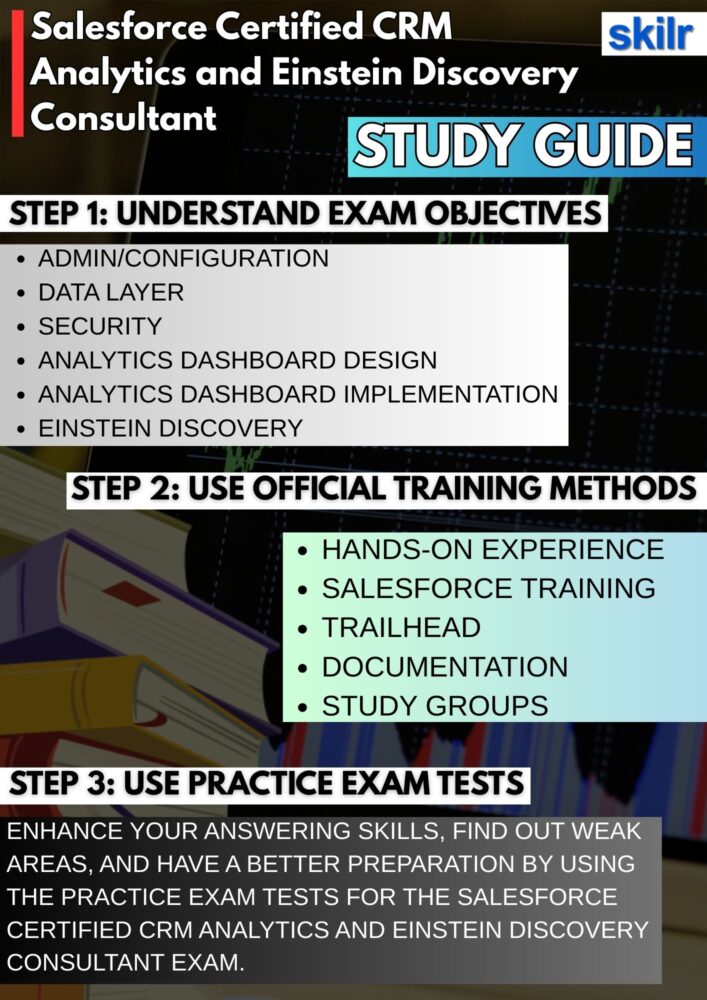
1. Understand the Salesforce CRM Analytics & Einstein Discovery Exam Guide
A thorough understanding of the official Exam Guide is the foundation of your preparation. The guide details every domain assessed in the exam, ranging from data modeling and ingestion to dashboard interactivity, performance optimization, governance, prediction evaluation, and model deployment. Reviewing the guide helps you recognize how Salesforce weighs various competencies, enabling you to structure your study plan around high-impact areas such as dataset management, SAQL proficiency, and discovery insights.
It also clarifies the format, the number of questions, and the level of difficulty to expect. Taking time to interpret each objective ensures your preparation is aligned precisely with what the exam measures, and it helps you avoid spending effort on topics that are not part of the assessment.
2. Build Strong Expertise Through Hands-On Experience
This certification rewards practical ability, making hands-on experience essential. Working directly in a CRM Analytics-enabled Salesforce environment allows you to understand how datasets are created, transformed, and optimized. Through real-world practice, you learn to create and debug dataflows, build recipes for enrichment, and work with bindings to develop responsive dashboards.
Experimenting with the Model Manager in Einstein Discovery gives you a realistic sense of how predictions are generated, evaluated, and deployed. Hands-on work also exposes you to challenges related to performance issues, governance constraints, or security inheritance—which are heavily emphasized in the exam. The more real use cases you work with, the easier it becomes to think through questions that require practical reasoning rather than memorized concepts.
3. Upskill with Trailhead Learning Paths and Structured Online Modules
Trailhead is one of the most effective ways to gain structured knowledge aligned directly to Salesforce product capabilities. The platform offers curated trails and projects designed specifically for CRM Analytics and Einstein Discovery, covering modules such as dataset creation, SAQL basics, JSON editing for dashboard customizations, predictions, and best practices for data preparation.
Completing these learning paths helps reinforce fundamental concepts in a systematic manner while letting you experiment with guided hands-on challenges. Trailhead also provides scenario-based projects that closely resemble real enterprise implementations, making it a powerful complement to your hands-on practice environment. Consistently progressing through badges and superbadges builds both your confidence and your applied skillset. The Trailhead trails covers:
- Exploring with CRM Analytics
- Gaining Insight and Improve Outcomes with Einstein Discovery
- Basics of CRM Analytics Apps
- Building and Administering CRM Analytics
- Accelerating CRM Analytics with Apps
4. Learn from Salesforce-Certified Instructors and Expert-Led Training Sessions
Instructor-led courses offered through Salesforce and authorized partners provide an accelerated learning experience for complex topics such as multi-dataset dashboards, advanced SAQL queries, data security architecture, model interpretation, and dashboard performance optimization. These sessions are taught by experts who work with CRM Analytics and Einstein Discovery regularly, giving you access to practical insights and solutions that may not be easily available in documentation.
Instructor-led learning allows you to ask questions directly, observe live demonstrations, and learn through deep-dive explanations, which are especially valuable for understanding exam areas like bindings, data sync behavior, and advanced dashboard design principles. It’s an excellent way to clarify doubts and ensure your conceptual understanding matches enterprise-level expectations. However, the related training include:
– Implement and Manage CRM Analytics (ANC301)
This advanced, three-day instructor-led program is designed to help you build a fully functional CRM Analytics environment capable of handling data from Salesforce and external systems. Throughout the course, participants learn how to configure CRMA features, manage user access, load and transform data, implement robust security controls, and tailor queries to create highly customized dashboards.
By the end of the training, you will be able to identify trends, uncover insights, and leverage predictive analytics to support faster and more informed decision-making. The class is ideal for integration specialists, Salesforce administrators, business analysts, and developers who want to deepen their understanding of data connectivity and governance within CRM Analytics.
– Building Lenses, Dashboards, and Apps in CRM Analytics (ANC201)
This one-day, hands-on course introduces you to the fundamentals of building visual analytics assets in CRM Analytics using Lightning Experience. You will learn how to design intuitive, user-friendly dashboard layouts, create meaningful lenses, and assemble them into dashboards using the CRMA Dashboard Designer.
The course also covers mobile optimization techniques and how to embed dashboards into Lightning pages and home screens to enhance visibility and usability. This training is suited for professionals responsible for developing lenses and dashboards, as well as anyone involved in preparing or integrating data that feeds into these analytics components.
5. Engage with Study Groups, Communities, and Trailhead Academy Resources
Learning as part of a community significantly enhances your understanding and retention. The Trailblazer Community, Salesforce discussion groups, LinkedIn study cohorts, and Trailhead Academy forums give you access to peers and certified professionals who share real-world insights, exam tips, and recommended study approaches.
Engaging with others helps you stay consistent, exposes you to practical scenarios across industries, and offers solutions to challenges you may not encounter on your own. Community discussions often highlight recent platform updates, relevant features, and common mistakes candidates make during the exam. By participating actively, you strengthen your grasp of exam topics while gaining strategic advice from those who have already cleared the certification.
6. Validate Your Knowledge Through Practice Tests and Exam Simulations
Practice exams play a crucial role in preparing you for the actual testing environment. They help you understand how Salesforce structures its questions, how scenario-driven problems appear, and how concepts are tested through real-world situations rather than simple definitions. Taking multiple practice tests helps you identify weak areas, refine your reasoning skills, and learn to manage your time effectively during the 90-minute exam window.
Analyzing your incorrect answers allows you to revisit specific topics—such as security predicates, data sync impacts, binding types, or predictive model evaluation—and strengthen your knowledge before test day. Over time, these mock assessments build confidence and reduce exam anxiety.
7. Study Official Documentation, Tip Sheets, and Salesforce User Guides
Salesforce’s own documentation library is one of the richest and most authoritative sources for exam preparation. Reviewing documentation on CRM Analytics, Einstein Discovery, dataflows, replication, governance, dashboard JSON, and the Model Manager helps clarify detailed behavior that may appear in exam scenarios. Tip Sheets and User Guides provide concise explanations of dashboards, predictions, performance tools, and recommended practices, making them especially useful for quick revision.
These resources also reflect the most current features and platform updates, ensuring your preparation aligns with the latest functionality. Revisiting documentation throughout your preparation helps reinforce conceptual clarity and ensures you have an accurate understanding of how various parts of the platform work together. This additionally includes:
