
The Salesforce Certified Heroku Architect credential validates the expertise of professionals who design, deploy, and manage scalable applications on the Heroku platform. This certification is ideal for individuals experienced in architecting cloud solutions, leading development teams, and applying best practices to Heroku Enterprise environments. The exam emphasizes the following core capabilities:
- Application Architecture and Deployment: Designing, building, deploying, and scaling Heroku applications while managing infrastructure, teams, and operational workflows.
- Enterprise Usage: Understanding when to leverage Heroku Enterprise, including security features, trust options, and compliance considerations.
- Add-ons and Services: Utilizing Heroku add-ons, including Heroku Postgres, Heroku Redis, Dataclips, Apache Kafka, and other Elements Marketplace extensions.
- Salesforce Integration: Integrating Heroku applications with Salesforce data via APIs, Heroku Connect, and event-driven systems.
- Microservices and Scalable Solutions: Architecting applications using the Twelve-Factor App methodology and designing microservices architectures.
- Advanced Heroku Features: Leveraging Heroku Private Space Peering, VPN connections, Heroku Shield, Enterprise Teams, and understanding Private Space vs Common Runtime.
– Exam Experience Requirements
Candidates for this exam are expected to have a minimum of two years of experience in:
- Building and deploying apps on Heroku
- Designing scalable, secure solutions
- Utilizing Heroku add-ons effectively
- Integrating Heroku with Salesforce Lightning Platform
- Constructing architectures using Heroku Postgres, Heroku Redis, Dataclips, Heroku Connect, and Apache Kafka
- Implementing Enterprise Teams and Heroku Shield features
Candidates are not required to have experience architecting Salesforce Lightning Platform solutions outside of Heroku integrations.
– Who Should Take This Exam
This certification is designed for:
- Heroku Consultants and Partners who implement enterprise-grade applications
- Architects and Developers responsible for building scalable, secure, and maintainable applications on Heroku
- Professionals with experience in cloud architecture, team management, and application deployment workflows on Heroku Enterprise
- Individuals seeking to validate their expertise in integrating Heroku apps with Salesforce and other enterprise systems
Exam Details
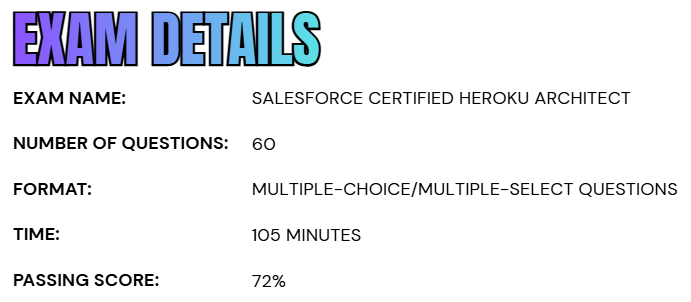
- The Salesforce Certified Heroku Architect exam consists of 60 multiple-choice and multiple-select questions.
- Candidates are given 105 minutes to complete the exam, and a passing score of 72% is required to earn the certification.
- The exam is delivered in a proctored format, either onsite at an authorized testing center or remotely in an online proctored environment.
- During the exam, no reference materials—either in print or online—are allowed.
- There are no prerequisites for taking this exam, making it accessible to professionals with the relevant Heroku experience and knowledge.
Course Outline
The Salesforce Certified Heroku Architect exam evaluates a candidate’s knowledge and proficiency in the areas outlined in the exam objectives. Candidates are expected to have practical, hands-on experience with Heroku architecture and be able to demonstrate the effective application of the features and functions listed below.
1. Understand Heroku Platform: 10%
- Demonstrating an understanding of the basics behind building and deploying apps on Heroku, including the role of buildpacks in slug creation.
- Architecting scalable solutions that are performant even during high-traffic spikes.
- Architecting and deploying solutions using add-ons and other components from the Elements Marketplace, including various add-ons, buildpacks, and Heroku Buttons.
2. Learn about Data: 17%
- Demonstrating knowledge of Heroku Postgres, including data handling, security, and common use cases for follower databases. Describe the use cases of Dataclips.
- Architecting solutions using Apache Kafka on Heroku to facilitate streaming communication between applications, services, or functions.
- Architecting solutions using Heroku Redis.
- Demonstrating the ability to prescribe a third-party add-on and add-on sharing, when appropriate.
3. Understand Security: 15%
- Constructing architectures that leverage Heroku to achieve different security certifications.
- Recommending Heroku Private Space Peering or VPN connections for appropriate use cases.
- Recommending when an app should run in the Private Space Runtime versus the Common Runtime.
4. Learn About Heroku Enterprise: 28%
- Demonstrating how features of Heroku Enterprise can improve a system’s architecture.
- Recommending networking solutions that use Heroku Private Spaces or the Common Runtime, appropriately.
- Describing the compliance features of Heroku Shield.
- Describing the features of Enterprise Teams.

5. Understand Architect Applications: 15%
- Recommending architectures that use the Twelve-Factor App methodology correctly.
- Constructing solutions for creating an orchestration layer for building a microservices architecture using Apache Kafka on Heroku.
6. Learn Integrations: 15%
- Recommending architectures that use Heroku Connect appropriately, including the correct use of External IDs.
- Recommending techniques to integrate Heroku apps with the Salesforce Lightning Platform, and understand when to apply particular techniques.
Salesforce Certified Heroku Architect Exam FAQs

Salesforce Exam Policy
The Salesforce Exam Policy defines the official procedures and guidelines for scheduling, rescheduling, canceling, and completing certification exams, whether taken online or at an authorized testing center. Following these policies ensures a secure, fair, and consistent experience for all candidates.
Onsite (Testing Center) Exams
Candidates taking exams at a Pearson VUE testing center may reschedule or cancel their appointment up to 48 hours before the scheduled exam via their Pearson VUE account. Requests submitted after this deadline are generally not accepted. Failing to appear for the exam without prior notice will result in a no-show status, and the full exam fee will be forfeited.
Online Proctored Exams
Candidates opting for an online proctored exam can reschedule or cancel up to 24 hours before the scheduled start time through the Pearson VUE platform without additional charges. Requests made after this window may not be accommodated. Noncompliance with these rules may lead to forfeiture of the exam fee.
Salesforce Exam Candidate Code of Conduct
All candidates pursuing Salesforce certification must adhere to the Credential and Certification Program Agreement, which emphasizes fairness, integrity, and professionalism throughout the certification process. Candidates are encouraged to utilize official Salesforce training materials, engage with the Trailblazer Community, and uphold ethical conduct at every stage of preparation and testing.
Any form of unethical or prohibited behavior—including sharing confidential exam content, seeking or providing unauthorized assistance, or violating exam rules—is strictly prohibited. Such actions may result in serious consequences, including exam invalidation, credential suspension or revocation, and permanent disqualification from the Salesforce Certification Program.
Salesforce Certified Heroku Architect Exam Study Guide
1. Review the Official Exam Guide
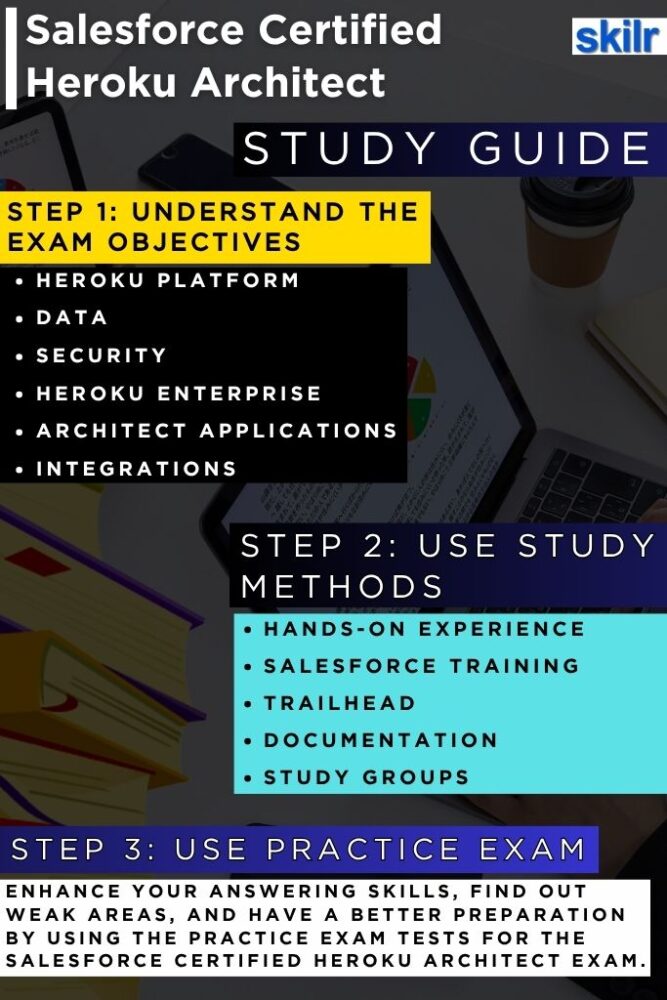
Begin by thoroughly studying the Salesforce Certified Heroku Architect Exam Guide, which outlines the exam objectives, question formats, time limits, and areas of emphasis. Understanding the structure of the exam is essential for strategic preparation. Take time to analyze the weighting of each domain and identify the areas that require deeper focus. This step allows you to allocate study time efficiently, understand expectations, and form a roadmap for exam readiness.
2. Combine Hands-On Experience with Formal Training
Practical experience is a key factor in mastering the Heroku platform. Pair this with formal Salesforce training courses to establish a strong conceptual foundation. Training sessions, workshops, and guided tutorials provide insights into best practices, platform capabilities, and real-world deployment strategies. Applying this knowledge to actual projects—whether creating Heroku apps, managing infrastructure, or implementing team workflows—ensures you develop both technical competence and operational understanding.
3. Leverage Trailhead for Guided Learning
Salesforce Trailhead modules are an essential tool to enhance your Heroku expertise. Interactive learning paths and hands-on projects provide step-by-step guidance on critical concepts such as scalable app architecture, Heroku Enterprise features, add-ons, Postgres, Redis, Kafka, and integrations with Salesforce. Trailhead also offers scenario-based exercises, which simulate real-world challenges you may encounter in the exam, reinforcing your ability to think critically and solve complex problems effectively.
4. Gain Practical Experience
Hands-on application is crucial for deep mastery. Work on real-world projects, experimental deployments, and microservices architectures to understand how Heroku applications operate at scale. Focus on building solutions using Heroku Connect, Private Spaces, Shield, and Enterprise Teams, as well as integrating Heroku apps with Salesforce data via APIs or event-driven architectures. This experience helps you anticipate exam scenarios, enabling you to demonstrate both practical skills and architectural thinking.
5. Engage with Study Groups and Communities
Collaboration accelerates learning. Participating in study groups, Salesforce community forums, and Trailhead Academy sessions allows you to exchange knowledge with peers, discuss real-life use cases, and clarify complex topics. Engaging with the Salesforce ecosystem helps you stay informed about updates, share best practices, and gain multiple perspectives on architectural solutions—skills that are highly valuable for the exam.
6. Practice with Mock Exams
Regularly taking practice exams is vital for assessing your readiness and identifying areas that need improvement. Simulated tests not only familiarize you with the multiple-choice and multiple-select formats but also help build confidence under timed conditions. Reviewing incorrect answers deepens understanding and reinforces concepts, making you better prepared to tackle complex scenario-based questions during the actual exam.
7. Review Official Documentation, Tip Sheets, and User Guides
Finally, reinforce your preparation by studying official Salesforce documentation, tip sheets, and user guides. These resources provide comprehensive coverage of Heroku’s architecture, features, security practices, and enterprise use cases. Keeping up-to-date with the latest platform enhancements and best practices ensures that you can confidently address questions about Heroku Postgres, Redis, add-ons, Kafka, and integrations with Salesforce, while also demonstrating knowledge of security, scalability, and operational excellence.
