


The Salesforce Certified MuleSoft Catalyst Consultant Exam validates your ability to identify business outcomes, plan engagements, and design composable architecture solutions aligned with the MuleSoft Catalyst methodology. This certification demonstrates your proficiency in bridging business goals with technical execution using Catalyst principles and best practices.
Earning the Salesforce Certified MuleSoft Catalyst Consultant credential demonstrates your expertise in applying the Catalyst methodology to align IT initiatives with business strategy. It validates your ability to deliver measurable outcomes, foster reusability, and drive innovation through structured, value-driven engagement models.
– What the Exam Measures
Candidates for the MuleSoft Catalyst Consultant certification are expected to possess a comprehensive understanding of the Catalyst framework and its application in enterprise integration initiatives. You should be able to:
- Understand Catalyst Core Concepts: Define and apply key pillars of Catalyst, including playbooks, delivery approaches, assets, lifecycle management, engagement types, delivery models, and roles and responsibilities.
- Analyze Business Drivers and Objectives: Translate an organization’s strategic goals, KPIs, and initiatives into a logical network of business influences.
- Design with Reusability in Mind: Leverage Catalyst principles to develop architectural solutions that emphasize reusability while addressing immediate business needs.
- Develop Engagement Roadmaps: Use organizational context—such as drivers, goals, and objectives—to create engagement plans that achieve measurable business outcomes.
- Promote and Sustain a C4E (Center for Enablement): Explain C4E foundational assets, promotion processes, and best practices for maintaining a sustainable operational model.
- Communicate Catalyst Benefits: Articulate the advantages of adopting Catalyst and tailor messages to resonate with stakeholders across different business levels.
– Who Should Take the Exam
The Salesforce Certified MuleSoft Catalyst Consultant credential is ideal for professionals involved in integration strategy, solution architecture, and organizational transformation using MuleSoft technologies. Suitable candidates include:
- Integration and Solution Architects
- Developers working with MuleSoft or integration platforms
- Technical Project Managers overseeing MuleSoft implementations
- Integration Product Owners responsible for driving business outcomes
- IT Professionals and Operations Teams supporting enterprise integrations
Exam Details

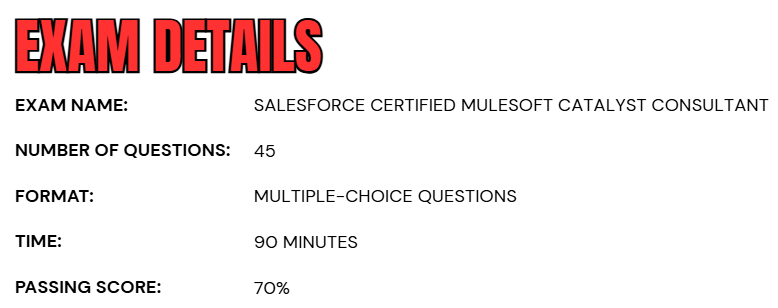
- The Salesforce Certified MuleSoft Catalyst Consultant Exam consists of 45 multiple-choice questions along with up to five additional unscored questions that do not impact the final score.
- Candidates are given a total of 90 minutes to complete the exam, which includes time for the unscored items.
- To pass, a minimum score of 70% is required.
- The exam can be taken either onsite at an authorized testing center or online through a remote proctoring system, offering flexibility for test-takers.
- No hard-copy or online reference materials are permitted during the exam, ensuring that all responses reflect the candidate’s own knowledge and understanding.
- There are no formal prerequisites for this certification, making it accessible to professionals who wish to validate their expertise in MuleSoft Catalyst principles and methodologies.
Course Outline
The Salesforce Certified MuleSoft Catalyst Consultant Exam is designed to assess a candidate’s practical understanding of the Catalyst methodology and its application in delivering business value. It focuses on the following areas:
1. Learn About Applying Catalyst principles: 9%
- Classifying given activities, concepts, or assets as belonging to Catalyst Methodology, Catalyst Knowledge Hub (KH), Catalyst service offering.
- Describing the terms of use and lifecycle of Catalyst itself.
- Explaining the defining characteristics and principles of Catalyst.
- Identifying Catalyst roles given engagement responsibilities.
2. Understand about Leveraging Catalyst Knowledge Hub: 7%
- Explaining the structure and types of Catalyst-related content in Knowledge Hub: assets/articles, playbooks and their steps, delivery approaches and their steps.
- Explaining the types of assets in Knowledge Hub: standards, best practices, examples, tools, and templates.
- Explaining the difference between playbooks and delivery approaches and select the right one for a given purpose.
3. Architecting to Catalyst Principles: 27%
- Articulating the role architecture plays in aligning business and technology.
- Organizing business environment drivers, organizational vision, and strategic goals, objectives, KPIs, and initiatives into a logical network of influences.
- Analyzing the value of each principle of architecting with Catalyst for projects and engagements.
- Articulating the role of integration architecture in realizing end-to-end business processes.
- Creating a backlog of architectural significance to capture engagement scope in a way that is conducive to architecting in a Catalyst context.
- Critique too narrow engagement scope definitions and objections to their widening.
- Architect to maximize reuse and reuse potential without neglecting short-term objectives.
- Analyzing the advantages that architecting on top of a digital platform brings to projects.
- Applying an API-led approach to connectivity on the conceptual and logical level, making idiomatic use of interaction types and patterns.
- Architecting in the context of projects to support the productization of APIs.
- Architect to achieve both short-term outcomes and long-term goals, in a balanced way.


4. Realizing business outcomes with a Catalyst approach: 11%
- Articulating key terminology, business and platform capability benefits, common mistakes when defining business outcomes, the Catalyst Business Outcome Playbook.
- Discovering and defining business outcomes.
- Aligning business outcomes with stakeholders.
- Aligning engagement scope with stakeholders.
- Measure and track business outcomes.
5. Implementing a Center for Enablement (C4E): 15%
- Describing what C4E is and explain its value proposition.
- Explaining the difference between C4E and Center of Excellence (CoE).
- Describing the C4E organizational models.
- Describing the components of building a C4E.
- Explaining the concepts of C4E foundational assets.
- Explaining the importance and process of promoting a C4E.
- Explain activities to maintain an operational and relevant C4E.
6. Learn About Position and reframe with Catalyst methodology: 11%
- Position the benefits of a Catalyst approach to stakeholders.
- Reframing the value of a Catalyst approach when the team is diverging from a Catalyst approach.
- Resolving common objections to a Catalyst approach.
7. Designing composable solutions: 20%
- Describing the principles and properties of composability.
- Identifying the generic patterns, interaction types, and interaction patterns on the conceptual and logical levels.
- Applying these generic patterns in a catalyst context to the most common integration architectural styles and designs such as API-led. EDA, Asynchronous, Batch, ETL, Multi-way synchronization, etc.
- Addressing the cross-cutting concerns such as idempotency, transactionality, reliability, etc., in the solution design adhering to Catalyst principles.
- Identifying between composability and low coupling, high cohesion as well as the benefits and implications of DDD and Bounded Contexts.
- Applying principles of API-led approach to connectivity to common integration patterns beyond simple RESTful APIs, incl. application integration scenarios, EDAs, batch, etc.
- Articulating the benefits of Automation and Intelligently identify the use cases that benefit from it.
Salesforce Certified MuleSoft Catalyst Consultant Exam FAQs

Salesforce Exam Policy
The Salesforce Exam Policy outlines the official rules and procedures for scheduling, rescheduling, canceling, and completing Salesforce certification exams—whether taken online or at an authorized testing center. Adhering to these guidelines ensures a secure, fair, and standardized testing experience for all participants.
– Onsite (Testing Center) Exams
For candidates testing at a Pearson VUE testing center, rescheduling or cancellation requests can be made up to 48 hours before the scheduled exam through the Pearson VUE account. Requests made after this period are typically not accepted. Candidates who fail to appear for their appointment without prior notice will be marked as no-show, resulting in forfeiture of the full exam fee.
– Online Proctored Exams
Candidates taking their exam in an online proctored environment may reschedule or cancel their booking up to 24 hours before the scheduled start time via the Pearson VUE platform without any additional cost. Requests made after this deadline are generally not accommodated, and failure to comply with the policy may lead to loss of the exam fee.
Salesforce Exam Candidate Code of Conduct
All candidates participating in the Salesforce Certification Program must follow the Credential and Certification Program Agreement, which promotes honesty, integrity, and professionalism throughout the certification journey. Candidates are expected to use official Salesforce study materials, engage positively with the Trailblazer Community, and maintain ethical behavior during both preparation and examination.
Engaging in unethical or prohibited activities—such as sharing confidential exam content, receiving or providing unauthorized assistance, or violating testing rules—will result in serious disciplinary action. Consequences may include exam invalidation, credential suspension or revocation, and potential permanent disqualification from the Salesforce Certification Program.
Salesforce Certified MuleSoft Catalyst Consultant Exam Study Guide

Step 1: Review the Official Exam Guide
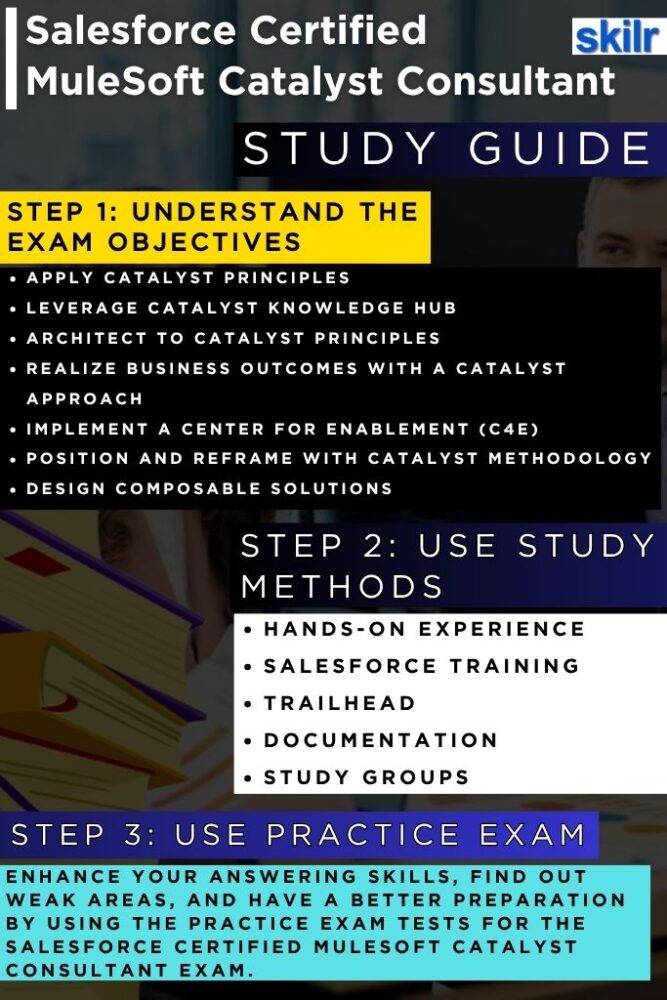
The first and most essential step in your preparation journey is to thoroughly review the Salesforce Certified MuleSoft Catalyst Consultant Exam Guide. This document serves as your blueprint for success, outlining key exam objectives, content areas, and the weightage of each topic. By studying the guide carefully, you gain a clear understanding of what concepts to prioritize—such as Catalyst methodology, engagement planning, business outcome alignment, and composable architecture design. The exam guide also provides insights into the format of questions, duration, and scoring criteria, allowing you to tailor your study plan accordingly. Treat this as your foundation before exploring any other resources.
Step 2: Combine Learning with Hands-On Experience
Salesforce strongly emphasizes a balance between theoretical learning and practical application. While completing recommended MuleSoft training courses is vital, it’s equally important to apply that knowledge in real-world or simulated projects. Participating in MuleSoft implementation scenarios helps you understand how Catalyst principles are used to deliver tangible business outcomes. By combining hands-on experience with structured training, you not only retain information more effectively but also develop the analytical and problem-solving skills needed to handle the case-based questions in the exam.
Step 3: Enhance Your Skills on Trailhead
Trailhead, Salesforce’s official learning platform, is a key resource for preparing for this certification. It provides guided learning paths specifically designed for MuleSoft and integration professionals. Through a combination of modules, projects, and hands-on challenges, Trailhead allows you to build your skill set in a practical, engaging way. You can explore topics such as API-led connectivity, Catalyst playbooks, composable design, and enterprise integration strategy—all of which align with the exam’s competencies. Completing related trails and earning badges demonstrates your growing expertise and helps solidify your readiness for the certification.
Step 4: Gain Practical Experience to Deepen Expertise
To truly master the Catalyst framework, hands-on experience is invaluable. Working directly on integration projects or sandbox environments enables you to apply theoretical concepts to real-world challenges. Focus on developing reusable APIs, designing engagement roadmaps, and implementing Centers for Enablement (C4E) to gain confidence in applying Catalyst methodologies. Exposure to live environments allows you to think critically about architectural trade-offs, governance models, and stakeholder management—skills that are central to a MuleSoft Catalyst Consultant’s responsibilities. The more practical experience you accumulate, the more intuitive the exam scenarios will feel.
Step 5: Engage with Study Groups and Trailblazer Communities
Becoming part of the Salesforce and MuleSoft learning ecosystem can significantly enhance your preparation. Join Trailblazer Community groups, MuleSoft forums, or LinkedIn professional circles where certified consultants and experts discuss exam strategies, share experiences, and offer guidance. Participating in community discussions exposes you to a wide range of real-world use cases, helping you learn from others’ successes and challenges. Additionally, Trailhead Academy offers instructor-led courses and workshops that can provide structured learning and direct interaction with experts. Engaging with peers also helps maintain motivation and accountability throughout your preparation journey.
Step 6: Take Practice Tests and Mock Exams
Before sitting for the actual certification exam, it’s crucial to test your knowledge through practice exams and mock assessments. These simulations closely mirror the real testing environment and question formats, helping you identify strengths and weaknesses. Regularly taking practice tests improves your time management, critical reasoning, and confidence. After each test, review your incorrect answers thoroughly to understand the reasoning behind them. This iterative learning process ensures that you not only memorize concepts but also understand their practical application in different business contexts—a skill that’s key to passing scenario-based exams like this one.
Step 7: Review Official Documentation, Tip Sheets, and User Guides
In the final stages of your preparation, dedicate time to studying official MuleSoft documentation, Salesforce Tip Sheets, and User Guides. These resources provide in-depth technical explanations, best practices, and examples of real-world implementations. Reviewing this material helps reinforce your conceptual understanding of Catalyst principles and keeps you up to date with the latest Salesforce and MuleSoft innovations. Pay special attention to Catalyst playbooks, delivery models, and asset lifecycle management details, as they often form the basis of complex exam questions. Using these official materials ensures that your knowledge is both accurate and aligned with Salesforce’s current standards and methodologies.
