

The Salesforce Certified MuleSoft Platform Architect Exam is designed for experienced professionals who play a key role in defining, implementing, and managing an organization’s Anypoint Platform strategy. This certification validates an individual’s ability to architect and guide the creation of an effective application network using API-led connectivity principles across diverse systems and teams.
Certified MuleSoft Platform Architects are skilled at ensuring that integration solutions align with business goals, technology standards, and long-term scalability. They provide direction in transforming complex integration landscapes into a unified, agile, and secure connectivity ecosystem using MuleSoft’s Anypoint Platform.
– Who Should Take This Exam
This certification is ideal for professionals who are responsible for strategic and architectural decisions related to the Anypoint Platform. You should consider this exam if you:
- Have experience working with API-led connectivity and enterprise integration patterns.
- Are responsible for defining and managing integration architecture across an organization.
- Work closely with business leaders, infrastructure, and security teams to optimize integration strategies.
- Want to establish best practices, reusable assets, and automation to ensure scalability and sustainability of the Anypoint Platform.
Ideal candidates include:
- Enterprise Architects
- Solution Architects
- Integration Architects
- Technical Leads
– Key Competencies Validated
Certified professionals demonstrate the ability to:
- Optimize and scale Anypoint Platform deployments in diverse organizational contexts.
- Integrate Anypoint Platform with existing enterprise systems, tools, and workflows.
- Define governance models and operational processes for long-term platform sustainability.
- Guide teams in building reusable assets and standardizing integration practices across multiple lines of business.
Exam Details
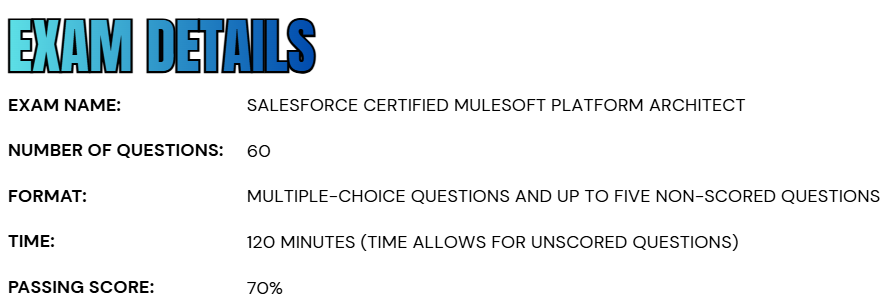
- The Salesforce Certified MuleSoft Platform Architect Exam consists of 60 multiple-choice questions along with up to five unscored questions that do not impact the final score.
- Candidates are given a total of 120 minutes to complete the exam, which includes time allocated for the unscored items. To successfully pass, a minimum score of 70% is required.
- The exam is available in two delivery formats:
- It can be taken as a proctored exam either onsite at an authorized testing center or online in a monitored environment.
- During the exam, candidates are not permitted to use any reference materials, including printed or online resources.
- There are no formal prerequisites for this certification, although practical experience with MuleSoft’s Anypoint Platform and enterprise integration concepts is highly recommended for optimal preparation.
Course Outline
The Salesforce Certified MuleSoft Platform Architect Exam aims to assess a candidate’s knowledge and practical expertise in designing and managing an organization’s Anypoint Platform strategy. It focuses on evaluating the ability to build and guide the development of effective application networks by integrating individual solutions through API-led connectivity across the enterprise. The related objectives areas include:
1. Learn about application network basics: 7%
- Identifying and differentiating between technologies typically used to implement API-led connectivity.
- Describing the role and characteristics of web APIs.
- Correctly assign APIs to tiers according to ownership, functional focus, and rate of change.
- Describing the capabilities and high-level components of Anypoint Platform.
2. Understand about Establishing organizational and platform foundations: 10%
- Advising on establishing a Center for Enablement (C4E) and identify key performance indicators (KPIs) to measure its success.
- Describing the high-level structure and benefits of MuleSoft Catalyst.
- Choosing between options for hosting and managing Anypoint Platform control and runtime planes.
- Comparing and contrasting Identity Management and Client Management options on Anypoint Platform.
- Identifying data residency of different kinds of data (payload, metrics, and others).
3. Process of Designing and sharing APIs: 10%
- Identifying dependencies between an API, its API specification, its implementation, and its clients.
- Describing the creation and publication of reusable API-related assets using API specifications and Anypoint Platform components.
- Identifying changes to an API that would require or not require changing the major/minor/patch component of its semantic version.
- Given a specific power relationship between two Bounded Contexts, choose the most appropriate strategy for mapping between the API data models of these Bounded Contexts.
- Identifying idempotent HTTP methods and HTTP-native support for optimistic concurrency.
4. Learn about Designing APIs using System, Process, and Experience Layers: 12%
- Identifying appropriate APIs to implement a business process and assign them to layers of API-led connectivity.
- Assign APIs to layers according to ownership, functional focus, and rate of change.
- Recommending the most appropriate approach relating the API data model of System APIs to that of their backend system based on specific requirements and organizational characteristics.
- Recommending the use of an Enterprise Data Model or Bounded Context Data Models based on a set of APIs and specific preferences and organizational characteristics.
- Selecting DataGraph only for suitable roles in an application network, according to its high-level features.
5. Learn about Governing web APIs on Anypoint Platform: 17%
- Making appropriate use of API instances and environments in API Manager, taking into account the nature of the API and the underlying data and system.
- Selecting appropriate API policies and other components of the API to support specific non-functional requirements (NFRs).
- Identifying any change(s) required to an API specification to reflect the application of an API policy with specific characteristics.
- Selecting an approach to API policy enforcement based on specific preferences and constraints, including, but not limited to, API proxies/API gateways and Anypoint Service Mesh.
- Secure web APIs using API policies appropriately chosen for the API’s tier (System, Process, Experience).
- Describing in what circumstances and how to pass client ID and secret to a web API.
- Explaining how to request access to an API version for an API client, and how that access is approved and revoked.
- Selecting appropriate API policies to enforce non-functional security constraints on web API invocations.
- Explaining the relationships of Anypoint Platform, external Identity Providers (IdPs), AP Business Groups, and API clients in the context of OAuth 2.0.
- Identifying scenarios needing custom API policies.

6. Process of Architecting and deploying API implementations: 11%
- Explaining how to use auto-discovery to link a web API implementation to an API instance managed with API Manager.
- Identifying requirements that call for the use of an Anypoint Virtual Private Cloud (VPC).
- Compare and contrast options for hosting and managing Anypoint Platform runtime planes.
- Comparing unit and integration tests and specify where MUnit is best employed.
- Explaining options for automated building, testing, and deployment of API implementations and related artifacts in a DevOps setting.
7. Learn about Deploying API implementations to CloudHub: 11%
- Describing the scenarios for which Object Store (OS) should be used with CloudHub.
- Selecting CloudHub worker sizes and configuration as appropriate.
- Given an app deployed to the CloudHub shared worker cloud in one or more regions, describe and predict its reliability and performance characteristics.
- Identifying the defining differences between the CloudHub Shared and Dedicated Load Balancers.
- Compare and contrast the options for CloudHub networking in the presence of customer-owned Amazon VPCs and on-premises data centers.
- Identifying and avoiding single points of failure in CloudHub deployments of API implementations.
8. Meeting API quality goals: 10%
- Design, describe, and differentiate between scenarios that use an OS or caching.
- Selecting resilience strategies that help web API clients guard against failures when invoking APIs.
- Describing when horizontal scaling of an API implementation is or is not likely to benefit response time and throughput as seen by API clients.
9. Understand about Monitoring and analyzing application networks: 12%
- Identifying the components of Anypoint Platform that generate data for monitoring and alerting.
- Describing the metrics collected by Anypoint Platform for API invocations.
- Specifying alerts to define for key metrics of API invocations for all layers of API-led connectivity.
- Specifying alerts to define for Mule applications.
Salesforce Certified MuleSoft Platform Architect Exam FAQs
Salesforce Exam Policy
The Salesforce Exam Policy defines the official rules and procedures governing the scheduling, rescheduling, cancellation, and completion of Salesforce certification exams—whether taken online or at an authorized testing center. Following these policies helps maintain a secure, fair, and consistent testing experience for all candidates.
– Onsite (Testing Center) Exams
For exams taken at a Pearson VUE testing center, candidates may reschedule or cancel their exam up to 48 hours before the scheduled appointment via their Pearson VUE account. Requests submitted after this window are generally not accepted. Candidates who fail to appear for their exam without prior notice will be recorded as a no-show, and the entire exam fee will be forfeited.
– Online Proctored Exams
Candidates opting for an online proctored exam may reschedule or cancel their appointment up to 24 hours before the scheduled start time using the Pearson VUE platform at no additional cost. Requests made after this period are typically not accommodated, and failure to comply with this policy may result in the loss of the full exam fee.
Salesforce Exam Candidate Code of Conduct
All participants in the Salesforce Certification Program are required to adhere to the Credential and Certification Program Agreement, which emphasizes honesty, integrity, and professionalism throughout the certification process. Candidates must rely solely on official Salesforce study materials, participate ethically in the Trailblazer Community, and follow all exam rules during both preparation and testing.
Engaging in unauthorized or unethical activities—including sharing confidential exam content, receiving or providing prohibited assistance, or violating testing protocols—can lead to severe disciplinary actions. These may include exam invalidation, credential suspension or revocation, and even permanent disqualification from the Salesforce Certification Program.
Salesforce Certified MuleSoft Platform Architect Exam Study Guide

Step 1: Review and Understand the Exam Guide
The first and most important step in preparing for the Salesforce Certified MuleSoft Platform Architect Exam is to thoroughly review the official exam guide. This document provides a detailed breakdown of the exam’s structure, including the number of questions, duration, format, and passing score.
More importantly, it highlights the key domains and objectives you will be tested on, such as API-led connectivity, application network design, governance models, and deployment strategies. Understanding the weightage of each topic helps you allocate your study time efficiently and build a targeted preparation plan. Make it a habit to revisit the guide throughout your preparation to ensure your progress aligns with the official exam objectives.
Step 2: Combine Learning with Hands-On Experience
The MuleSoft Platform Architect certification requires more than just theoretical understanding—it demands real, practical experience. Combine formal training with hands-on exposure to Anypoint Platform components such as API Designer, API Manager, Exchange, and Runtime Manager.
Salesforce recommends completing official training courses that cover architecture design, integration best practices, and platform management. In parallel, spend time experimenting with live environments or sandbox instances to apply what you learn. This blend of structured learning and practical execution ensures you not only understand the concepts but can also implement them in real-world enterprise integration scenarios.
Step 3: Build Practical Expertise Through Real Projects
To truly master the skills required for this certification, immerse yourself in real-world project experiences. Working on live or simulated integration projects helps bridge the gap between theory and practice. Design and deploy APIs using Anypoint Platform, establish connectivity between systems, and apply governance and security principles as you would in an enterprise environment.
This level of practical exposure sharpens your architectural decision-making skills and helps you gain confidence in building scalable, secure, and reusable integration solutions. The more you experiment with different business use cases, the better prepared you’ll be for scenario-based exam questions.
Step 4: Develop and Refine Your MuleSoft Skills
Continuous skill enhancement is crucial to becoming an effective MuleSoft Platform Architect. Focus on deepening your understanding of API-led connectivity, integration patterns, and platform automation. Learn how to design high-performing APIs, manage lifecycle governance, and optimize runtime deployments.
Explore advanced capabilities like monitoring, analytics, and hybrid deployments to gain a complete view of how Anypoint Platform operates in complex enterprise ecosystems. Use Trailhead modules and documentation to stay up to date with the latest features and architectural patterns introduced by MuleSoft. Developing a solid technical foundation ensures your architectural designs are both innovative and aligned with best practices.
Step 5: Learn from Experts Through Instructor-Led Training
Enrolling in instructor-led training programs through MuleSoft or Trailhead Academy can be a game changer in your preparation journey. These sessions are conducted by certified experts who have extensive experience implementing MuleSoft solutions across industries. Instructor-led classes help clarify complex concepts, provide practical demonstrations, and offer opportunities to ask questions directly to industry professionals.
They also cover real-world case studies and implementation scenarios that mirror those tested in the certification exam. Participating in these expert-led sessions enhances your conceptual clarity and helps you understand how to translate technical knowledge into effective architecture strategies. However, the related course include:
– Anypoint Platform Architecture: Application Networks (ARC720)
The Anypoint Platform Architecture: Application Networks (ARC720) course is a comprehensive three-day, instructor-led training designed to help professionals master the art of building scalable and connected application networks using API-led connectivity on MuleSoft’s Anypoint Platform.
Through hands-on learning and guided instruction, participants explore how to design, develop, and manage an application network that seamlessly connects applications, data, and devices through reusable APIs. The course focuses on turning individual integration solutions into a unified architecture that promotes agility, reusability, and governance across the enterprise.
This training is ideally suited for senior solution architects and enterprise architects who are responsible for defining integration strategies and implementing API-led architectures within their organizations. By the end of the course, learners gain a strong foundation in applying MuleSoft’s architectural best practices to deliver secure, maintainable, and future-ready connectivity solutions.
Step 6: Engage with Study Groups and the MuleSoft Community
Becoming part of the MuleSoft and Salesforce Trailblazer Community can significantly enrich your preparation experience. Joining study groups, discussion forums, or online learning communities allows you to connect with other professionals pursuing the same certification. You can exchange insights, share study materials, and discuss challenging exam topics.
Participating in these communities not only provides peer support but also exposes you to diverse problem-solving approaches and real-world integration challenges faced by other architects. Engaging with the community keeps you motivated, helps clarify doubts, and ensures that you remain updated with the latest best practices and platform developments.
Step 7: Use Practice Tests and Official Learning Resources
As you near the final stages of your preparation, take official practice exams to evaluate your readiness. Practice tests simulate the real exam environment, allowing you to assess your time management skills and identify weak areas that need more attention. Reviewing your performance helps you refine your approach and build confidence for the actual test.
In addition, make extensive use of Salesforce’s official documentation, Tip Sheets, and User Guides, which cover every aspect of the Anypoint Platform in depth. These materials serve as reliable references to reinforce your knowledge of platform architecture, deployment models, and integration best practices. Combining structured study, consistent practice, and real-world exposure will equip you with the expertise needed to pass the certification exam and perform effectively as a MuleSoft Platform Architect.
