

The Salesforce Certified MuleSoft Platform Integration Architect credential validates an individual’s ability to design and oversee robust, scalable, and compliant integration solutions using MuleSoft’s Anypoint Platform. Certified professionals demonstrate their expertise in working with both technical and non-technical stakeholders to translate functional and non-functional requirements into effective integration designs and implementations.
This certification is intended for professionals who have hands-on experience leading MuleSoft Anypoint Platform implementations and ensuring the quality, governance, and operationalization of integration solutions.
Certified MuleSoft Platform Integration Architects are responsible for defining integration strategies, designing reusable components, and ensuring that enterprise integration projects meet performance, scalability, and security standards.
While not mandatory, holding the Salesforce Certified MuleSoft Developer certification is highly recommended before pursuing this credential.
– Key Skills and Knowledge Areas
Successful candidates for this certification possess the ability to:
- Design high-level integration architectures and guide teams in selecting appropriate MuleSoft components and patterns.
- Choose the most suitable deployment model and configuration of Anypoint Platform (MuleSoft-hosted or customer-hosted).
- Architect Mule applications optimized for various runtime deployment options.
- Apply standardized development methodologies throughout the full lifecycle — including design, development, testing, and deployment.
- Provide technical guidance on performance, scalability, reliability, and monitoring of MuleSoft integrations.
- Develop reusable assets, frameworks, and standards to accelerate API-led integration projects.
– Who Should Take This Exam
The Salesforce Certified MuleSoft Platform Integration Architect exam is ideal for experienced professionals who play a key role in designing and implementing enterprise-level integration solutions. Recommended job roles include:
- Solution Architects – responsible for defining integration strategies and overall architecture.
- Technical Architects – ensuring governance, compliance, and technical quality of integration solutions.
- Senior Developers – with deep experience in MuleSoft application development and deployment seeking to advance into architectural leadership roles.
Exam Details
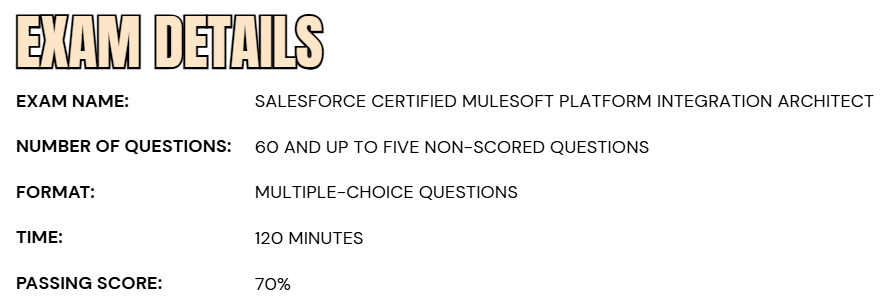
- The Salesforce Certified MuleSoft Platform Integration Architect exam consists of 60 multiple-choice questions, along with up to five unscored items that do not affect the final result.
- Candidates are given 120 minutes to complete the test, which includes time for the unscored questions.
- To pass the exam, a minimum score of 70% is required.
- The exam is delivered in a proctored format, available either onsite at an authorized testing center or online in a monitored environment. During the exam, no reference materials—whether hard-copy or digital—are permitted.
- While there are no formal prerequisites, Salesforce recommends that candidates possess prior hands-on experience with MuleSoft’s Anypoint Platform and a strong understanding of integration design principles before attempting the certification.
Course Outline
The Salesforce Certified MuleSoft Platform Integration Architect exam evaluates a professional’s ability to design, lead, and operationalize Anypoint Platform implementations, ensuring solution quality while effectively bridging the gap between technical and non-technical stakeholders to translate complex business requirements into seamless, scalable integration architectures using various objectives such as:
1. Learn about Initiating integration solutions on the Anypoint Platform: 8%
- Differentiating between functional and non-functional requirements for integration solutions.
- Selecting features of Anypoint Platform for designing and managing web and event-driven application programming interfaces (APIs).
- Selecting deployment options of the Anypoint Platform control plane and runtime plane.
2. Understand about Designing for the runtime plane technology architecture: 15%
- Analyzing the mode of operation of a Mule runtime cluster that differentiates it from other deployment options.
- Designing integration solutions deployed to CloudHub to address specific requirements using CloudHub’s network features.
- Choosing Mule runtime domains and domain-shared configuration only for those requirements that clearly benefit from their capabilities.
- Designing Mule applications making effective use of the implications of the Mule 4 class loader isolation of Mule modules.
- Describing the characteristics and implications of the Mule 4 reactive event processing model.
3. Learn about Designing architecture using integration paradigms: 10%
- Creating high-level integration architectures using API-led Connectivity.
- Creating high-level integration architectures using web APIs and HTTP.
- Creating high-level integration architectures using event-driven APIs and message brokers.
- Designing Mule applications and integration solutions using common messaging patterns and technologies.
4. Process of Designing and developing Mule applications: 15%
- Selecting among available options for setting Mule application properties.
- Selecting and using fundamental features available to all Mule applications.
- Designing Mule applications using core routers available to all Mule applications.
- Describing the fundamental features of the Salesforce Connector.
- Designing Mule applications using common features of core connectors.
- Selecting and using the available sources of metadata in the Transform Message component.
- Designing Mule applications and integration solutions using a Common/Canonical Data Model.
- Correctly apply methods for validating data in Mule applications.
5. Learn about Designing automated tests for Mule applications: 5%
- Designing unit test suites using MUnit and Studio’s related features.
- Identifying test requirements and scenarios that are best addressed using integration testing or performance testing.
6. Process of Designing integration solutions to meet persistence requirements: 10%
- Designing Mule applications using Virtual Machine (VM) queues and the Anypoint VM Connector in all deployment options.
- Designing Mule applications using Object Stores (OSs), the OS Connector, and OS services in all deployment options.
- Designing Mule applications and integration solutions using stateful components that may be configured with an OS.

7. Understand about Designing integration solutions to meet reliability requirements: 8%
- Selecting alternatives to traditional transactions (local or XA) where appropriate and beneficial.
- Recognizing the purpose and characteristics of Until Successful scope, reconnection strategies, and redelivery policies.
- Differentiating between disaster recovery and high availability and the basic approaches to achieving either in all deployment options.
- Designing Mule applications and integration solutions using local and XA transactions for all Mule connectors that support them.
8. Designing integration solutions to meet performance requirements: 7%
- Design Mule applications and integration solutions to meet performance and capacity goals.
- Designing Mule applications using available streaming features in Mule.
- Designing Mule applications to process large sequences/streams of messages.
9. Designing integration solutions to meet security requirements: 8%
- Designing secure access to the Anypoint Platform control plane and APIs.
- Designing secure edge access using Anypoint Security.
- Analyzing and counteracting potential security vulnerabilities of Mule applications.
- Recognizing the audit logging capabilities of Anypoint Platform.
10. Process of Applying DevOps practices and operating integration solutions: 14%
- Creating the high-level design of continuous integration (CI) and continuous delivery (CD) pipelines for Mule applications using MuleSoft-provided Maven plugins.
- Identifying the features and characteristics for automating interactions with Anypoint Platform.
- Designing the logging configurations and options of Mule applications in all deployment options.
- Identifying the features and characteristics of Anypoint Monitoring in all deployment options.
Salesforce Certified MuleSoft Platform Integration Architect Exam FAQs

Salesforce Exam Policy Overview
The Salesforce Exam Policy outlines the official guidelines and procedures for scheduling, rescheduling, canceling, and completing Salesforce certification exams—whether conducted online or at authorized testing centers. Adhering to these rules ensures a secure, fair, and standardized certification experience for every candidate.
– Onsite (Testing Center) Exams
For exams administered at Pearson VUE testing centers, candidates can reschedule or cancel their appointment up to 48 hours before the scheduled time through their Pearson VUE account. Requests made after this period are generally not accepted. Candidates who fail to appear without prior notice will be marked as a no-show, and the entire exam fee will be forfeited.
– Online Proctored Exams
For candidates choosing the online proctored format, rescheduling or cancellation is permitted up to 24 hours before the exam start time via the Pearson VUE platform at no extra cost. Changes requested after this window are typically not accommodated, and missing the appointment without proper cancellation will result in the loss of the full exam fee.
Salesforce Exam Candidate Code of Conduct
All participants in the Salesforce Certification Program must comply with the Credential and Certification Program Agreement, which promotes integrity, fairness, and professionalism throughout the certification journey. Candidates are expected to use only official Salesforce study resources, engage ethically within the Trailblazer Community, and strictly follow exam rules during both preparation and testing.
Any involvement in unauthorized or unethical conduct—such as sharing confidential exam content, seeking or providing prohibited assistance, or violating exam procedures—may result in severe disciplinary actions. These can include exam invalidation, credential suspension or revocation, and potential permanent disqualification from the Salesforce Certification Program.
Salesforce Certified MuleSoft Platform Integration Architect Exam Study Guide
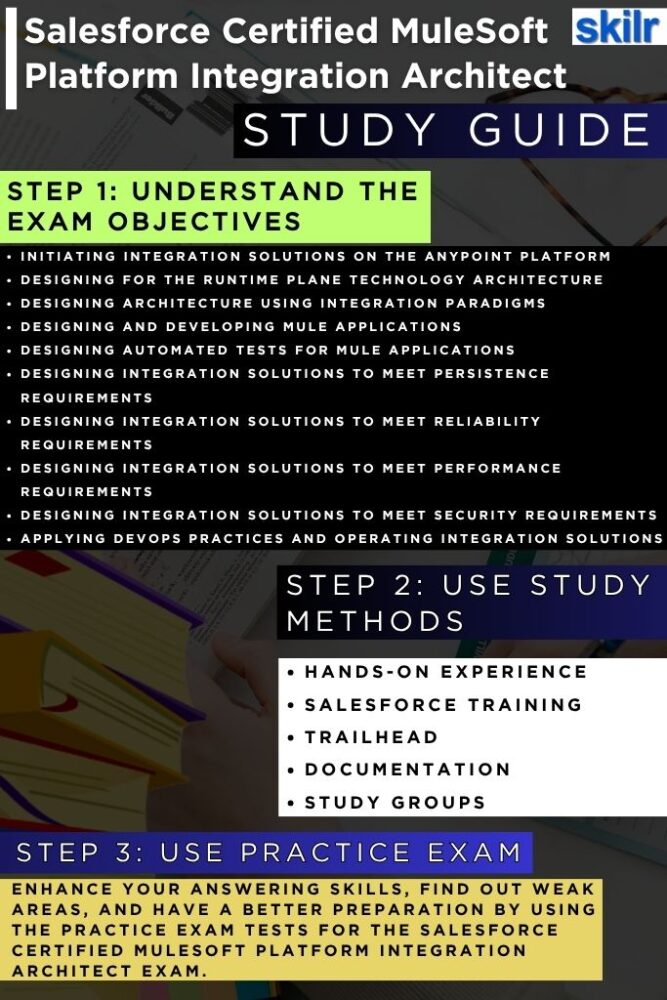
1. Review and Understand the Official Exam Guide
The first step in your preparation journey is to thoroughly review the Salesforce Certified MuleSoft Platform Integration Architect Exam Guide. This document defines the structure of the exam, including the number of questions, scoring system, and time limit. It also breaks down the exam objectives and topic weightage, helping you prioritize your study areas effectively. Key domains such as API-led connectivity, integration design, governance, and deployment models are detailed within the guide, allowing you to create a focused and efficient preparation plan.
2. Gain Practical Experience with Anypoint Platform
Practical exposure is critical for mastering the concepts tested in this certification. Work on real or simulated projects involving API design, system integrations, data transformations, and runtime deployments using Anypoint Platform. Experiment with creating and managing APIs, defining reusable assets, and handling operational concerns like scalability, reliability, and performance monitoring. The more you work within live environments, the more confident you’ll become at applying your knowledge to real integration scenarios—skills that are directly assessed in the exam.
3. Deepen and Expand Your MuleSoft Expertise
As you progress, focus on expanding your MuleSoft and integration architecture skills beyond the basics. Learn about advanced topics such as reusability frameworks, performance tuning, security best practices, and deployment automation. Familiarize yourself with different control plane and runtime plane configurations, both MuleSoft-hosted and customer-hosted, and understand how to design integration solutions that align with enterprise-level governance and compliance standards. This depth of knowledge will not only prepare you for complex exam questions but also position you as a technically proficient MuleSoft Architect.
4. Learn from Experts Through Instructor-Led Classes
Participating in instructor-led training offered by Trailhead Academy or certified Salesforce partners is an excellent way to enhance your preparation. These live sessions are conducted by industry experts and certified MuleSoft architects, providing an interactive learning environment. You’ll gain insights into real-world case studies, architectural decision-making, and implementation strategies—all while having the opportunity to ask questions and clarify complex concepts directly with experienced professionals.
Further, to build a strong foundation, Salesforce’s Trailhead platform offers curated learning paths designed for MuleSoft Architects, which cover essential integration and architecture concepts in a step-by-step manner. Completing official MuleSoft courses helps you understand design principles, integration patterns, and governance best practices. Engaging with both self-paced and instructor-led training ensures a balance of conceptual learning and real-world application. However, the related training includes:
– Anypoint Platform Architecture: Integration Solutions (ARC730)
The Anypoint Platform Architecture: Integration Solutions (ARC730) course is a five-day instructor-led training program that teaches participants how to design and implement complex integration solutions using MuleSoft’s Anypoint Platform and Mule runtime. The course emphasizes building robust, scalable integrations that meet both functional and non-functional requirements across various deployment environments.
This course is ideal for solution architects, technical architects, and senior developers responsible for designing enterprise integration solutions on the Anypoint Platform. It is also strongly recommended for professionals preparing for the MuleSoft Integration Architect I certification.
Participants are expected to have the MuleSoft Developer I certification (or equivalent experience) and prior exposure to integration projects. They should be proficient in JVM-based programming languages and development tools such as Git, GitHub, Maven, and Jenkins. A solid understanding of object-oriented, procedural, and functional programming, as well as core Java concepts like threads, sockets, and JDBC data sources, is essential.
Additionally, learners should have foundational knowledge of enterprise integration concepts, including API design (REST/SOAP), data formats (XML/JSON), messaging systems (JMS, AMQP), and network protocols (TCP/IP, HTTP/HTTPS). Familiarity with security principles—such as certificates, encryption, and authentication mechanisms—and an understanding of enterprise and cloud architecture components like identity providers, load balancers, and DNS servers will further support successful course completion.
5. Engage with Study Groups and the Trailblazer Community
Becoming part of Salesforce’s Trailblazer Community, MuleSoft forums, and local study groups can significantly enrich your preparation. These communities are filled with professionals who have taken or are currently preparing for the same certification. Engaging in discussions, sharing resources, and collaborating on problem-solving exercises can help reinforce your understanding and expose you to different perspectives. Additionally, many certified architects share valuable advice, preparation tips, and real exam experiences that can guide your approach.
6. Practice and Review with Official Documentation and Resources
Before attempting the exam, take practice tests and mock exams to evaluate your readiness. These assessments simulate real exam conditions and help identify any weak areas that require additional study. Complement this with a thorough review of MuleSoft’s official documentation, tip sheets, and user guides, which provide comprehensive explanations of platform components and integration patterns. Revisiting these materials ensures you have both the conceptual clarity and practical knowledge needed to perform well on exam day.
