
The Salesforce Certified Platform Data Architect credential validates the expertise of professionals who design scalable, high-performing, and data-driven solutions within the Salesforce Customer 360 Platform. These architects analyze organizational data environments, assess integration requirements, and develop comprehensive data management strategies to support complex enterprise ecosystems.
– Key Responsibilities of a Salesforce Platform Data Architect
A certified Platform Data Architect plays a vital role in bridging business and technical requirements. Their responsibilities include:
- Designing data models and database architectures aligned with business needs.
- Implementing master data management (MDM) and data governance frameworks.
- Managing Salesforce data models, relationships, and metadata structures.
- Ensuring data quality, accuracy, and stewardship across systems.
- Optimizing performance for large data volumes (LDV) and handling data migration.
- Communicating complex architectural trade-offs to business and IT stakeholders effectively.
– Core Knowledge Areas
Candidates should possess deep expertise in the following domains:
- Data Modeling & Database Design – Custom fields, relationships, and object structures.
- Salesforce Data Management – Leveraging standard and big objects efficiently.
- Data Governance & Stewardship – Policies ensuring accuracy, consistency, and compliance.
- Large Data Volume (LDV) Considerations – Indexing, performance tuning, and migration strategies.
- Integration and Data Movement – Understanding ETL tools, scripting, and mapping client data needs.
- Information Architecture – Covering data sourcing, persistence, MDM, metadata, and delivery mechanisms.
– Ideal Candidate Background
The ideal Salesforce Certified Platform Data Architect typically has:
- 2–3 years of hands-on Salesforce experience.
- 5+ years in supporting or implementing data-centric solutions.
- Proven ability to analyze business requirements and translate them into efficient database and data flow designs.
– Who Should Take This Exam
This certification is designed for professionals who want to demonstrate expertise in enterprise data architecture and governance within Salesforce. It’s ideal for:
- Data Architects who design end-to-end data strategies.
- Technical or Solution Architects responsible for multi-system integration.
- Advanced Salesforce Administrators looking to expand into architectural roles.
- Platform Developers seeking to deepen their understanding of complex data management.
– Skills Validated by the Exam
Candidates are expected to demonstrate proficiency in:
- Salesforce data model and schema design
- Mapping client business needs to data architecture
- Understanding Sales and Service Cloud standard objects
- Handling large data volumes and data migrations
- Applying Salesforce declarative and programmatic tools
- Maintaining data integrity and quality assurance
– Recommended Prerequisites
While not mandatory, the following certifications are highly recommended to strengthen foundational skills:
- Salesforce Platform App Builder
- Salesforce Platform Developer I & II
Exam Details
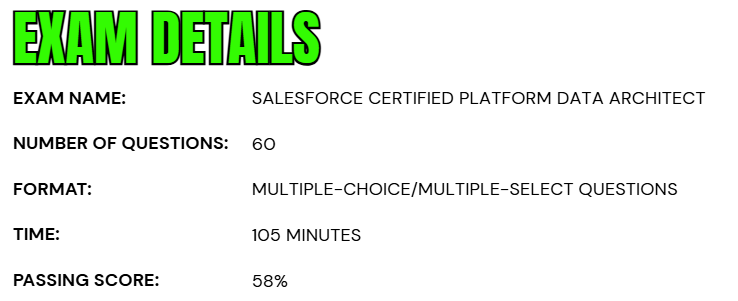
- The Salesforce Certified Platform Data Architect Exam consists of 60 multiple-choice or multiple-select questions, along with up to five unscored questions that do not impact the final result.
- Candidates are given 105 minutes to complete the exam.
- To pass, a minimum score of 58% is required.
- The exam can be taken in two formats:
- Either as a proctored exam at an authorized testing center or through an online proctored environment for remote convenience.
- During the assessment, no reference materials, whether printed or online, are permitted.
- There are no formal prerequisites for this certification, making it accessible to professionals who wish to validate their expertise in Salesforce data architecture and enterprise data management.
Course Outline
The Salesforce Certified Platform Data Architect Exam evaluates a candidate’s proficiency and understanding across the following key knowledge areas and objectives.
1. Understand Data Modeling/Database Design: 25%
- Comparing and contrasting various techniques and considerations for designing a data model for the Customer 360 Platform. (for example, objects, fields & relationships, object features).
- Given a scenario, recommending approaches and techniques to design a scalable data model that obeys the current security and sharing model.
- Comparing and contrasting various techniques, approaches and considerations for capturing and managing business and technical metadata (for example, business dictionary, data lineage, taxonomy, data classification).
- Comparing and contrasting the different reasons for implementing big objects versus standard/custom objects within a production instance, alongside the unique pros and cons of utilizing big objects in a Salesforce data model.
- Given a customer scenario, recommending approaches and techniques to avoid data skew (record locking, sharing calculation issues, and excessive child to parent relationships).
2. Learn About Master Data Management: 5%
- Comparing and contrasting the various techniques, approaches and considerations for implementing master data management (MDM) Solutions (for example, MDM implementation styles; harmonizing and consolidating data from multiple sources; establishing data survivorship rules, thresholds and weights; leveraging external reference data for enrichment; canonical modeling techniques, hierarchy management).
- Given a customer scenario, recommending and using techniques for establishing a “golden record” or “system of truth” for the customer domain in a single org.
- Given a customer scenario, recommending approaches and techniques for consolidating data attributes from multiple sources. Discuss criteria and methodology for picking the winning attributes.
- Given a customer scenario, recommending appropriate approaches and techniques to capture and maintain customer reference and metadata to preserve traceability and establish a common context for business rules.
3. Understand Salesforce Data Management: 25%
- Given a customer scenario, recommending appropriate combination of Salesforce license types to effectively leverage standard and custom objects to meet business needs.
- Given a customer scenario, recommending techniques to ensure data is persisted in a consistent manner.
- Given a scenario with multiple systems of interaction, describing techniques to represent a single view of the customer on the Salesforce Platform.
- Given a customer scenario, recommending a design to effectively consolidate and/or leverage data from multiple Salesforce instances.
4. Learn Data Governance: 10%
- Given a customer scenario, recommending an approach for designing a General Data Protection Regulation (GDPR) compliant data model. Discuss the various options to identify, classify, and protect personal and sensitive information.
- Comparing and contrasting various approaches and considerations for designing and implementing an enterprise data governance program.

5. Understand Large Data Volume Considerations: 20%
- Given a customer scenario, designing a data model that scales considering LDV and solution performance.
- Given a customer scenario, recommending a data archiving and purging plan that is optimal for the customer’s data storage management needs.
- Given a customer scenario, decide when to use virtualized data and describe virtualized data options.
6. Learn About Data Migration: 15%
- Given a customer scenario, recommending appropriate techniques and methods for ensuring high data quality at load time.
- Comparing and contrasting various techniques for improving performance when migrating LDVs into Salesforce.
- Comparing and contrasting various techniques and considerations for exporting data from Salesforce.
Salesforce Certified Platform Data Architect Exam FAQs

Salesforce Exam Policy
The Salesforce Exam Policy outlines the official guidelines and procedures governing the scheduling, rescheduling, cancellation, and completion of all Salesforce certification exams—whether taken online or at an authorized testing center. Adhering to these policies ensures a secure, fair, and consistent testing experience for every candidate.
– Onsite (Testing Center) Exams
For exams administered at a Pearson VUE testing center, candidates may reschedule or cancel their appointment up to 48 hours before the scheduled exam time via their Pearson VUE account. Requests made after this period are generally not accepted. Candidates who do not appear for their scheduled exam without prior notice will be marked as no-shows, and their exam fee will be forfeited.
– Online Proctored Exams
Candidates choosing the online proctored delivery option may reschedule or cancel their exam up to 24 hours before the scheduled start time through the Pearson VUE platform at no additional charge. Changes requested after this deadline are typically not accommodated, and failure to comply with this policy may result in the loss of the full exam fee.
Salesforce Exam Candidate Code of Conduct
All participants in the Salesforce Certification Program are expected to uphold the Credential and Certification Program Agreement, which emphasizes honesty, integrity, and professionalism throughout the certification journey.
Candidates must prepare using official Salesforce study resources, engage ethically within the Trailblazer Community, and follow all exam rules and security protocols during both preparation and testing.
Engaging in any unauthorized or unethical behavior—such as sharing confidential exam materials, receiving or providing prohibited assistance, or violating testing rules—can result in serious disciplinary actions. These may include exam invalidation, credential suspension or revocation, and in severe cases, permanent disqualification from the Salesforce Certification Program.
Salesforce Certified Platform Data Architect Exam Study Guide
Step 1: Understand the Official Exam Guide
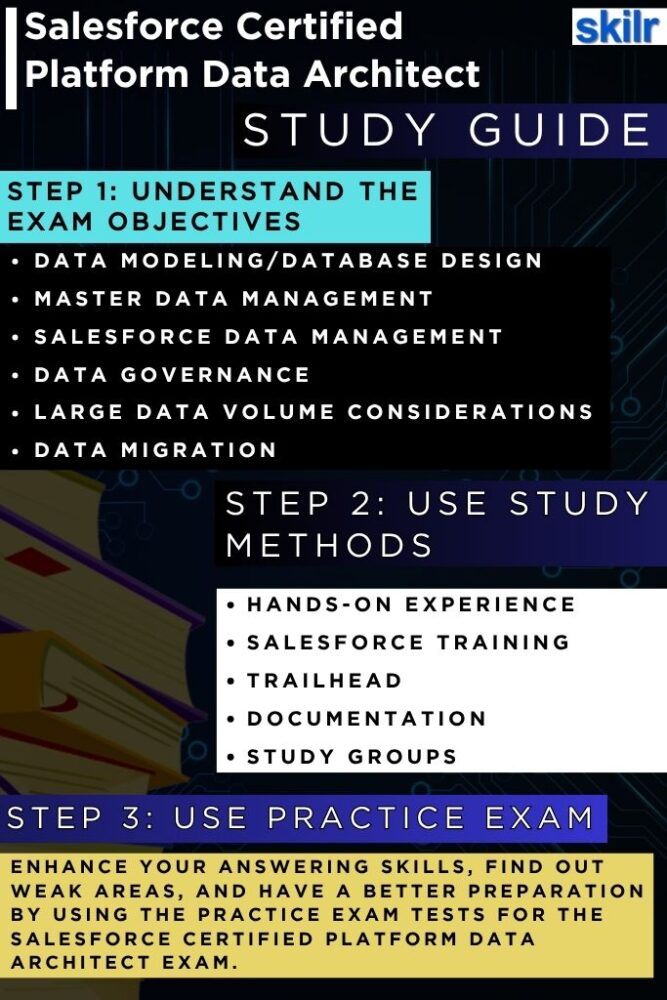
The first and most important step is to thoroughly understand the Salesforce Certified Platform Data Architect Exam Guide. This official document serves as your preparation roadmap, detailing everything from the exam format and time limit to the weighting of each topic domain. Reviewing the guide helps you identify the key knowledge areas—such as data modeling, master data management, and large data volume considerations—that require deeper study. Regularly revisiting the guide ensures that your preparation remains focused on the competencies Salesforce evaluates in the actual exam.
Step 2: Build a Strong Foundation Through Hands-On Experience
Salesforce architecture is learned best through real-world application. Hands-on experience allows you to explore how data is modeled, governed, and integrated within complex enterprise environments. Work on Salesforce projects or sandbox environments where you can design data models, establish object relationships, and manage data migration scenarios. Exposure to large data volumes, performance optimization, and governance frameworks helps you internalize theoretical concepts and prepares you to answer scenario-based questions with confidence.
Step 3: Enroll in Official Salesforce Training Programs
To strengthen your conceptual understanding, participate in official Salesforce training courses available through Trailhead Academy or authorized learning partners. Instructor-led sessions provide comprehensive coverage of topics like data lifecycle management, metadata design, semantic reconciliation, and data governance. These classes, led by Salesforce-certified instructors, encourage interactive discussions and offer practical insights that help bridge the gap between theory and application. The related course include:
– Build Data Architect Expertise – ARC201
Gain the skills to design and implement high-performing enterprise data management solutions on the Salesforce Platform. This three-day instructor-led course covers key data architecture concepts such as data modeling, master data management, large data volumes, data migration, and data governance. Learn to create scalable, efficient data architectures that support business goals, improve decision-making, and enhance operational performance.
This is ideal for architects responsible for developing enterprise-level data management solutions in Salesforce, as well as professionals preparing for the Salesforce Certified Data Architect credential.
Step 4: Skill Up with Salesforce Trailhead
Complement your training with self-paced learning on Trailhead, Salesforce’s official education platform. Trailhead offers a range of Trails, Modules, and Superbadges focused on data management, integration, platform scalability, and governance. Each module features hands-on challenges that simulate real business scenarios, allowing you to apply what you’ve learned directly within Salesforce environments. Completing relevant Superbadges helps demonstrate your practical expertise and readiness for architect-level responsibilities.
Step 5: Engage with Study Groups and the Trailblazer Community
Learning within a collaborative environment can significantly enhance your preparation. Join Salesforce study groups, participate in Trailblazer Community discussions, and attend Trailhead Academy events to interact with other learners and certified professionals. These forums provide valuable exam strategies, real-world case studies, and peer support. Engaging in knowledge exchange helps you clarify complex topics, stay motivated, and gain diverse perspectives on how different organizations implement Salesforce data architecture.
Step 6: Test Your Knowledge with Practice Exams
Once you’ve completed your coursework and hands-on practice, assess your readiness through practice tests. Mock exams replicate the actual testing experience and help you get comfortable with the question style, format, and pacing. Review your results thoroughly to identify weak areas and revisit those topics in greater detail. Consistent practice improves accuracy, enhances time management, and builds the confidence required to perform well under real exam conditions.
Step 7: Review Salesforce Documentation and Tip Sheets
In the final phase of preparation, review official Salesforce documentation, implementation guides, and tip sheets available on the Salesforce Help and Trailhead portals. These resources contain in-depth explanations of data governance models, integration patterns, metadata management, and performance optimization best practices. Understanding how Salesforce handles these topics in enterprise-scale deployments gives you a strong technical foundation and prepares you for advanced, scenario-based exam questions. This final review phase ensures your knowledge is both comprehensive and current.
