

The Salesforce Certified Platform Developer II credential validates a professional’s ability to build advanced, scalable, and maintainable solutions on the Salesforce Lightning Platform. This certification focuses on complex programmatic development, sophisticated data modeling, and the implementation of efficient business logic and user interfaces.
Candidates are expected to design, develop, test, and deploy high-quality programmatic applications using industry-standard patterns, object-oriented principles, and best practices across the platform.
Prerequisite: Salesforce Certified Platform Developer I certification.
– Who Should Take the Exam
This exam is ideal for experienced Salesforce developers who want to demonstrate mastery beyond foundational skills. It is best suited for:
- Professionals with 2–4 years of development experience, including at least 1 year working directly on the Lightning Platform.
- Developers who design and build custom applications, write scalable Apex code, and use Lightning Web Components, Aura Components, and Visualforce.
- Individuals who want to prove competence in advanced programmatic concepts, platform limits, integration capabilities, and multi-layer application design.
- Anyone looking to validate deep understanding of data handling, asynchronous processing, performance optimization, and secure, enterprise-grade solution development on Salesforce.
– Ideal Candidate Profile
A successful Platform Developer II candidate typically demonstrates the following skills and capabilities:
1. Advanced Platform Knowledge
- Strong understanding of Salesforce data modeling, user experience principles, and application lifecycle management.
- Ability to apply best coding practices, testing strategies, and maintainable design patterns in real projects.
2. Solution Design & Custom Development
- Skilled in choosing the right declarative or programmatic approach to address specific business requirements.
- Able to design solutions that align with platform standards and meet complex organizational needs.
3. Apex Excellence & Performance Awareness
- Expertise in writing scalable Apex code that operates efficiently with large datasets.
- Familiarity with governor limits, performance factors, and strategies for optimizing code execution.
- Knowledge of implications when working with high-volume records (approximately 300k–480k).
4. Advanced UI Development
- Experience developing custom interfaces using:
- Lightning Web Components (LWC)
- Aura Components
- Visualforce (advanced usage)
- CSS and JavaScript
- Ability to tune UI components for performance and responsiveness.
5. Security, Sharing & Access Control
- Understanding of both general web security and Salesforce-specific security frameworks.
- Ability to design/implement complex sharing models through declarative and programmatic methods.
6. Testing & Quality Assurance
- Skilled in building comprehensive test plans ensuring:
- High code coverage
- Accurate application behavior
- Scalability and reliability
- Environment-agnostic execution
- Security compliance
- Ability to test LWCs using Jest.
7. Deployment & Lifecycle Expertise
- Familiar with the Salesforce development lifecycle, CI/CD concepts, and various deployment tools (e.g., Change Sets, Metadata API, SFDX).
- Knows when and how to use each tool effectively.
8. Integration & API Proficiency
- Ability to create and consume Apex REST and SOAP services.
- Skilled in making secure callouts from Apex using both protocols.
9. Asynchronous Processing Mastery
- Hands-on experience with asynchronous tools such as:
- Queueable Apex
- Batch Apex
- Scheduled Apex
- @future methods
- Knowledge of when to apply each approach for optimal performance.
10. Error Handling & Design Patterns
- Proficient in applying structured error/exception handling approaches across various application contexts.
- Understands trigger best practices, design patterns, and techniques for reusable, maintainable business logic.
11. Component Placement & Surfacing
- Knows how to display LWCs and Aura components across multiple Salesforce touchpoints, including Lightning pages, Visualforce, and Quick Actions.
Exam Details
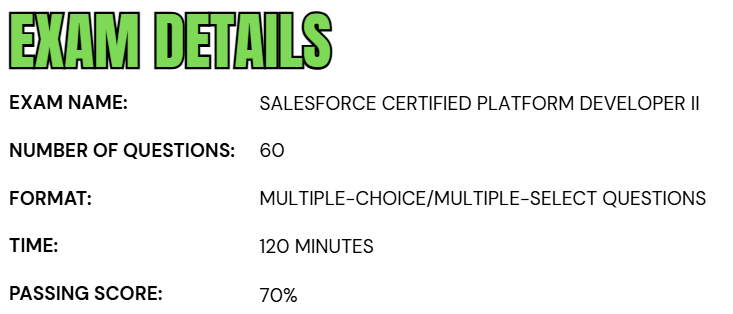
- The Salesforce Platform Developer II exam consists of 60 scored multiple-choice and multiple-select questions, along with up to five unscored items that do not affect the final result.
- Candidates are given 120 minutes to complete the full assessment, ensuring ample time to analyze and respond to each scenario-based question.
- To earn the certification, examinees must achieve a minimum passing score of 70%.
- The exam can be taken either in person at an authorized testing center or through an online proctored environment, offering flexibility based on personal preference and convenience.
- During the exam, no external materials—digital or printed—are allowed, ensuring that all responses reflect a candidate’s own knowledge and hands-on experience.
- A recent enhancement to the exam experience allows candidates to submit feedback on specific questions, providing an opportunity to help improve the assessment and ensure continued relevance and fairness.
Course Outline
The Salesforce Platform Developer II Exam evaluates a candidate’s expertise across a defined set of advanced objectives. Applicants are expected to have practical, hands-on experience building custom applications on the Lightning Platform and be able to demonstrate the effective use of the features and functionalities outlined below.
1. Overview of Advanced Developer Fundamentals: 15%
- Demonstrating knowledge of localization and multi-currency features and capabilities and how they affect coding.
- Given a scenario, justifying using sharing objects and Apex managed sharing.
- Given a scenario, identifying best practices for various types of custom metadata and custom settings, and how to implement required solutions.
2. Understand Process Automation, Logic, and Integration: 27%
- Given a scenario, identifying the considerations of interactions between multiple processes, both declarative and programmatic.
- Given a scenario, proposing and justifying the optimal programmatic or declarative solution.
- Demonstrating knowledge of the best practices for writing Apex triggers.
- Describing the Apex features available for error handling and maintaining transactional integrity.
- Demonstrating how and where to use advanced keywords in a SOQL query structure.
- Analyzing a set of requirements and determine the benefits of using asynchronous Apex coding.
- Given a scenario and requirements, identifying the appropriate dynamic Apex feature to use in the solution.
- Given a scenario, identifying the appropriate publish / subscribe logic for platform events.
- Given a scenario, applying programmatic integration techniques and platform features for inbound and outbound communication.
3. Understand User Interface: 20%
- Given requirements and code snippets for a Lightning web component or Aura component and its Apex controller class, analyze and determine necessary changes to the Apex class.
- Identifying the techniques for using Visualforce to perform actions, partial page refreshes, and asynchronous operations.
- Given a scenario, identifying best practices for displaying errors in the user interface.
- Given a set of requirements, selecting the appropriate Lightning web component, Aura component, or Visualforce solution and describe its benefits.
- Given a scenario, describing the aspects of Lightning web components or Aura components that can be used to cause elements in a component’s markup to display in a responsive manner based on a device’s form factor.
- Given a scenario, implementing the correct method to communicate events through Lightning web components or Aura components.
- Describing the purpose and benefit of static resources in Visualforce, Lightning web components, and Aura components.

4. Learn about Testing, Debugging, and Deployment: 20%
- Applying advanced techniques and tools for testing Apex classes and triggers, such as mocks and stubs.
- Applying techniques and tools for testing and debugging Lightning web components, Aura components, and Visualforce controllers, Visualforce controller extensions, and JavaScript.
- Given a scenario, Apex code, Apex trigger, or Apex test that is not executing as expected, apply techniques and tools to isolate and identify the root cause.
- Given a scenario, formulating the deployment process, supporting tools, and mechanisms for source-driven development.
5. Understand Performance: 18%
- Identifying the common performance issues for user interfaces and demonstrate knowledge of techniques and tools to mitigate them.
- Given a scenario, choose the appropriate logic and query structure to maximize application performance and handle large data volumes.
- Analyzing a given scenario and determine performance improvements that can be achieved with an asynchronous callout.
- Selecting scenarios where code reuse is applicable and how the reuse should be implemented.
- Given sample code, identifying inefficiencies and demonstrate the ability to resolve them.
Salesforce Certified Platform Developer II Exam FAQs

Salesforce Certification Exam Policy
The Salesforce Certification Exam Policy outlines the official standards for scheduling, modifying, canceling, and completing any Salesforce certification exam. These guidelines apply uniformly to all candidates, whether they test online via a remote proctor or at an authorized testing center. The policy is designed to safeguard exam integrity, ensure fairness, and deliver a consistent testing experience for every candidate.
Testing at Authorized Onsite Centers
Candidates taking their exam at a Pearson VUE testing center can reschedule or cancel their appointment through their Pearson VUE account, as long as the change is made at least 48 hours before the scheduled exam time. Requests submitted after this deadline are typically not permitted. Failure to appear for the appointment without a valid, timely modification results in a no-show status, and the full exam fee is forfeited.
Online Proctored Exam Sessions
For those taking the exam remotely, Pearson VUE allows rescheduling or cancellation up to 24 hours before the exam start time. Any adjustments requested past this window are usually denied. Missing the online session without updating the appointment within the allowed timeframe also leads to forfeiture of the exam fee.
Salesforce Exam Candidate Code of Conduct
All Salesforce certification candidates must demonstrate professionalism, honesty, and ethical behavior throughout the registration and examination process. By scheduling an exam, candidates agree to follow the Salesforce Credential and Certification Program Agreement, which establishes expectations for ethical preparation and compliant test-taking behavior.
Candidates must rely solely on official Salesforce learning resources, participate responsibly within the Trailblazer Community, and adhere to all proctoring and security requirements. Prohibited actions—such as seeking or sharing actual exam questions, using unauthorized materials, or disregarding proctor instructions—may lead to disciplinary action, including score invalidation, certification suspension or revocation, or permanent removal from the Salesforce Certification Program.
Salesforce Certified Platform Developer II Exam Study Guide
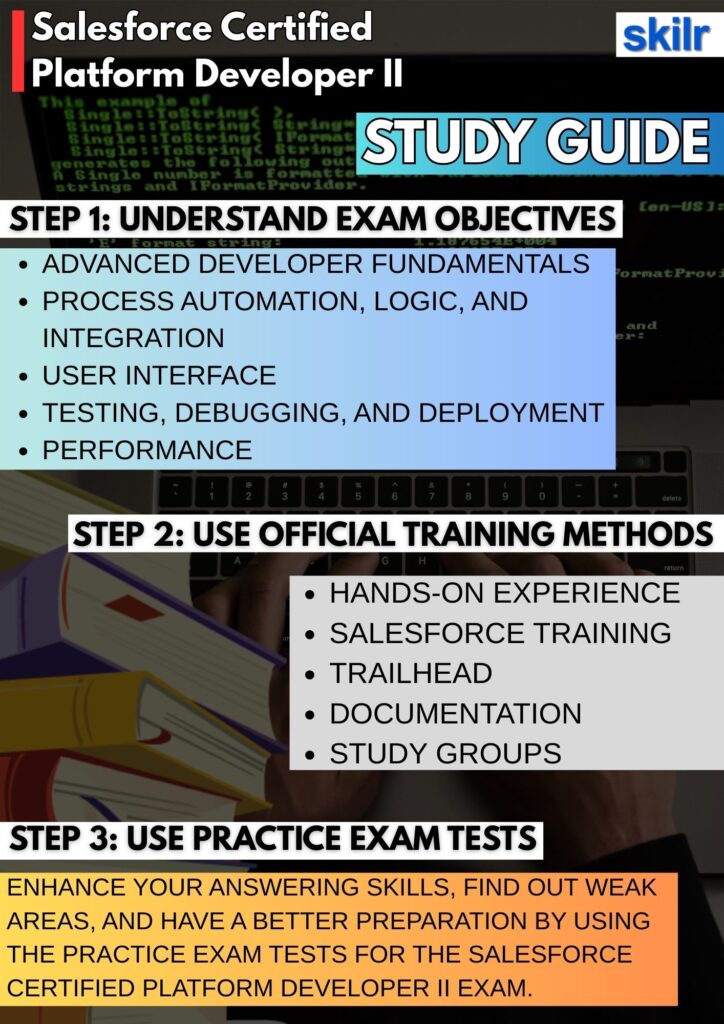
1. Start with the Official Exam Guide
Your preparation should begin with a careful study of the Salesforce Platform Developer II Exam Guide. This document is the foundation of your learning plan, as it outlines the structure of the exam, the distribution of topics, and the competencies that Salesforce expects you to master. By understanding the objectives in detail, you gain clarity on the areas that require deeper attention—such as Apex best practices, platform limits, integrations, asynchronous processing, and Lightning development.
The Exam Guide also helps you set realistic expectations for the types of scenario-based questions you will encounter, making it easier to organize your study schedule and allocate time more efficiently.
2. Combine Hands-On Experience with Formal Training
The Platform Developer II exam is designed to test real-world application of advanced development skills, so a mix of practical experience and formal coursework is essential. Begin by completing Salesforce training programs—either self-paced or instructor-led—to strengthen your understanding of core concepts. However, training alone is not enough. You should actively apply what you learn by working on custom development tasks within a sandbox or real Salesforce implementation.
Designing complex Apex classes, optimizing queries, troubleshooting governor limits, refactoring code using design patterns, and developing Lightning Web Components will help you internalize concepts far more effectively than theoretical study alone. This blend of structured training and hands-on problem-solving is what truly builds the depth of knowledge required for PDII.
3. Deepen Your Knowledge Through Trailhead
Trailhead offers a rich set of materials that closely align with the exam content. Completing relevant trails, modules, and hands-on projects allows you to put theory into practice while gaining exposure to real platform features. You can work through advanced Apex techniques, asynchronous processing patterns, Lightning Web Components, secure development principles, and data handling at scale.
Trailhead’s structured learning paths make it easy to progress from foundational to expert-level topics, and the scenario-based challenges help reinforce problem-solving skills. Spending time on Trailhead not only strengthens your conceptual understanding but also aligns your habits with Salesforce-recommended best practices.
4. Gain Practical Experience to Advance Your Expertise
To succeed in the PDII exam, you must be comfortable building solutions that work within Salesforce’s constraints while maintaining performance, scalability, and reliability. Practical experience enables you to confidently navigate complex topics such as multi-layered architecture, integration patterns, error-handling strategies, asynchronous transactions, and data-intensive processing.
By engaging with real world or simulated projects, you learn how to design reusable components, optimize SOQL queries, refactor for bulk processing, manage transactions effectively, and build UI components with Lightning Web Components or Aura. These experiences help transform theoretical concepts into instinctive skills, making it easier to understand scenario-based questions during the exam.
5. Leverage Trailblazer Groups, Communities, and Trailhead Academy
Joining Salesforce communities and study groups is an invaluable part of your preparation. The Trailblazer Community, developer groups, and regional meetups often host technical discussions, webinars, and hands-on workshops that expose you to different perspectives and advanced problem-solving approaches. These groups create opportunities to ask questions, seek clarification on challenging topics, and learn from seasoned developers who have already passed the PDII exam.
Trailhead Academy’s instructor-led courses offer additional depth and structure, helping you develop confidence in areas where you may feel less experienced. Engaging with a community also keeps you updated on platform changes, which is especially important since Salesforce evolves with every release.
6. Use Practice Exams to Assess Your Readiness
Practice exams play a critical role in preparing for the Platform Developer II exam because they simulate the style, difficulty, and timing of real exam questions. Taking multiple mock tests helps you build stamina, improve decision-making under time pressure, and develop strategies for tackling multi-select questions.
After each practice test, reviewing the explanations for correct and incorrect answers is essential, as it highlights gaps in understanding and reinforces the reasoning behind best practices. Over time, consistent practice will reveal patterns in the types of questions asked, helping you refine your exam strategy and build confidence.
7. Study Salesforce Documentation, Tip Sheets, and Additional Resources
Salesforce’s official documentation is one of the most comprehensive resources available for understanding platform behavior, API capabilities, coding standards, and performance considerations. Reviewing Developer Guides, Apex reference materials, API documentation, and architecture resources gives you a detailed, authoritative understanding of the topics covered in the exam. Tip sheets, release notes, and implementation guides offer additional insights into platform updates and refined best practices.
Beyond Salesforce’s official resources, consider exploring blogs, GitHub repositories, technical deep dives, whitepapers, and expert-led video tutorials. These supplemental materials provide practical examples and advanced explanations that can significantly broaden your understanding and help you master the more challenging exam objectives. The additional resources include:
- Apex Developer Guide
- Lightning Web Components Developer Guide
- SOAP API Developer Guide
- REST API Developer Guide: Introducing Lightning Platform REST API
- Salesforce Reports and Dashboards REST API Developer Guide
- Salesforce Development Tools
- Salesforce Tools and Toolkits
- SOQL and SOSL Reference
- Lightning Aura Components Developer Guide
- Visualforce Developers Guide
