

The Salesforce Certified Platform Developer certification validates your ability to build, test, and deploy custom solutions on the Lightning Platform using programmatic tools such as Apex, Visualforce, Lightning Web Components, and Flow. Certified developers are expected to design business logic, create custom interfaces, and extend Salesforce with scalable, efficient, and secure code.
This exam targets professionals who have hands-on experience developing applications on Salesforce and a solid understanding of the platform’s programmatic features. It evaluates your ability to apply core development concepts, work within Salesforce’s multi-tenant architecture, and follow industry best practices to solve complex business problems.
The exam also serves as the required prerequisite for the Salesforce Certified Platform Developer II certification, making it a foundational step in a Salesforce developer’s learning path.
Candidates typically have:
- 1–2 years of development experience, including at least 6 months working on the Lightning Platform.
- Practical experience creating data-driven applications and working with relational databases.
- Knowledge of object-oriented programming using languages such as Apex, Java, JavaScript, C#, or TypeScript.
- Understanding of governor limits, Salesforce architecture, MVC patterns, and component-based designs.
- Familiarity with Salesforce schema and features like formula fields and roll-up summary fields.
- Ability to decide between declarative and programmatic approaches based on business needs.
- Awareness of the capabilities of Salesforce AI products, including Agentforce, where applicable.
- Experience writing efficient Apex code and following platform best practices.
- Proficiency in using Flow, Apex, Lightning Components, and Visualforce to extend platform functionality.
- Hands-on knowledge of testing, debugging, deployment processes, and various development environments.
It’s important to note that this certification does not require expertise in administering standard Salesforce applications, building mobile apps, publishing managed packages to the AppExchange, tuning performance, or designing integration patterns such as callouts, APIs, or email services.
– Who Should Take the Exam?
The Salesforce Certified Platform Developer exam is ideal for:
- Aspiring Salesforce Developers who want formal validation of their programmatic skills.
- Junior to Mid-Level Developers transitioning into Salesforce development roles.
- Technical Consultants who configure and extend Salesforce solutions using custom logic.
- Backend and Full-Stack Developers familiar with object-oriented programming and seeking to specialize in Salesforce.
- Professionals preparing for Platform Developer II, as PD1 is the required first step.
- Developers working with Apex, LWC, or Flow who want to solidify their expertise with a globally recognized credential.
Exam Details
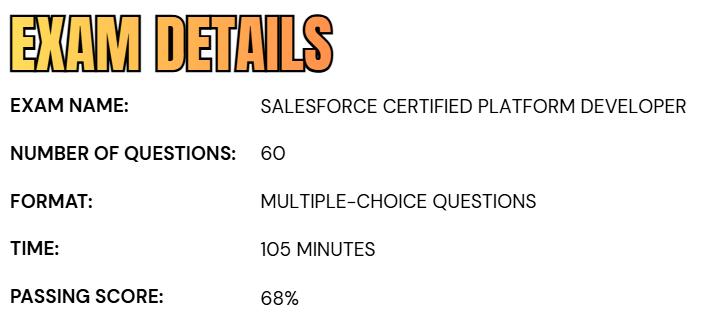
- The Salesforce Certified Platform Developer Exam consists of 60 scored multiple-choice questions, with the possibility of up to five additional unscored questions included to collect performance data. These unscored items are placed randomly throughout the test and do not affect the final score.
- Candidates are given 105 minutes to complete the exam and must achieve a minimum passing score of 68%.
- The exam can be taken either at an authorized testing center or through an online proctored environment, offering flexibility based on the candidate’s preference.
- During the assessment, no reference materials—whether digital or printed—are permitted, ensuring a secure and knowledge-based evaluation experience.
Course Outline
The Salesforce Certified Platform Developer Exam evaluates a candidate’s proficiency and understanding across the following objective areas.
1. Learn About Developer Fundamentals: 27%
- Understanding multi-tenant concepts and design frameworks, such as MVC architecture and Lightning Component Framework.
- Given a scenario, identifying common use cases and best practices for declarative versus programmatic customizations, including governor limits, formula fields, and roll-up summaries.
- Given a scenario, determining, creating, and accessing the appropriate data model including objects, fields, relationships, and external IDs.
- Understanding use cases and limitations of using Agentforce for Developers.
2. Understand Process Automation and Logic: 28%
- Identifying the capabilities of the declarative process automation features.
- Understanding how to declare variables, constants, methods, modifiers, Apex interfaces, and the appropriate use cases for each.
- Given a scenario, assessing how Apex control flow statements will execute and when to apply different control flow statements.
- Given a scenario, writing SOSL, SOQL, and DML statements in Apex, and assess what they will return.
- Given a scenario, following best practices to write Apex classes and triggers.
- Given a scenario, understanding governor limits and their implications on Apex transactions.
- Describing the relationship between Apex transactions, the save order of execution, and the potential for recursion and/or cascading.
- Implementing exception handling in Apex, including custom exceptions as needed.
- Given a scenario, using declarative functionality and Apex together to automate business logic.

3. Learn about User Interface: 25%
- Given a scenario, preventing user interface and data access security vulnerabilities.
- Given a scenario, displaying and using custom user interface components, including Lightning components, Flow, and Visualforce.
- Describing the use cases and best practices for Lightning Web Components, including the framework, benefits, and events.
- Given a scenario, implementing Apex to work with various types of page components, including Lightning components, Flow, and Agentforce.
4. Understand Testing, Debugging, and Deployment: 20%
- Writing and executing tests for triggers, controllers, classes, and flows using various sources of test data.
- Given a scenario, know how and when to use the Salesforce Developer tools such as Salesforce DX, Salesforce CLI, and Developer Console.
- Describing how to approach debugging system issues and monitoring flows, performance, asynchronous, and batch jobs.
- Describing the environments, requirements, and process for deploying code and associated configurations.
Salesforce Certified Platform Developer Exam FAQs

Salesforce Certification Exam Policy
The Salesforce Certification Exam Policy defines the official rules for scheduling, updating, canceling, and completing any Salesforce certification exam. These standards apply to all candidates, regardless of whether the exam is taken online with a remote proctor or onsite at an authorized testing center. The policy ensures exam security, fairness, and a uniform testing experience across all delivery methods.
Testing at Authorized Onsite Centers
Candidates testing at a Pearson VUE center may modify or cancel their appointment through their Pearson VUE account, provided the change is submitted at least 48 hours before the scheduled exam time. Requests made after this window are normally not accepted. Missing the appointment without making the required updates results in a no-show designation, and the full exam fee is forfeited.
Online Proctored Exams
For remote exam sessions, Pearson VUE permits rescheduling or cancellation up to 24 hours before the exam begins. Adjustments requested after this period are generally declined. Failure to attend the online exam without updating the appointment within the permitted timeframe also leads to forfeiture of the exam fee.
Salesforce Exam Candidate Code of Conduct
All candidates pursuing Salesforce certifications are expected to uphold professional, honest, and ethical behavior during exam preparation, registration, and test delivery. By booking an exam, candidates agree to follow the Salesforce Credential and Certification Program Agreement, which outlines acceptable conduct and responsible exam practices.
Candidates must use only authorized Salesforce learning materials, engage ethically within the Trailblazer Community, and comply with all exam security and proctoring requirements. Actions such as sharing or requesting real exam questions, using unapproved resources during the test, or violating proctor instructions are strictly prohibited. Such misconduct can result in score cancellation, suspension or revocation of certifications, or even permanent removal from the Salesforce Certification Program.
Salesforce Certified Platform Developer Exam Study Guide
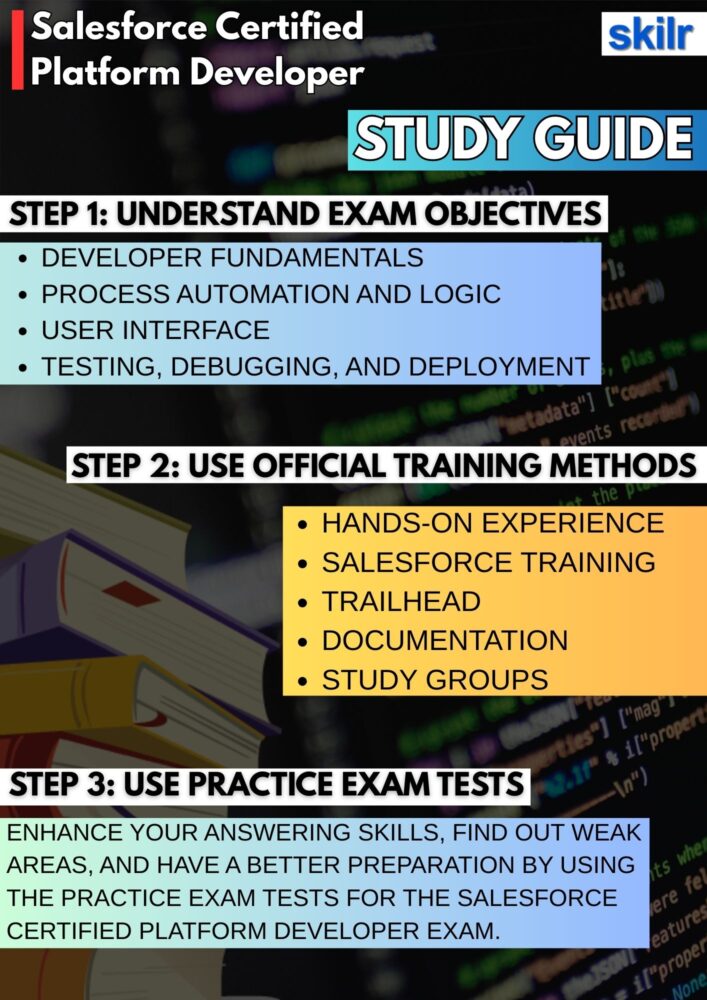
1. Understanding the Official Exam Guide
A strong preparation journey begins with a thorough review of the Salesforce Certified Platform Developer Exam Guide. This resource clearly outlines the exam structure, weightage of each topic, delivery format, scoring criteria, and the specific skills Salesforce expects every certified developer to demonstrate.
Studying the guide helps you understand the depth and breadth of the content areas—ranging from Apex logic and database interactions to Lightning Web Components and deployment strategies. The guide acts as your blueprint, enabling you to plan your study path efficiently and prioritize areas that require deeper attention.
2. Combining Hands-On Experience with Structured Training
Real-world practice is essential for success in this exam. The Platform Developer certification is heavily application-oriented, so it is important to actively build custom business logic, write Apex classes and triggers, experiment with asynchronous processes, and develop Lightning components. Alongside hands-on work, completing Salesforce-approved training courses helps reinforce fundamental and advanced concepts, ensuring you understand both the practical and theoretical aspects of development. Formal training also exposes you to platform limitations, design patterns, and best practices that may not be immediately apparent through practice alone.
3. Building Skills Through Trailhead Learning Paths
Trailhead offers a wealth of curated modules, projects, and Superbadges tailored specifically for developers preparing for the exam. By completing developer-focused trails, you can strengthen your understanding of object-oriented programming on the platform, governor limits, SOQL and DML operations, debugging tools, and the core principles behind Lightning Web Components.
Superbadges, in particular, serve as mini real-world challenges that test your ability to apply concepts in practical scenarios, giving you experience that mirrors what the exam expects. Trailhead ensures you build not just conceptual clarity but also platform-confidence through guided, hands-on tasks.
4. Growing Expertise Through Continuous Practical Application
To truly master the skills required, you must apply your knowledge in real development environments. This involves building sample applications, experimenting with different schema designs, optimizing code to stay within governor limits, writing robust unit tests, and pushing code between sandboxes using change sets or Salesforce DX.
Regular exposure to real problem-solving helps you understand how various components—Apex, LWC, Flow, and database operations—interact within Salesforce’s multi-tenant architecture. The more you build and break things, the stronger your intuition becomes when answering scenario-based exam questions.
5. Learning from Experts Through Instructor-Led Training
Instructor-led classes, especially through Trailhead Academy, offer focused and guided learning from certified Salesforce experts. These trainers help simplify complex concepts like asynchronous Apex, transactional behavior, bulkification strategies, and testing frameworks. Their real-world examples, demonstrations, and interactive exercises give you deeper insights into how theoretical concepts apply in actual implementations.
Attending these sessions provides a strong knowledge foundation, clarifies common misconceptions, and prepares you for the type of logic-based problem-solving the exam demands. The related training includes:
– Build Applications Programmatically on the Salesforce Platform (DEX450)
The DEX450 course teaches developers how to build custom, programmatic applications on the Salesforce Platform using Apex, Visualforce, and Lightning Web Components. Over five days of instructor-led training, participants learn to write, test, and deploy custom logic while creating tailored user interfaces with Visualforce and LWC. The course also covers how Apex works alongside declarative tools, introduces essential no-code automation features, and explains key considerations when developing in a multi-tenant environment.
This course is ideal for developers responsible for implementing custom business logic and UI components. While prior experience with object-oriented programming and basic Salesforce configuration is helpful, it is not strictly required.
6. Engaging in Study Groups and the Trailblazer Community
Joining the Trailblazer Community, local developer meetups, online forums, and dedicated study groups significantly enhances your preparation. These communities allow you to discuss challenging topics, exchange practical tips, troubleshoot problems collaboratively, and learn from developers who have already passed the exam.
Group discussions often uncover insights you may not encounter during self-study, and community support keeps you motivated and accountable throughout your preparation journey. Trailhead Academy communities also host study sessions, webinars, and events that provide additional guidance.
7. Practicing with Mock Exams and Reviewing Official Documentation
Practice tests are a crucial component of exam readiness, helping you evaluate your strengths and identify areas that require further review. They simulate the exam environment, train you to manage time effectively, and familiarize you with the style of questions you will encounter. Complementing practice exams with a thorough review of official Salesforce documentation—such as developer guides, release notes, Apex reference materials, and tip sheets—ensures you have accurate, up-to-date knowledge. Salesforce documentation often provides deeper technical clarity on topics that may appear in the exam, making it an essential part of your study routine.
8. Exploring Additional Resources for Comprehensive Mastery
Beyond Salesforce’s official learning platforms, you can enhance your understanding through technical blogs, expert-led webinars, YouTube tutorials, whitepapers, and community-contributed learning materials. These resources offer alternative explanations, real-world implementation stories, and practical development strategies that broaden your perspective. Leveraging a wide range of material helps you build well-rounded expertise, making you more confident and prepared when tackling the various scenario-based and conceptual questions on the exam. The additional resources include:
- Object Reference for Salesforce and Lightning Platform
- Apex Developer Guide
- Apex Reference Guide
- Lightning Web Components Developer Guide
- Lightning Aura Components Developer Guide
- Visualforce Developer Guide
- Platform Events Developer Guide
- Salesforce Developer Limits and Allocations Quick Reference
- SOQL and SOSL Reference
