
The Salesforce Certified Platform Development Lifecycle and Deployment Architect certification recognizes professionals who excel in implementing DevOps practices, lifecycle management, and governance frameworks within the Salesforce environment. This exam validates a candidate’s ability to create efficient release strategies, design scalable deployment solutions, and communicate technical approaches to both business and IT teams.
– Who Should Take This Exam
This certification is best suited for experienced Salesforce professionals who are responsible for designing, managing, and optimizing the end-to-end development and deployment process across Salesforce environments. It’s ideal for individuals who bridge the gap between technical execution and organizational strategy.
Recommended Background:
- Bachelor’s degree in Computer Science or a related discipline.
- 2–3 years of hands-on experience with the Salesforce Platform.
- 1–2 years of exposure to Salesforce DevOps and lifecycle management.
- Practical experience with governance models and project delivery methodologies (Agile, Waterfall, or Hybrid).
Common Job Roles:
- Technical Lead
- Release Manager
- Delivery Lead
- Environment or Operations Manager
- Test Manager
- Technical Architect
– Core Skills and Knowledge Areas
To earn this certification, candidates must demonstrate the ability to:
- Select and apply appropriate development methodologies while understanding their trade-offs.
- Design efficient DevOps and release management architectures for Salesforce projects.
- Clearly communicate technical design choices to various stakeholder levels.
- Implement lifecycle management best practices for design, deployment, and performance tracking.
- Develop and manage secure, scalable environments for testing and production.
- Understand and use Salesforce Metadata and Tooling APIs effectively.
- Leverage source control systems, branching models, and continuous integration pipelines.
- Apply automated testing and cross-release validation strategies.
- Contribute to governance and compliance frameworks within enterprise environments.
- Design resilient backup and recovery mechanisms.
– Key Areas That May Require Extra Focus
Candidates may find additional preparation useful in:
- Configuring complex Salesforce environments.
- Integrating declarative and programmatic development.
- Setting up CI/CD pipelines and managing automated testing.
- Establishing governance and multi-org management strategies.
Exam Details
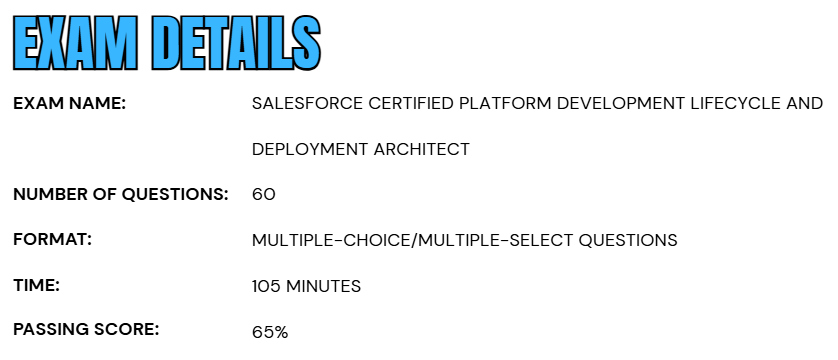
- The Salesforce Certified Platform Development Lifecycle and Deployment Architect exam consists of 60 multiple-choice and multiple-select questions, designed to evaluate a candidate’s knowledge of DevOps, lifecycle management, and governance within the Salesforce ecosystem.
- Candidates are given 105 minutes to complete the exam, and a minimum score of 65% is required to pass.
- The exam can be taken either onsite at an authorized testing center or through an online proctored environment, offering flexibility in how professionals choose to take it.
- No reference materials, whether printed or digital, are allowed during the test.
- There are no formal prerequisites for this certification, although practical experience with Salesforce platform development and deployment is highly recommended for success.
Course Outline
The Salesforce Platform Development Lifecycle and Deployment Architect exam evaluates a candidate’s expertise using the following areas:
1. Overview of Application Lifecycle Management: 8%
- Given the project risk and customer requirements, explaining how to assess the benefits and risks of the different development methodologies and recommend the appropriate governance strategies based on the customer maturity.
2. Understand Planning: 13%
- Given a complex customer scenario, assessing application lifecycle management maturity and identify the people, technology, and processes required.
- Understanding customer environment risks and articulate appropriate mitigation strategies.
- Given a customer scenario, analyzing and recommending the appropriate governance framework.
- Given a customer scenario involving a new Salesforce release (Summer, Winter, Spring), recommending the appropriate strategy to mitigate risks.
3. Learn about System Design: 15%
- Explaining the advantages of using agile tools to support an agile development process.
- Given a customer landscape and their requirements, evaluating business, technical, and architectural considerations that support the defined org strategy.
- Given a customer scenario, defining an environment (sandbox) strategy that utilizes the correct sandbox types (for example, multiple project streams, training requirements, staging, production, and hotfixes).
- Given a scenario, compare, contrast, and recommend the components and tools of a successful deployment strategy.
4. Overview of Building: 14%
- Given a customer scenario, explaining how to use source control branching/versioning/merging, and recommend appropriate strategies.
- Describing the appropriate approaches to building test data strategy and unit test to ensure successful code (positive, negative, permission-based, large data volume).
- Given a customer scenario, describing the appropriate development model (org-based vs package-based) and development environment (scratch org vs sandboxes).
- Describing the methods to ensure the delivery of quality code, such as coding standards, pull requests, code review, and static code analysis.

5. Understand Deploying: 14%
- Given a scenario, describing the capabilities, limitations, and considerations when using the Metadata and Tooling APIs for deployment.
- Given a scenario, describing approaches to handle pre and post-deployment steps, including items not supported via the APIs.
- Given a scenario, describing approaches to manage and deploy technical reference data.
6. Learn about Testing: 13%
- Given a customer scenario, describing and recommending an appropriate testing methodology.
- Given a customer testing strategy, describe the appropriate test execution methodology and coverage requirements.
- Given a customer scenario, describing and recommending a unified test data strategy that utilizes representative data in a secure manner throughout the development lifecycle.
7. Process of Releasing: 13%
- Given a scenario, analyzing and explaining the use cases and considerations when using managed, unmanaged, and unlocked packages.
- Apply map sandbox strategy to a specific release plan, taking into consideration multiple project streams, training requirements, staging, and hotfixes.
- Given a customer scenario, describe and recommend an appropriate release management strategy.
8. Understand about Operating: 10%
- Given a detailed customer environment scenario including a specific request, explain the implications of incorporating the request directly in a production environment.
- Given a customer scenario where changes are made directly in production, explain the implications on the development lifecycle and steps to integrate changes into application lifecycle management.
- Given a multi-org customer scenario, compare and contrast approaches for managing common release artifacts.
Salesforce Certified Platform Development Lifecycle and Deployment Architect Exam FAQs

Salesforce Certification Exam Policy
The Salesforce Certification Exam Policy defines the official rules and procedures for scheduling, rescheduling, canceling, and completing Salesforce certification exams—whether taken online or at an authorized testing center. These guidelines are designed to maintain exam security, fairness, and consistency for all candidates.
– Onsite Testing Center Exams
Candidates taking their exam at a Pearson VUE testing center can modify or cancel their appointment up to 48 hours before the scheduled exam time through their Pearson VUE account. Any change requests made after this deadline are generally not accepted. Candidates who fail to appear for their appointment without prior notice will be recorded as no-shows, resulting in the forfeiture of their exam fee.
– Online Proctored Exams
Those opting for the online proctored format may reschedule or cancel their exam up to 24 hours before the scheduled start time via the Pearson VUE platform. Requests submitted after this cutoff are typically denied, and missing the scheduled session without notice may lead to loss of the full exam fee.
Salesforce Candidate Code of Conduct
All individuals pursuing Salesforce certifications are expected to comply with the Salesforce Credential and Certification Program Agreement, which upholds the values of honesty, integrity, and professionalism throughout the certification process. Candidates should prepare using authorized Salesforce learning resources, engage responsibly within the Trailblazer Community, and strictly follow exam security and testing protocols.
Any form of misconduct or unethical behavior—including sharing exam content, seeking or offering unauthorized help, or breaching testing rules—can lead to severe consequences. Disciplinary actions may include exam invalidation, credential suspension or revocation, and in serious cases, permanent disqualification from the Salesforce Certification Program.
Salesforce Certified Platform Development Lifecycle and Deployment Architect Exam Study Guide
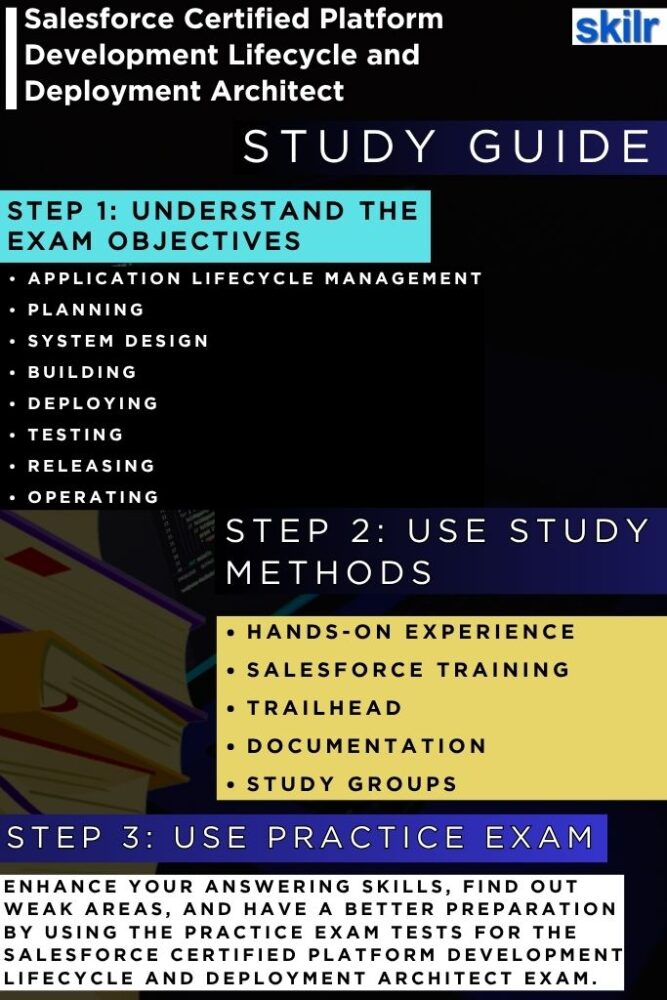
Step 1: Understand the Exam Guide
Your preparation should always begin with a thorough review of the Salesforce Certified Platform Development Lifecycle and Deployment Architect Exam Guide. This document outlines the key domains, weightage of topics, and the skills expected from candidates. Understanding the guide helps you identify which areas—such as DevOps architecture, release management, environment strategy, or governance—require deeper focus. By aligning your study plan with the guide’s objectives, you ensure your preparation is structured and covers all competencies assessed in the exam. The also provides details on exam format, duration, and registration steps, so you know exactly what to expect on test day.
Step 2: Combine Learning with Practical Experience
Success in this exam relies heavily on your ability to connect theoretical concepts with real-world application. Work on actual Salesforce projects where you can practice environment management, CI/CD pipelines, version control, and deployment automation. Experiment with tools like Salesforce CLI, Git, Jenkins, and DevOps Center to gain confidence in handling complex deployment processes. By applying governance frameworks and release strategies in a practical setting, you’ll develop the technical maturity needed to address architecture-level challenges during the exam and in professional roles.
Step 3: Enroll in Salesforce Training and Learn on Trailhead
Salesforce offers a variety of instructor-led training courses and Trailhead modules that are directly aligned with this certification. Enrolling in these resources helps reinforce key concepts while providing guided learning paths. Trailhead, in particular, allows you to explore topics such as Application Lifecycle Management (ALM), Source Control Integration, Metadata API Usage, and DevOps Automation through interactive, hands-on exercises. Earning relevant badges and superbadges helps validate your readiness and demonstrates your ability to apply best practices in real-world scenarios.
Step 4: Gain Real-World Expertise Through Projects
Theoretical study alone is not enough for this architect-level exam. You should actively engage in Salesforce implementation or DevOps projects, preferably across different environments such as sandbox, staging, and production. Work on end-to-end deployment strategies that include testing, version control, and rollback mechanisms. Exposure to large-scale or multi-org environments helps you understand governance complexities, environment dependencies, and change management processes. This kind of experience provides a strong foundation to tackle scenario-based exam questions effectively.
Step 5: Engage with the Salesforce Community and Study Groups
Collaboration is a key part of becoming a Salesforce architect. Participate in Trailblazer Community discussions, join study groups, or attend Trailhead Academy events to interact with other professionals on the same learning journey. These forums are excellent spaces for sharing knowledge, discussing case studies, and gaining insights into how others solve DevOps and governance challenges. Engaging with peers also helps you stay updated with the latest Salesforce platform changes and industry best practices—valuable information for both the exam and your professional growth.
Step 6: Practice with Mock Exams and Assessments
Taking practice exams and mock assessments is one of the most effective ways to measure your readiness. These tests simulate the actual exam environment, helping you improve time management and question interpretation skills. After each practice test, analyze your results to identify weak areas and revisit those topics in more depth. Understanding the logic behind correct and incorrect answers enhances conceptual clarity, especially for complex subjects like release governance and automation workflows.
Step 7: Review Salesforce Documentation, Tip Sheets, and User Guides
As a final step, review Salesforce’s official documentation, whitepapers, and best-practice guides. These materials provide in-depth explanations of platform capabilities, APIs, and configuration limits that may not be fully covered in training or Trailhead modules. Focus particularly on the Metadata API, Tooling API, Environment Management, Source Control Integration, and CI/CD frameworks. Salesforce’s tip sheets and user guides often include concise insights and troubleshooting methods that can strengthen your exam understanding and real-world implementation skills. Regularly revisiting these resources ensures your knowledge remains accurate and up to date with the latest Salesforce releases and features.
