
The Salesforce Certified Platform Integration Architect Exam is designed for professionals who specialize in designing and implementing secure, scalable, and high-performing integrations with the Salesforce Lightning Platform. This certification validates a candidate’s ability to analyze integration requirements, design reliable solutions, and communicate technical strategies effectively to both technical and business stakeholders. It also ensures that candidates can establish a robust project delivery framework that promotes quality, scalability, and long-term success across enterprise systems.
A Salesforce Platform Integration Architect is responsible for assessing, designing, and implementing integration solutions that connect the Salesforce Platform with other enterprise systems. These architects are adept at handling complex integration patterns, understanding system dependencies, and balancing design trade-offs while aligning with organizational goals.
Professionals in this role are expected to effectively bridge the gap between technical implementation and business strategy, ensuring that integration designs meet performance, security, and compliance standards.
– Recommended Background and Experience
Candidates aiming for this certification are expected to have the following background:
- 1–2 years of Salesforce Platform Integration Architecture experience
- 2–3 years of hands-on Salesforce administration and/or development experience
- At least 1 year of experience supporting or implementing data-centric enterprise integration solutions
– Typical Job Roles
This certification is highly relevant for professionals in roles such as:
- Technical Architect
- System Architect (Integration Domain)
- Integration Architect
- Solution Architect
- Application Manager
- Programmer Analyst
– Key Skills and Knowledge Areas
A certified Salesforce Platform Integration Architect is capable of:
- Designing scalable, secure, and reliable integrations between Salesforce and enterprise applications
- Analyzing current and future-state integration architectures
- Developing and maintaining the Integration Architecture Blueprint for projects
- Applying integration best practices and selecting appropriate integration patterns
- Recommending and implementing suitable middleware and platform capabilities
- Designing within Salesforce platform limits and API constraints
- Ensuring data integrity, error handling, and security compliance in all integration scenarios
- Demonstrating familiarity with Salesforce APIs and integration tools
- Selecting the right API and integration method based on use-case and performance needs
– Who Should Take the Exam
This certification is ideal for professionals who:
- Are responsible for integrating Salesforce with external systems or cloud applications
- Want to advance their career as a Salesforce Architect or specialize in the integration domain
- Have hands-on experience with API management, middleware platforms, or enterprise data flow design
- Aspire to validate their ability to design end-to-end integration strategies that align with business objectives
– Areas Where Candidates May Need Guidance
Candidates preparing for this exam may need additional support in:
- Selecting the most suitable middleware tools for specific business and technical requirements
- Comparing and evaluating feature/functionality trade-offs between integration options
Exam Details
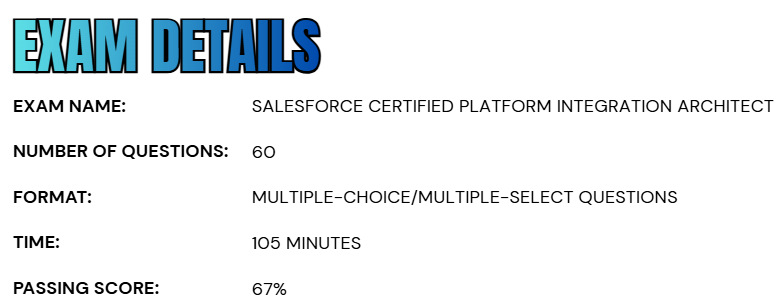
- The Salesforce Certified Platform Integration Architect Exam evaluates a candidate’s ability to design and implement secure, scalable, and high-performing integration solutions across the Salesforce ecosystem.
- The exam consists of 60 scored multiple-choice or multiple-select questions, along with up to five additional non-scored items used for research or future exam development.
- Candidates are given 105 minutes to complete the assessment.
- To achieve certification, a minimum passing score of 67% is required.
- The exam can be taken either in-person at an authorized testing center or through an online proctored session, allowing flexibility based on the candidate’s preference.
- This is a closed-book exam, meaning no external materials, online resources, or notes are permitted during the test.
- There are no formal prerequisites to appear for the exam, though prior experience with Salesforce integration design and architecture concepts is highly recommended for success.
Course Outline
The Salesforce Certified Platform Integration Architect Exam evaluates a candidate’s proficiency across key objectives within the Platform Integration Architecture domain. This includes:
1. Evaluating the Current System Landscape: 8%
- Given a set of business requirements, identifying the current system landscape and determine what standards, limitations, boundaries, and protocols exist.
- Given an existing system landscape, analyzing for constraints and/or pain-points to satisfy a business requirement(s).
- Given a set of requirements, evaluating the authentication and authorization needs based on the system landscape.
2. Learn about Evaluating Business Needs: 11%
- Given a use case, identifying functional and non-functional requirements needed for integration.
- Based on a given integration requirement, identifying and classifying data into Confidential/Secure/Public.
- Given a use case, identifying key factors for CRM success that should be included as integration requirements.
- Given a use case, identifying the business growth and regulatory factors that can impact choice of integration solutions.
3. Translating Needs to Integration Requirements: 22%
- Given an existing system landscape diagram, creating an inventory of the systems and integration patterns.
- Given a use case and business process, evaluating system and process constraints.
- Given a use case, identifying integration security/authentication/authorization requirements.
- Given a use case, identifying performance needs (volumes, response times, latency) and propose appropriate integration solutions that will meet business requirements.
4. Understand how to Design Integration Solutions: 28%
- Given a use case, identifying the integration pattern that meets business requirements.
- Given a use case, defining the components which create a solution that meets business requirements.
- Given a use case, identifying the trade-offs, limitations, and constraints that meet the proposed solution.
- Given a use case that includes technical requirements, constraints, or drivers, specify the appropriate Salesforce application programming interface(s) (API) for the proposed solution.
- Given a use case that includes technical requirements, constraints, or drivers, determine the standards, components, techniques, and security mechanism that should be used.

5. Learn about Building Solution: 23%
- Given a use case that includes technical requirements, constraints, or drivers, identify the considerations when designing and implementing an API(s), both Salesforce as an API provider and Salesforce as an API consumer.
- Given a use case, identifying the considerations when choosing the right option in making an outbound call to an external system.
- Given a use case, describing what should be considered when building a scalable solution.
- Given a use case, determining error handling for different integration options.
- Given a use case, creating a security solution for inbound or outbound integrations.
- Given a use case, identifying the factors needed to build resilience in an integration solution for system updates.
6. Maintaining Integration: 8%
- Given an integration maintenance use case, identifying performance monitoring needs for integration requirements.
- Given a use case, identifying the appropriate error handling, escalation, and recovery procedures for a failed integration.
- Given a use case, identifying reporting needs for integration monitoring.
Salesforce Certified Platform Integration Architect Exam FAQs
Salesforce Certification Code of Conduct
All participants in the Salesforce Certification Program are expected to uphold the highest standards of honesty, integrity, and professionalism throughout their certification process. By registering for any certification exam, candidates agree to the Salesforce Credential and Certification Program Agreement, which outlines the ethical expectations for exam preparation, testing, and post-exam behavior.
Candidates should rely on official Salesforce learning resources, engage responsibly within the Trailblazer Community, and strictly follow all exam security and procedural guidelines. Any unethical behavior—such as sharing confidential exam content, seeking or offering unauthorized help, or violating test center rules—will be treated as a breach of Salesforce’s integrity policy.
Violations may result in severe consequences, including nullification of exam results, revocation or suspension of credentials, and, in extreme cases, permanent removal from the Salesforce Certification Program.
Salesforce Exam Policy
The Salesforce Exam Policy governs how candidates schedule, modify, or complete their certification exams, ensuring a secure, fair, and standardized testing experience for everyone.
– Onsite (Testing Center) Exams
For in-person exams administered through Pearson VUE testing centers, candidates can reschedule or cancel their appointment up to 48 hours before the scheduled time through their Pearson VUE account. Requests made after this window are not typically accepted. Failing to appear without prior notice will be marked as a no-show, resulting in loss of the exam fee.
– Online Proctored Exams
Candidates choosing the online proctored delivery option may reschedule or cancel their exam up to 24 hours before the scheduled start time via the Pearson VUE platform at no extra charge. Requests made after this cutoff are generally declined, and missing the exam may lead to the forfeiture of the full exam fee.
Salesforce Certified Platform Integration Architect Exam Study Guide
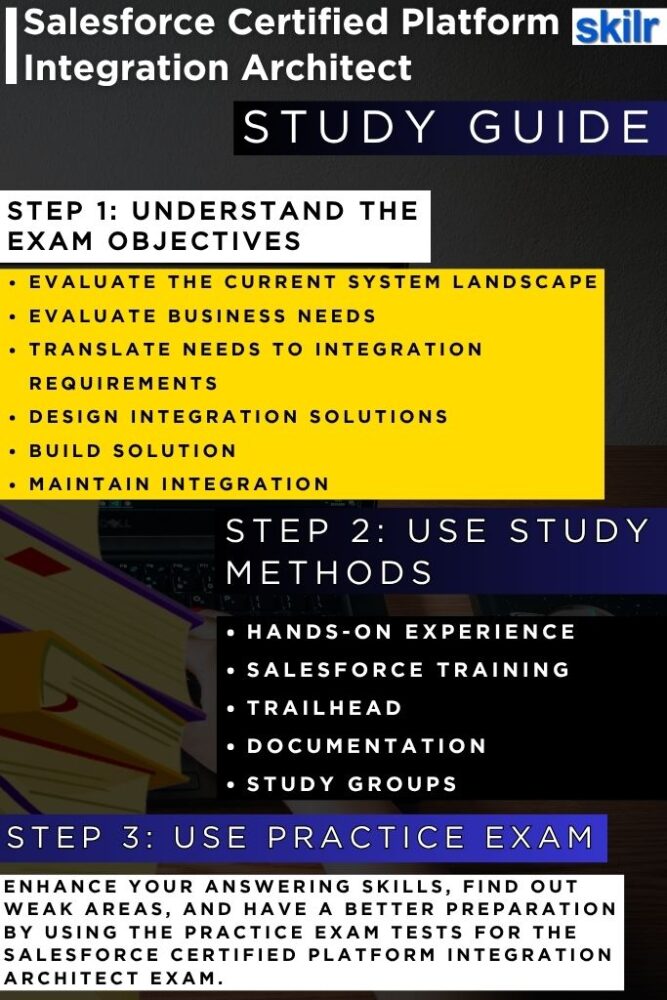
1. Understand the Official Exam Guide
The first and most important step in preparing for the Salesforce Certified Platform Integration Architect Exam is to thoroughly study the official Exam Guide. This document provides a detailed outline of the exam objectives, topic weightings, question format, and scoring criteria. It defines the core domains that Salesforce evaluates, such as integration patterns, security, APIs, and best practices for scalable architecture.
Understanding the structure and scope of the exam helps you allocate study time efficiently and focus on high-priority areas. The guide also gives insights into the type of scenarios you can expect, ensuring that your preparation aligns with Salesforce’s expectations for real-world integration architects.
2. Build a Strong Foundation Through Hands-On Experience
The Platform Integration Architect certification is not just about theoretical knowledge; it requires a deep understanding of how integration works in real-world environments. Candidates should gain substantial hands-on experience by designing, implementing, and troubleshooting integrations on the Salesforce Platform. Working directly with APIs such as REST, SOAP, Bulk, and Streaming APIs will help you understand the nuances of data synchronization and system connectivity.
Building proof-of-concept integrations using middleware tools like MuleSoft, Informatica, or Dell Boomi can significantly enhance your problem-solving ability. Real-world experience ensures that you can apply architectural concepts practically, which is essential for answering scenario-based questions and designing effective, scalable solutions.
3. Complete Recommended Training and Trailhead Modules
Salesforce provides official training courses and resources to help candidates prepare comprehensively. Enrolling in instructor-led classes through Trailhead Academy allows you to learn directly from certified Salesforce experts who explain core concepts, architectural trade-offs, and integration strategies in depth.
Additionally, Trailhead offers guided learning paths specifically designed for Integration Architects, featuring interactive modules and hands-on challenges that simulate real business problems. Completing these modules not only strengthens your understanding of Salesforce integration but also boosts your confidence by allowing you to apply theory in a safe, guided environment. However, the related training include:
– Design and Build Integration Solutions (ARC101)
The Design and Build Integration Solutions (ARC101) course is a comprehensive three-day, instructor-led training that teaches professionals how to design, architect, and implement secure, scalable, and high-performing integrations within the Salesforce Platform. Participants gain a deep understanding of Salesforce’s integration capabilities, architecture patterns, and key design considerations required to connect multiple systems and deliver seamless, data-driven experiences. The course emphasizes practical application—helping learners translate business needs into reliable technical solutions that ensure consistent data flow and platform efficiency.
This training is ideal for Salesforce administrators, platform developers, solution and enterprise architects, and technical architects who are responsible for integrating Salesforce with external applications or enterprise systems. It is also well-suited for program and project managers seeking to strengthen their understanding of the Salesforce integration lifecycle and the architectural decisions that drive successful implementation.
4. Learn from Experts and Real-World Scenarios
Beyond structured study, it’s crucial to learn from professionals who have already achieved the certification or have practical experience in integration architecture. Attend webinars, panel discussions, and Salesforce community events to hear experts discuss best practices and real-life integration challenges.
Many certified architects share their personal experiences, project insights, and lessons learned, which can help you avoid common pitfalls and understand how Salesforce integration fits into larger enterprise ecosystems. Learning from seasoned professionals provides a broader perspective that goes beyond textbook concepts, enabling you to think like an architect rather than just a developer or administrator.
5. Engage with Study Groups and Trailblazer Communities
Collaboration is a powerful part of Salesforce learning. Joining study groups or Trailblazer Community discussions allows you to interact with peers preparing for the same exam. These communities often host mock sessions, exchange notes, and share practical exam tips. Engaging in these forums exposes you to different viewpoints, which helps you understand integration concepts more deeply.
You can also find mentors within these groups who can guide your study approach, review your architecture solutions, and provide constructive feedback. The Trailblazer Community in particular is a supportive environment where candidates collaborate to solve challenges and celebrate learning milestones together.
6. Use Practice Tests to Assess Readiness
Taking practice exams is one of the most effective ways to measure your readiness for the certification. Practice tests mirror the format and difficulty level of the actual exam, helping you gauge your understanding of key topics and identify weak areas that need improvement. They also train you to manage your time effectively during the real test. Reviewing explanations for incorrect answers gives you valuable insights into Salesforce’s reasoning and helps clarify misunderstood concepts. Regularly assessing your progress ensures that your preparation remains on track and that you enter the exam with full confidence.
7. Review Salesforce Documentation, Tip Sheets, and User Guides
Finally, reinforce your preparation by studying the official Salesforce documentation, which provides the most accurate and up-to-date technical information about APIs, integration tools, security models, and platform limits. Tip Sheets and User Guides from Salesforce are valuable for understanding specific configurations, implementation details, and recommended best practices.
These materials often clarify complex integration topics and can bridge knowledge gaps left by other learning resources. Reviewing documentation not only helps you answer technical questions correctly but also ensures that your architectural decisions align with Salesforce’s official guidelines and standards.
