


The Salesforce Certified Platform Sharing and Visibility Architect credential validates the expertise of professionals who can design and implement secure, scalable, and efficient sharing and visibility solutions on the Salesforce Platform. This certification is ideal for those who want to demonstrate advanced mastery in building robust data access frameworks, maintaining compliance, and ensuring high system performance across complex Salesforce environments.
A certified professional is expected to understand how to balance usability, data privacy, and organizational security through effective architecture, while also communicating these solutions clearly to both business and technical stakeholders.
– Key Skills and Knowledge Areas
To succeed in this exam, candidates should possess the ability to design comprehensive security and sharing models that align with business and compliance needs. Some essential areas of expertise include:
- Design and Implementation
- Develop secure, scalable sharing models for complex data structures.
- Recommend system design approaches, evaluating trade-offs and advantages for various security configurations.
- Identify when to apply standard Salesforce functionality and when custom solutions provide a better fit.
- Access and Permissions
- Configure organization-wide defaults (OWDs), role hierarchies, profiles, and permission sets to enforce proper access controls.
- Design object relationships that directly impact record visibility and sharing behavior.
- Apply CRUD (Create, Read, Update, Delete) and FLS (Field-Level Security) principles effectively.
- Advanced Sharing Mechanisms
- Implement both criteria-based and ownership-based sharing rules.
- Understand and apply Apex managed sharing for custom scenarios.
- Extend data access to external users such as partners, customers, and guest users securely.
- Performance and Scalability
- Address performance bottlenecks and scalability concerns in large data volumes (LDVs).
- Design and test sharing models that maintain efficiency in enterprise-scale Salesforce deployments.
- Identify appropriate tools like territory management, account teams, and sharing groups based on business use cases.
- Security Best Practices
- Secure files, dashboards, and reports against unauthorized access.
- Implement security for Big Objects and ensure compliance with data protection regulations such as PCI, PII, and HIPAA.
- Recognize and mitigate risks when using “run as Administrator” features in Apex or Visualforce.
– Who Should Take the Exam
This certification is ideal for professionals involved in designing and implementing Salesforce security frameworks. Typical candidates include:
- Salesforce Technical or Solution Architects who design end-to-end system architectures.
- Advanced Salesforce Administrators responsible for maintaining and scaling security models.
- Business Analysts with a strong understanding of access control and compliance requirements.
Recommended Background
- 2–3 years of Salesforce platform experience.
- 4–5 years of hands-on experience with complex data security and sharing model implementations.
- Strong understanding of data governance, compliance, and access control principles.
– Areas Where Guidance May Be Needed
Candidates may require additional learning or mentorship in areas such as:
- Designing and implementing tokenization strategies.
- Understanding off-platform and AppExchange security considerations.
- Managing Heroku and hybrid data security architectures.
- Explaining cryptographic methods like SSL and RSA.
- Evaluating performance impacts of sharing rules in large data scenarios.
- Implementing programmatic sharing while adhering to principles like Least Privilege, Defense in Depth, and Fail Securely.
Exam Details

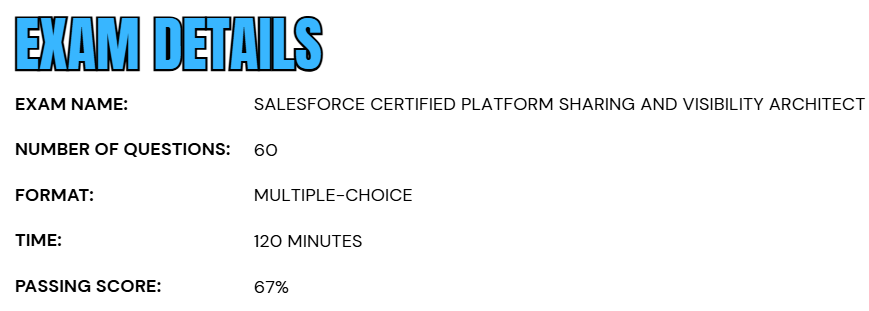
- The Salesforce Platform Sharing and Visibility Architect Exam is a professional-level certification designed to evaluate a candidate’s ability to design and implement secure, scalable sharing and visibility solutions on the Salesforce Platform.
- The exam consists of 60 multiple-choice questions, which must be completed within a 120-minute time limit.
- To successfully pass the exam, candidates must achieve a minimum score of 67%.
- The exam is conducted in a proctored environment, available onsite at authorized testing centers, ensuring the integrity and fairness of the assessment process.
- During the examination, no reference materials—either printed or online—are permitted.
- There are no formal prerequisites required to take this certification exam; however, a strong understanding of Salesforce security architecture, data access controls, and sharing mechanisms is highly recommended for optimal performance.
Course Outline
The Salesforce Platform Sharing and Visibility Architect Exam assesses a candidate’s expertise and proficiency across the following core objectives.
1. Learn about Permissions to Standard Objects, Custom Objects, and Fields: 27%
- Given a scenario, recommending the right level of object permissions needed to provide the appropriate access to a set of users.
- Given a scenario, recommending the correct level of field permissions needed to provide the appropriate access to a set of users.
- Given a scenario, recommending the appropriate mechanism to hide data at the user interface level.
- Given a scenario, determining the appropriate access controls to protect sensitive data (for example, PCI, PII, or HIPAA).
- Given a scenario, recommending the appropriate programmatic solution to ensure security settings are enforced.
2. Understand about Access to Records: 39%
- Given a set of conditions, recommending the appropriate organization-wide defaults to restrict access to records.
- Given a set of conditions, recommend a solution that leverages the role hierarchy to support the record access requirements.
- Given a set of conditions, determining how sharing rules can be implemented to support the record access requirements.
- Given a set of conditions, determine how groups can support the record access requirements.
- Given a set of conditions, determining how teams can support the record access requirements.


- Given a set of conditions, determine the correct object relationships that support record access sharing requirements.
- Given a set of conditions, determining how programmatic sharing supports the record access requirements.
- Given a set of conditions, determining what sharing mechanism is appropriate to share records with External Users.
- Given a set of conditions, determine how record access overrides support the record access requirements.
3. Learn about Access to Other Data: 16%
- Given a scenario, determining the appropriate access control needed to grant access to data that is not standard or custom objects.
4. Understand the Implications of Security Model Choice: 18%
- Given a scenario, determine the scalability implications of the sharing solution.
- Given a set of conditions, determine the license limitations that will impact the intended sharing solution.
- Given a set of conditions, determine how to test the sharing model.
Salesforce Certified Platform Sharing and Visibility Architect Exam FAQs
Salesforce Exam Candidate Code of Conduct
All participants in the Salesforce Certification Program are expected to uphold the highest standards of honesty, integrity, and professionalism throughout their certification journey. By registering for any Salesforce certification, candidates acknowledge and agree to follow the Salesforce Credential and Certification Program Agreement, which outlines clear expectations for ethical behavior during exam preparation, testing, and all related activities.
Candidates are strongly encouraged to prepare using official Salesforce study resources, participate ethically within the Trailblazer Community, and fully comply with all exam rules, guidelines, and security measures. Any act of misconduct—such as sharing or requesting confidential exam material, seeking unauthorized help, or violating testing protocols—will be treated as a breach of Salesforce’s ethical standards.
Violations of these standards can result in serious disciplinary action, including exam result invalidation, credential suspension or revocation, and, in severe cases, permanent disqualification from the Salesforce Certification Program.
Salesforce Exam Policy
The Salesforce Exam Policy outlines the official rules and procedures for scheduling, rescheduling, canceling, and completing certification exams, whether taken online or at an authorized testing center. These policies are designed to maintain fairness, consistency, and the highest level of security across all testing environments.
– Onsite (Testing Center) Exams
For exams conducted at Pearson VUE testing centers, candidates may reschedule or cancel their exam appointment up to 48 hours before the scheduled time through their Pearson VUE account. Requests made after this deadline are typically not accepted. Candidates who fail to appear without prior notice will be marked as no-shows, resulting in the forfeiture of their exam fee.
– Online Proctored Exams
For online proctored exams, candidates may reschedule or cancel their test up to 24 hours before the scheduled start time via the Pearson VUE platform, free of charge. Any changes requested after the deadline are generally not permitted, and missing the exam without prior rescheduling will lead to the loss of the full exam fee.
Salesforce Certified Platform Sharing and Visibility Architect Exam Study Guide

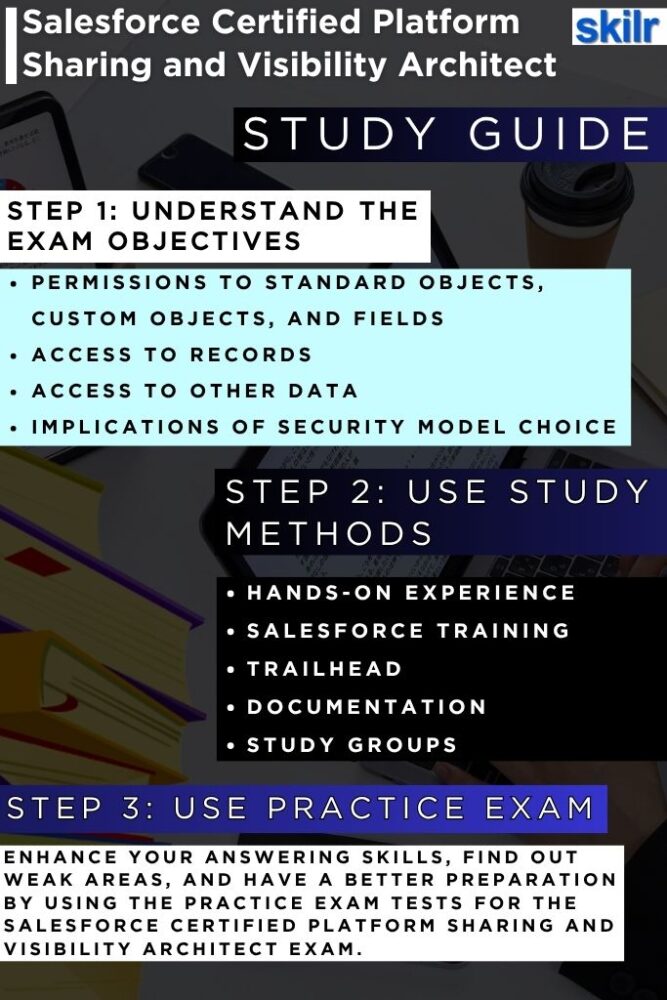
Step 1: Review and Understand the Exam Guide
The first and most crucial step in preparing for the Salesforce Certified Platform Sharing and Visibility Architect Exam is to thoroughly review the official Salesforce Exam Guide. This document outlines the exam’s format, structure, and topic distribution while clarifying the specific objectives you’ll be tested on. Familiarizing yourself with the guide helps you focus on what truly matters—such as the principles of secure system design, record-level access, data visibility, and scalability.
The exam guide also highlights key concepts and weightings across domains, allowing you to strategically plan your study time around areas with higher emphasis. Understanding this blueprint ensures you approach your preparation with a clear sense of direction rather than studying randomly.
Step 2: Combine Learning Resources with Real-World Experience
Salesforce certifications, especially at the architect level, are designed to test your ability to apply concepts in real scenarios. Therefore, it’s not enough to rely solely on study materials. The best preparation involves combining structured training courses with hands-on experience gained through practical exposure to the Salesforce platform. Working directly on Salesforce environments allows you to understand how various sharing rules, profiles, and permission sets interact with each other.
By experimenting with organization-wide defaults and complex sharing configurations, you begin to see how theoretical principles translate into business-ready implementations. Integrating what you learn from official training with your real-world practice ensures that your knowledge isn’t just academic but actionable and deeply rooted in practical understanding.
Step 3: Gain Practical Experience to Deepen Your Expertise
The Salesforce Platform Sharing and Visibility Architect Exam places strong emphasis on your ability to design and troubleshoot advanced security models. To master these skills, you must immerse yourself in actual Salesforce environments and experiment with different configurations. Create and test complex record-sharing frameworks that involve multiple levels of access, user hierarchies, and data segmentation. Understand how decisions made in your model impact performance, data integrity, and system scalability.
Working on sandbox environments or real client projects is particularly beneficial, as it exposes you to real-world challenges such as managing large data volumes, implementing Apex-managed sharing, and balancing security with user experience. This stage is where theory turns into applied expertise, and where your architectural thinking begins to mature.
Step 4: Learn from Certified Experts and Industry Mentors
No matter how detailed your preparation, learning from experienced professionals can provide valuable insights that go beyond textbooks. Interacting with Salesforce-certified architects, instructors, and solution experts allows you to understand how real enterprise projects handle security and data visibility challenges. These professionals often share practical lessons learned from large-scale implementations, explaining the trade-offs between declarative and programmatic sharing solutions.
By participating in webinars, technical talks, or expert Q&A sessions, you can gain perspectives on system design strategies that help you make better architectural decisions. Mentorship also boosts confidence, as real-world examples provide clarity on how Salesforce’s theoretical frameworks translate into actual business use cases.
Step 5: Attend Instructor-Led Training Sessions
Enrolling in instructor-led classes is one of the most effective ways to gain a structured understanding of the exam material. Salesforce and its authorized training partners offer comprehensive live courses that cover all exam domains in detail. These sessions not only provide access to guided lessons and case studies but also allow for direct interaction with certified trainers who can answer your technical questions in real time.
The hands-on labs and scenario-based exercises conducted during these classes mimic real exam situations, giving you practical exposure to complex security designs. By the end of such sessions, you’ll have developed both conceptual clarity and problem-solving agility, two skills that are crucial to succeed in the exam. However, the related training course includes:
– Build Sharing and Visibility Architect Expertise – ARC202
This three-day instructor-led course equips you with the advanced knowledge and practical skills required to architect scalable and compliant security frameworks. You’ll explore the core principles of Salesforce sharing and visibility architecture, learning how to safeguard sensitive information while ensuring the right users have the right level of access.
Throughout the program, you’ll gain a deep understanding of data security for internal and external users, sensitive data protection methods, and the full spectrum of Salesforce sharing models and mechanisms. The course also covers best practices for designing robust and efficient sharing solutions that align with complex business requirements, maintain system performance, and uphold compliance standards. By the end of the course, you’ll be able to confidently design and implement enterprise-grade sharing architectures that balance accessibility with security—protecting critical data, reinforcing customer trust, and enhancing the overall integrity of your Salesforce ecosystem.
Step 6: Skill Up with Trailhead and Salesforce Communities
Trailhead, Salesforce’s official learning platform, remains one of the most powerful tools for structured self-learning. It provides guided learning paths specifically aligned with the Platform Sharing and Visibility Architect certification. Through interactive modules and hands-on challenges, you can practice real scenarios while earning badges that track your progress.
In addition to Trailhead, candidates should engage with the Trailblazer Community, where professionals share insights, resources, and tips on certification preparation. Joining study groups, Trailhead Academy cohorts, and local user communities allows for collaborative learning and discussion of complex topics in a peer-supported environment. This combination of self-paced learning and community engagement creates a balanced approach to mastering both theoretical and practical aspects of the exam.
Step 7: Test, Review, and Refine Your Knowledge
Before scheduling your official exam, it’s essential to evaluate your readiness through practice exams and mock tests that simulate the real exam format. These tests help identify your weak areas and improve time management during the actual assessment. Use the results to revisit topics that require reinforcement, particularly those involving security design decisions, sharing rule implementation, and performance optimization.
Additionally, review Salesforce’s official documentation, Tip Sheets, and User Guides to clarify any remaining doubts. These materials provide deep technical insights and best practices that are often referenced indirectly in exam questions. A well-rounded review process that combines testing, reflection, and final study ensures you enter the exam confident and fully prepared to demonstrate your expertise.
