
The Salesforce Certified Service Cloud Consultant credential validates a professional’s ability to design, implement, and optimize Service Cloud solutions that are scalable, maintainable, and aligned with business goals. Consultants in this role translate complex service requirements into effective system designs that improve customer support operations and long-term organizational success.
A certified Service Cloud Consultant is skilled in gathering detailed business requirements, mapping them to Salesforce capabilities, and delivering solutions that enhance service processes. These consultants bring hands-on expertise in customer service tools, case management, automation, and analytics within Salesforce.
– Prerequisite
Candidates must hold the Salesforce Certified Platform Administrator credential before attempting the Service Cloud Consultant exam. This ensures a solid understanding of core Salesforce functionality, configuration, and platform fundamentals.
– Who Should Take the Exam
This certification is ideal for:
- Service Cloud implementers who work closely with customer support teams.
- Consultants or business analysts with experience designing service workflows and digital support processes.
- Administrators or Salesforce professionals looking to specialize in customer service capabilities.
- Support operations managers who want to validate their knowledge of Salesforce service features.
- Technical professionals aiming to deepen their understanding of Service Cloud’s architecture and best practices.
Salesforce recommends that candidates have 2–5 years of professional experience, including hands-on work with service operations and Salesforce platform features.
– Core Knowledge Areas
Certified Service Cloud Consultants are expected to understand a wide range of service and support concepts, including:
- AI and Agentforce Adoption
- When and how to incorporate AI-driven agents (Agentforce) into customer service processes.
- Customer Support Processes
- Case management workflows, service operations, and cross-functional processes involving both technical and support departments.
- Knowledge-Centered Support (KCS)
- Principles and best practices for building and managing a scalable knowledge base.
- Incident Management
- Understanding incident lifecycles, escalations, and resolution frameworks.
- Service Metrics & KPIs
- Key indicators such as average handle time, case deflection, FCR, CSAT, and other performance benchmarks.
- Industry Trends
- Evolving technologies such as generative AI, automation tools, Agentforce capabilities, and data governance considerations.
- Service Intake Channels
- Omnichannel support including chat, messaging, telephony, email, social, and self-service portals.
- Automation & Efficiency
- Applying automation strategies to reduce manual effort and improve resolution efficiency.
- Data Management
- Best practices for data migration, quality, availability, security, and long-term maintenance.
– Key Skills Required
To succeed in the exam and the role, candidates should be able to:
- Analytical & Solution Design Skills
- Demonstrate the business impact of Service Cloud solutions using data-driven insights.
- Entitlements & SLAs
- Configure entitlements, milestones, and SLAs that align with service commitments.
- Case Management Expertise
- Build seamless end-to-end case processes, including routing, auto-responses, queues, and escalation rules.
- Service Console Customization
- Design an efficient agent workspace using console layouts, dynamic forms, and tailored record pages.
- Channel & Contact Model Recommendations
- Recommend appropriate channels such as bots, embedded chat, in-app messaging, telephony, Slack, or social platforms.
- Support Tools Understanding
- Work with web-to-case, email-to-case, Experience Cloud portals, and ticketing models for support workflows.
- Omni-Channel Configuration
- Set up and optimize Omni-Channel routing for real-time agent assignment and load management.
– Essential Abilities
A strong Service Cloud Consultant should be able to:
- Analytics & Dashboards
- Apply foundational analytics to build dashboards and monitor service performance.
- Requirements Gathering
- Collect, interpret, and prioritize business and functional requirements.
- Solution Evaluation
- Choose the right solution, explaining when to use standard Salesforce features versus custom or extension options.
- Stakeholder & Scope Management
- Communicate effectively with stakeholders and manage solution scope throughout the project lifecycle.
- Telephony & Voice
- Understand telephony integration, SMS, and Service Cloud Voice capabilities.
- Declarative vs. Programmatic Approaches
- Identify when a point-and-click configuration is appropriate versus when custom development is required.
Exam Details
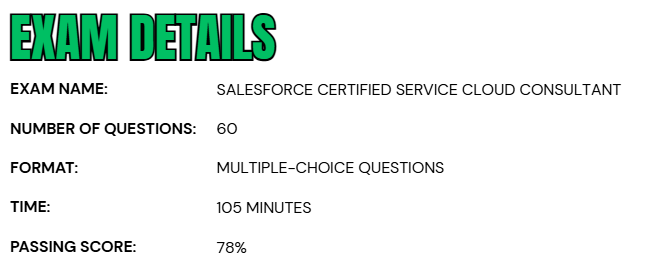
- The Salesforce Certified Service Cloud Consultant Exam consists of 60 multiple-choice questions, along with up to five unscored items that are included solely for performance evaluation.
- Candidates are given 105 minutes to complete the test and must achieve a minimum score of 78% to pass.
- The exam is offered in a proctored format, either at an authorized testing center or through a secure online proctoring environment.
- During the assessment, no reference materials—whether printed or digital—are permitted.
- Although the exam may include several unscored questions, these items are randomly placed throughout the test and do not influence the final score.
Course Outline
The Salesforce Certified Service Cloud Consultant Exam evaluates a candidate’s expertise and abilities across the following key objective areas.
1. Gain Industry Knowledge: 12%
- Explaining the factors that influence key Contact Center metrics and key performance indicators (KPIs).
- Determining the risks, benefits, and business challenges of meeting a client’s desired outcome.
2. Understand Implementation Strategies: 12%
- Given a scenario, determining how to participate in a successful consulting engagement.
- Given a scenario, recommending appropriate Service Cloud deployment and training strategies.
- Explain the considerations and implications for data migration, data quality, data governance, and large data volumes.
3. Learn about Service Cloud Solution Design: 15%
- Given a scenario, analyzing customer requirements to determine an appropriate solution design considering capabilities, limitations, and design trade-offs for the service rep experience.
- Given a scenario, analyzing customer requirements to determine an appropriate solution design considering capabilities, limitations, and design trade-offs for the customer experience.
- Given a set of customer data security and compliance requirements, determine a successful design to secure the data.
4. Understand Knowledge Management: 12%
- Explaining the Knowledge article lifecycle, Knowledge Centered Service (KCS), and Salesforce Knowledge Management configuration.
- Given a set of requirements, determining how to configure Knowledge to deliver service support and self-service processes.

5. Overview of Intake and Interaction Channels: 13%
- Given business process requirements, recommending the appropriate approach to intake channels and their design.
- Given a set of business goals, discuss the use cases and functionality for proposed interaction channels.
- Assessing the design considerations and best practices when configuring an interaction channel solution.
- Given a set of business requirements, recommend an appropriate use for AI agents in the customer service process.
- Explaining agentic service capabilities, use cases, and configuration processes.
6. Understand Case Management: 13%
- Given a set of requirements or KPIs, designing a case management solution from creation to closure.
- Given a set of requirements, explain how case deflection strategies are delivered in Experience Cloud sites, Agentforce, and Knowledge.
- Explaining the capabilities, use cases, and how to configure service entitlements, milestones, assets, business hours, and service-level agreements (SLAs).
- Differentiating the use cases and capabilities of Service Cloud automation.
7. Learn about Contact Center Analytics: 13%
- Given a scenario, develop reports and dashboards in Salesforce to provide relevant information to different stakeholders.
8. Understand Integrations: 10%
- Explaining the use cases and considerations for core Service Cloud integrations, including third-party solutions and connections to external sources of data.
Salesforce Certified Service Cloud Consultant Exam FAQs
Salesforce Certification Exam Policy
The Salesforce Certification Exam Policy outlines the official requirements for scheduling, modifying, and completing any Salesforce certification exam. These guidelines apply to all candidates, whether they choose to test online with a remote proctor or at an authorized in-person testing center. The policy ensures exam integrity, fairness, and a consistent, secure testing experience for every participant.
– Exams at Authorized Testing Centers
Candidates testing at a Pearson VUE physical testing center may reschedule or cancel their exam through their Pearson VUE account, as long as the request is made at least 48 hours before the scheduled appointment. Changes requested after this window are generally not permitted. Failure to appear for a scheduled onsite appointment without proper rescheduling results in a no-show, and the full exam fee is forfeited.
– Online Proctored Exam Appointments
For candidates testing remotely, Pearson VUE allows appointment changes or cancellations up to 24 hours before the exam start time. Requests made after the cutoff are typically denied. If a candidate does not join the online proctored session and has not updated the appointment within the allowed timeframe, the absence is treated as a missed session, and the exam fee is non-refundable.
Salesforce Exam Candidate Code of Conduct
All Salesforce certification candidates must uphold the highest standards of honesty, professionalism, and ethical behavior during exam preparation and testing. By scheduling an exam, candidates agree to the Salesforce Credential and Certification Program Agreement, which defines acceptable conduct and responsible exam practices.
Candidates must prepare using authorized Salesforce learning materials, participate ethically within the Trailblazer Community, and follow all proctoring and security instructions. Prohibited actions—such as using unauthorized resources, sharing or accessing real exam content, or disregarding proctor directives—are taken very seriously. Violations may result in consequences including exam score cancellation, suspension or revocation of certifications, or permanent removal from the Salesforce Certification Program.
Salesforce Certified Service Cloud Consultant Exam Study Guide
1. Review the Official Salesforce Exam Guide
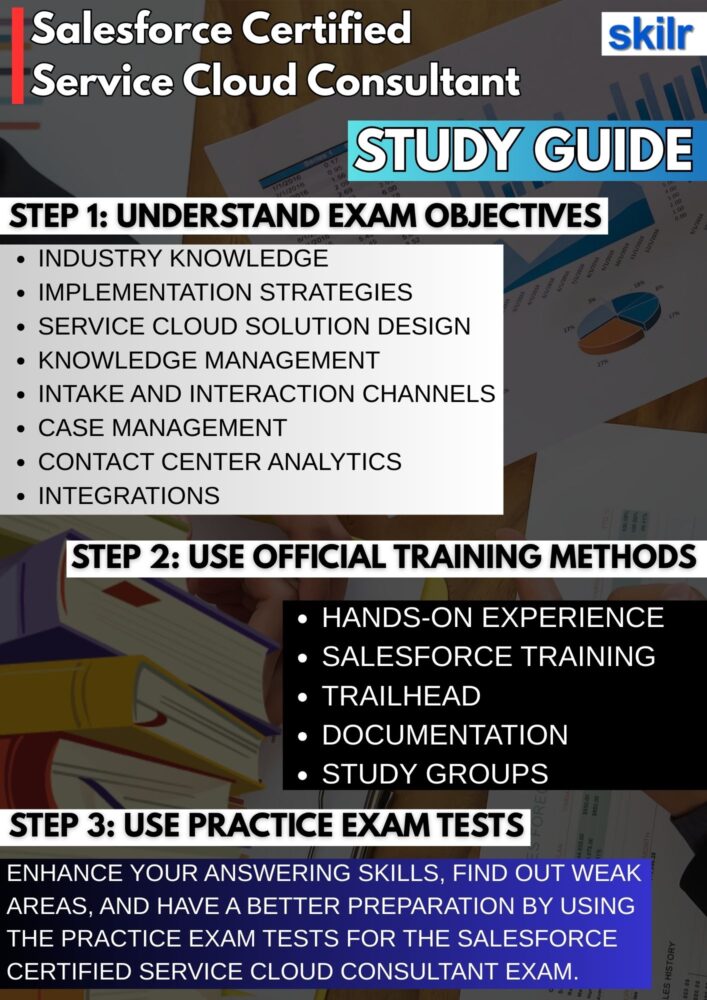
Your preparation should begin with a careful review of the official Salesforce Certified Service Cloud Consultant Exam Guide. This document outlines the complete structure of the exam, including the number of questions, time limits, scoring requirements, and—most importantly—the detailed weighting of each topic area.
Understanding the guide helps you determine which sections require deeper study, how Salesforce expects consultants to apply their knowledge, and the specific competencies you’ll be evaluated on. Treat the guide as your roadmap; it ensures that your study plan aligns with the actual exam objectives and prevents you from missing essential concepts.
2. Gain Practical, Hands-On Service Cloud Experience
Hands-on experience is one of the most important elements of exam success. Service Cloud is highly practical, and the exam is designed to test your ability to configure, troubleshoot, and optimize real-world service processes. Spend time working in a Salesforce environment where you can build case management systems, configure Omni-Channel routing, customize the Service Console, design automation using flows, work with knowledge articles, and implement key productivity tools.
The more time you spend experimenting with real org configurations, the more naturally the exam scenarios will make sense. Practical exposure ensures that you not only memorize concepts but also understand how they function in actual service operations.
3. Enhance Your Learning Through Trailhead Modules
Trailhead is Salesforce’s most accessible and structured learning platform, offering guided modules that walk you through fundamental and advanced Service Cloud topics. Completing recommended trails will give you hands-on practice, scenario-based challenges, and conceptual clarity on topics such as entitlements, milestones, knowledge management, digital engagement, and AI-powered service tools.
Since Trailhead content is designed by Salesforce experts, it aligns closely with the skills expected on the exam. As you progress through modules, you’ll build a strong technical foundation while earning badges that validate your growing expertise.
4. Learn from Certified Experts Through Instructor-Led Training
Instructor-led training can significantly elevate your understanding of Service Cloud features and exam expectations. Through Trailhead Academy or authorized Salesforce training partners, you can enroll in courses taught by experienced, certified instructors who offer in-depth explanations, practical demonstrations, and valuable exam insights.
These classes often explore advanced concepts such as case lifecycle design, channel strategy, automation frameworks, and best practices for scaling support organizations on Salesforce. Interacting directly with experts also allows you to ask questions, clarify difficult topics, and gain real-world knowledge that may not always be obvious from self-study alone. However, the exam related training includes:
– Administer and Maintain Service Cloud (ADX261)
The ADX261: Administer and Maintain Service Cloud course teaches you how to configure and manage Service Cloud solutions that scale with organizational support demands and elevate customer satisfaction. This two-day instructor-led program covers essential skills, including implementing case management, customizing the Lightning Service Console, enabling Salesforce Lightning Knowledge, automating service workflows with Flow, and building service reports that track agent performance.
Designed for Salesforce Administrators responsible for maintaining Service Cloud environments, this course is ideal for those who hold the Salesforce Certified Platform Administrator credential or have equivalent experience. Participants should have a strong understanding of Salesforce fundamentals and at least six months of hands-on platform experience.
– Administer Intelligent Service Cloud Solutions (ADX361)
The ADX361: Administer Intelligent Service Cloud Solutions course teaches you how to deliver personalized, AI-driven customer service experiences using Service Cloud and Einstein for Service. This three-day instructor-led program covers advanced capabilities such as building Omni-Channel flows, routing chats with Enhanced Omni-Channel, customizing self-service Experience Cloud sites, and configuring Messaging for In-App and Web (MIAW). You will also learn to implement Einstein for Service features—including Einstein Bots, Article and Reply Recommendations, Service Replies, and Work Summaries—to enhance agent efficiency, accelerate case resolution, and improve overall customer satisfaction.
This course is intended for experienced Salesforce Administrators responsible for configuring Service Cloud and Einstein for Service solutions. Participants should hold the Salesforce Certified Platform Administrator credential or have at least six months of hands-on administrative experience. A solid understanding of core Salesforce functionality—such as user permissions, profiles, page layouts—and prior experience working with the Service Console and Salesforce Flow is strongly recommended.
5. Connect with Study Groups, Communities, and Trailblazer Networks
Participating in the Trailblazer Community, online study forums, and Salesforce-focused groups provides an invaluable support system during your preparation. These communities allow you to learn from peers, share best practices, and gain insights from individuals who have already passed the exam. Collaborative learning environments help reinforce concepts, expose you to different problem-solving approaches, and keep you motivated throughout the process.
Whether you join virtual meetups, engage in discussion threads, or participate in study circles, connecting with others ensures you stay updated and informed about exam trends and common challenges.
6. Strengthen Exam Readiness Through Practice Tests
Taking practice exams is essential for building confidence and identifying knowledge gaps. Reliable mock tests simulate the real exam experience by presenting scenario-based questions, time limits, and complexity levels similar to the actual certification test. By reviewing your performance, you can pinpoint which topics need additional study, refine your reasoning skills, and develop familiarity with Salesforce’s question style. Consistent practice also helps improve time management, ensuring that you can thoughtfully analyze each scenario within the allotted timeframe.
7. Study Salesforce Documentation, User Guides, and Tip Sheets
Salesforce’s official documentation is one of the most accurate and comprehensive resources for understanding platform features. Reviewing product-specific documentation, feature guides, release notes, and configuration best practices gives you deep insight into how Service Cloud works behind the scenes. Tip Sheets and User Guides provide practical examples and step-by-step explanations that reinforce your technical understanding. Because Salesforce regularly updates features, reviewing documentation ensures you stay current with the latest capabilities—many of which may appear on the exam.
