

The Tanium Certified Administrator (TCA) is an advanced-level certification designed for professionals aiming to enhance their expertise and credentials in Tanium solutions. This certification validates the ability to operationalize, maintain, and troubleshoot the Tanium platform effectively, particularly in a Tanium Cloud environment.
Candidate Profile
Ideal candidates for the TCA certification are experienced Tanium administrators with a minimum of two years of hands-on experience managing endpoint solutions for servers and workstations. Candidates should be proficient in:
- Managing users, roles, and permissions within the platform.
- Performing core functionality tasks, operational management, and administrative tasks.
- Maintaining the Tanium platform and conducting basic troubleshooting in a Tanium Cloud environment.
Prerequisites
To be eligible for the TCA certification, candidates must have successfully earned the Tanium Certified Operator (TCO) certification.
Who Should Take the TCA Exam
This certification is recommended for:
- IT administrators seeking to advance their Tanium expertise.
- Professionals responsible for endpoint management and security operations.
- Individuals looking to validate their ability to manage, maintain, and troubleshoot Tanium in a cloud-based environment.
- Organizations aiming to ensure their teams are proficient in operationalizing Tanium solutions efficiently.
Exam Details
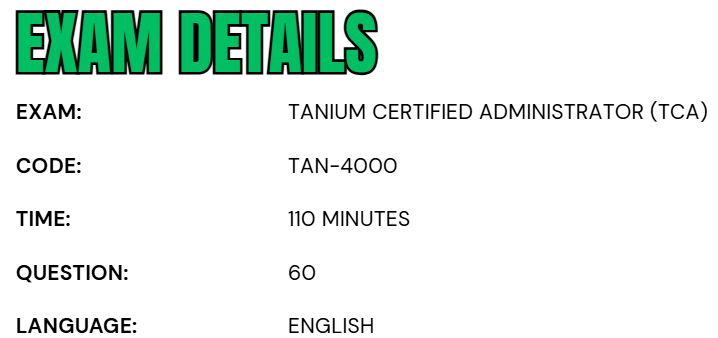
- The Tanium Certified Administrator (TCA) exam (SKU: TAN-EXAM-TCA, Exam Code: TAN-4000) is designed to evaluate both theoretical knowledge and practical skills.
- The assessment comprises 60 scored points, including a combination of multiple-choice questions and hands-on practical application tasks.
- Candidates are allotted 110 minutes to complete the exam, which tests their ability to effectively manage, maintain, and troubleshoot the Tanium platform in real-world scenarios.
Course Outline
The exam covers the following topics:
1. Intial Configuration – 30%
- Applying concepts required to configure logical groupings based on network locations/subnets
- Apply concepts required to configure bandwidth throttling
- Applying concepts required to configure Tanium client upgrades
- Identifying how to configure Tanium client installer artifacts
- Make determinations required for the configuration of RBAC for user-based roles
- Determine when to create computer groups vs. filter groups
- Determining when and how to create and modify action groups
- Analyzing how and when to configure and implement personas
- Applying concepts required to configure client settings
2. Troubleshoot – 18%
- Diagnose reporting and communication issues
- Determining how and when to gather logs or modify log settings from an endpoint
- Diagnosing endpoint performance issues
- Troubleshooting core platform and RBAC issues

3. Maintaining – 44%
- Monitor tool health
- Confirm clients are communicating properly
- Determining how to utilize an action group for a specific deployment type
- Making determinations required to migrate content from a disabled user
- Apply concepts required to manage computer groups
- Applying concepts to manage API tokens
- Determine how to maintain and address two-person integrity procedures
- Applying concepts required to register sensors with TDS
- Determining how to optimize client settings
4. Tanium Platform Advanced Knowledge – 8%
- Applying concepts for advanced question filtering
- Applying concepts required to configure Tanium integrations
Tanium Certified Administrator (TCA) Exam FAQs

Exam Policies
Before registering for the Tanium Certified Administrator (TCA) exam, candidates are strongly advised to carefully review the exam policies. Understanding these policies will help avoid potential issues during scheduling, testing, or result processing.
– Reschedule and Cancellation Policy
Candidates may reschedule or cancel their exam appointment up to 48 hours before the scheduled time. Changes requested within less than 48 hours of the appointment are not permitted.
- Failure to reschedule or cancel within the allowed timeframe will result in the forfeiture of the exam fee.
- Candidates who fail to appear for their scheduled exam appointment will also forfeit their exam fee.
– Exam Results
Testing at Pearson VUE Centers: Candidates will receive a printed copy of their exam results directly from the test center administrator immediately after completing the exam.
Testing via Pearson OnVUE (Online): Candidates will receive an email with instructions to access their score report through the Pearson VUE dashboard.
- Passing candidates: Only a pass notification is provided; no additional performance details are shared.
- Non-passing candidates: A detailed section-level performance breakdown will be included to highlight areas that require improvement.
In most cases, exam results are also available within 24 hours in the candidate’s profile on the Candidate Portal.
– Exam Retake Policy
Candidates who do not pass the exam on their first attempt must comply with the official retake policy.
- A seven-day waiting period is required before retaking the exam.
- The wait period begins on the day following the unsuccessful attempt.
- This policy applies without exception and must be observed by all candidates.
Tanium Certified Administrator (TCA) Exam Study Guide
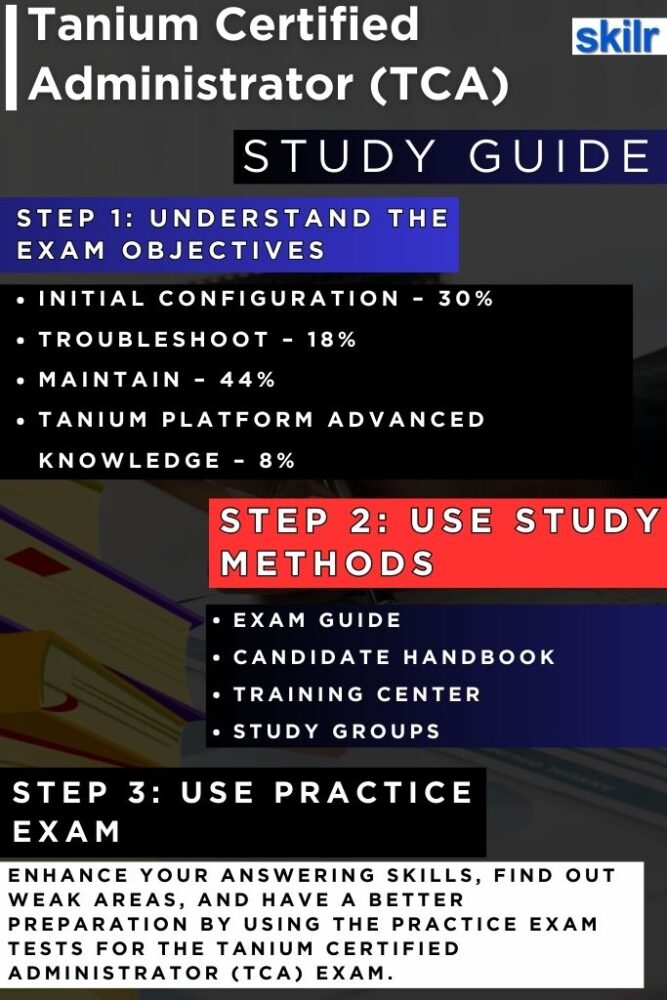
Step 1: Understand the Exam Objectives
The first step in preparing for the Tanium Certified Administrator (TCA) Exam is to carefully review the exam objectives. These objectives define the scope of the assessment and highlight the skills that will be tested. Candidates are expected to demonstrate their ability to manage users and permissions, perform daily operational tasks, maintain the Tanium platform for stability and performance, and troubleshoot common issues within the Tanium Cloud environment.
A thorough understanding of these objectives ensures that no knowledge area is overlooked and that study efforts remain focused on what matters most for the exam.
Step 2: Study the Candidate Handbook
Once the objectives are clear, the next stage is to review the Candidate Handbook provided by Tanium. This handbook contains essential information about the structure and format of the exam, the number of questions, the scoring process, and the policies governing registration, rescheduling, and retakes. It also explains the exam-day experience for both Pearson VUE test centers and Pearson OnVUE online proctoring.
Reviewing the handbook in detail prepares candidates for the administrative aspects of the exam and ensures they understand the rules, requirements, and expectations before scheduling their test.
Step 3: Utilize the Tanium Training & Resource Center
The Tanium Training & Resource Center is the official platform for building the knowledge and skills required to succeed in the TCA Exam. It provides comprehensive training courses that align directly with the exam’s content domains. These programs combine theoretical instruction with hands-on labs and simulations that replicate real-world scenarios.
By working through training modules focused on platform operations, endpoint management, troubleshooting techniques, and maintenance tasks, candidates can develop practical expertise that directly translates into exam success and on-the-job performance.
Step 4: Join Study Groups and Professional Communities
Independent study can be highly effective, but participation in study groups and professional communities provides additional benefits. Engaging with peers through online forums, certification communities, or professional networks allows candidates to exchange ideas, clarify complex concepts, and discuss real-world applications of Tanium.
This collaborative approach not only reinforces knowledge but also introduces different problem-solving perspectives. It also helps maintain motivation and accountability, especially for candidates preparing over several weeks or months.
Step 5: Take Practice Tests
The final step before sitting for the exam is to complete practice tests to assess readiness. Practice exams replicate the style, structure, and difficulty of the actual certification test. They help candidates become familiar with time constraints, question types, and overall exam flow. More importantly, practice tests provide valuable feedback by identifying strengths and weaknesses.
Reviewing performance and focusing on weaker areas enables candidates to refine their study plan and enter the exam with greater confidence and improved time management strategies.
