
The Tanium Certified Professional Endpoint Management (TCPEM) exam validates a candidate’s ability to manage, administer, and report on Tanium’s operations-focused modules to ensure enterprise operational effectiveness. This certification is designed to assess advanced-level skills required for leveraging Tanium to optimize IT operations at scale.
The exam measures real-world knowledge of endpoint management tasks such as patching, configuration, performance, and asset management, ensuring candidates can implement Tanium effectively in enterprise environments.
Who Should Take the TCPEM Exam?
The TCPEM certification is ideal for:
- IT Operations Professionals who are responsible for maintaining enterprise infrastructure health.
- System Administrators managing large-scale endpoints and configurations.
- Patch, Asset, and Performance Managers looking to deepen expertise with Tanium.
- Experienced Tanium Users aiming to validate and formalize their skills in endpoint management.
Recommended Candidate Profile:
- 1–2 years of hands-on IT operational experience in an enterprise environment.
- 6–12 months of Tanium experience, specifically with endpoint and system management modules.
- Basic knowledge of operating systems and familiarity in:
- Performance Management
- Patch Management
- Systems Management
- Network Management
- Configuration Management
- Asset Management
Exam Prerequisites
Before attempting the TCPEM exam, candidates must hold the following certification:
This ensures that all candidates already possess foundational Tanium skills before progressing to the professional-level exam.
Skills Validated in TCPEM
Candidates are assessed on their ability to:
- Configure and manage Tanium modules for endpoint operations.
- Monitor system and network performance across enterprise environments.
- Execute patch and configuration management tasks effectively.
- Generate reports for system health, compliance, and asset status.
- Apply operational knowledge to real-world enterprise IT scenarios.
Why Earn the TCPEM Certification?
- Career Advancement – Demonstrates professional-level expertise in endpoint management.
- Enterprise Value – Proves ability to optimize IT operations using Tanium’s advanced modules.
- Skill Validation – Establishes credibility for managing performance, patching, and system configurations at scale.
Exam Details
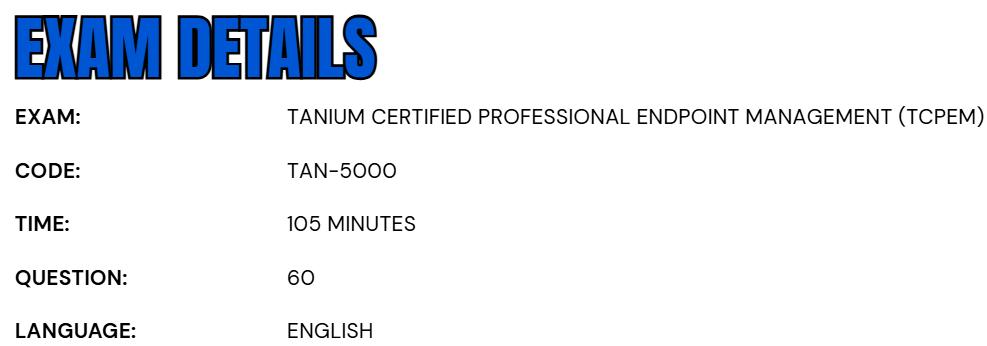
- The Tanium Certified Professional Endpoint Management (TCPEM) exam, identified by SKU: TAN-EXAM-TCPEM and Exam Code: TAN-5000, is a professional-level certification designed to validate advanced skills in managing and administering Tanium’s operations-focused modules.
- The exam is structured to comprehensively assess a candidate’s knowledge and practical abilities.
- It is scored out of a total of 60 points, with a combination of multiple-choice questions and practical application items that reflect real-world endpoint management tasks.
- Candidates are provided a total seat time of 105 minutes to complete the exam, ensuring adequate time to demonstrate both conceptual understanding and applied expertise.
Course Outline
The exam covers the following topics:
1. Learn about the Prerequisites – 18%
- Given a scenario, identifying data needed to support use cases
- Creating target groups
- Assigning access controls
2. Understand Configuration – 30%
- Creating and/or modifying Endpoint Management reports
- Configuring external dependencies
- Creating configurations for endpoints
- Configuring Tanium modules

3. Taking Action – 27%
- Exporting Endpoint Management data
- Configuring third-party integrations
- Given a scenario, interpreting module data
- Deploying configurations
4. Maintanance – 25%
- Collecting troubleshooting data
- Given a scenario, analyzing troubleshooting data
- Remediating affected endpoints
Tanium Certified Professional Endpoint Management (TCPEM) Exam FAQs

Exam Policies
Before registering for the Tanium Certified Administrator (TCA) exam, candidates should carefully review the official exam policies. Understanding these guidelines in advance helps avoid scheduling complications, testing interruptions, or delays in receiving results.
– Reschedule and Cancellation Policy
Candidates are allowed to reschedule or cancel their exam appointment up to 48 hours before the scheduled exam time. Any request made within less than 48 hours of the appointment is not permitted. Failure to make changes within the permitted window results in the forfeiture of the exam fee. Likewise, candidates who fail to appear for their scheduled exam will also lose their exam fee.
– Exam Results
At Pearson VUE Test Centers, results are provided immediately after the exam in the form of a printed report from the test center administrator. For those testing via Pearson OnVUE (Online), results are delivered through an email containing instructions to access the score report in the Pearson VUE dashboard.
Passing candidates receive only a pass notification, while non-passing candidates are given a detailed performance breakdown by section to help identify areas for improvement. In most cases, exam results are also available within 24 hours in the candidate’s Certification Portal profile.
– Exam Retake Policy
Candidates who do not achieve a passing score on their first attempt must adhere to the official retake policy. A mandatory seven-day waiting period is enforced before the exam can be attempted again. The waiting period begins on the day following the unsuccessful attempt, and this rule applies without exception to all candidates.
Tanium Certified Professional Endpoint Management (TCPEM) Exam Study Guide

Step 1: Understand the Exam Objectives
The first step in preparing for the Tanium Certified Professional Endpoint Management (TCPEM) exam is to gain a clear understanding of the exam objectives. These objectives outline the specific knowledge areas and skills that the exam will measure, including the ability to manage, report on, and administer Tanium’s operations-focused modules. By reviewing the objectives thoroughly, candidates can identify which domains require the most attention and design their study plan accordingly. Having clarity on what the exam emphasizes ensures that preparation remains focused on the areas that directly impact performance on test day.
Step 2: Review the Candidate Handbook
The next essential step is to carefully study the Candidate Handbook. This document is an official resource that provides a comprehensive overview of the exam format, the number of questions, the time allotted, and the types of items candidates will encounter. It also covers vital policies such as registration requirements, identification guidelines, scheduling and rescheduling rules, and result reporting procedures. Becoming familiar with the handbook reduces the risk of administrative issues, testing disruptions, or misunderstandings about the exam environment. It essentially serves as the rulebook for the exam and should be read in detail before scheduling a test date.
Step 3: Explore the Tanium Resource and Training Center
Once candidates are confident in the exam requirements, they should turn to the Tanium Resource and Training Center to build technical depth. This training hub contains official documentation, product guides, and structured courses designed by Tanium experts. By working through these resources, candidates can strengthen their hands-on knowledge of endpoint management, patching, performance monitoring, and asset management—all of which form the foundation of the TCPEM exam. Training modules also provide practical insights into how Tanium functions in real enterprise environments, which is essential for success in both the exam and professional practice.
Step 4: Join Study Groups and Community Discussions
Preparation is often more effective when shared, and engaging in study groups or online community discussions can be a powerful way to reinforce learning. Collaborative preparation provides opportunities to exchange insights, clarify difficult concepts, and hear first-hand experiences from individuals who have already attempted the exam. Candidates may also encounter scenario-based examples, troubleshooting strategies, and exam-taking tips that are not always available in official materials. This sense of community not only helps with knowledge-sharing but also keeps candidates motivated and accountable throughout their preparation journey.
Step 5: Take Practice Tests
The final stage of preparation involves taking practice tests that mirror the format and rigor of the actual exam. These practice sessions help candidates become familiar with time management strategies, question styles, and the balance between multiple-choice items and practical application tasks. More importantly, they serve as diagnostic tools, highlighting areas of strength and weakness. Candidates who perform well on practice exams build confidence and reduce test-day anxiety, while those who identify weaker areas can adjust their study plan for improvement. Consistent practice testing ensures that candidates are fully prepared to demonstrate their expertise during the TCPEM exam itself.
