
The Salesforce Certified Platform Strategy Designer exam is designed for professionals who want to validate their expertise in shaping strategic, user-centric solutions on the Salesforce Platform. This certification emphasizes the intersection of business goals, user experience, and technical design, ensuring candidates can effectively guide organizations through complex design and delivery processes.
Furthermore, candidates for this exam are expected to demonstrate knowledge, skills, and practical experience in the following areas:
- Guiding Discovery and Design: Leading research, discovery, and design efforts to create a shared vision and direction for a product or solution.
- Customer Journey Mapping: Facilitating the development of complete customer journeys from concept to execution.
- Business-User Alignment: Ensuring that business objectives align with the end-user experience of Salesforce products or services.
- Design Quality Advocacy: Championing design quality and alignment with the overall vision when recommending solutions.
- Problem Framing: Translating business problems into user-centered challenges and actionable design opportunities.
- Design Thinking Application: Applying design thinking principles to drive innovation and solution development.
- Prioritization and Focus: Leading design efforts with strategic prioritization to achieve impactful outcomes.
- Collaboration Across Roles: Leveraging team strengths and knowing when to consult experts in visual design, business strategy, or technology.
- Stakeholder Alignment: Presenting ideas clearly, resolving objections creatively, and influencing stakeholders to adopt a shared vision.
– Roles and Duties
The Salesforce Certified Platform Strategy Designer serves as a bridge across multiple disciplines, combining business strategy, design, and delivery expertise. These professionals:
- Align organizations around a shared vision for systems-level solutions.
- Focus on important, strategic outcomes rather than urgent tasks.
- Deliver results through both tangible outputs and relational influence.
- Lead innovation across product and solution lifecycles.
- Facilitate collaboration, fill skill gaps, and know when to bring in domain experts.
- Demonstrate empathy in connecting business objectives with user needs.
– Who Should Take This Exam
The exam is ideal for professionals who:
- Have at least 3 years of hands-on experience in a strategy design or equivalent role.
- Possess 1–2 years of experience working with the Salesforce Platform.
- Have advanced facilitation and consultative skills.
- Have led complex projects for a minimum of 2 years, managing cross-functional teams.
Salesforce Certified Platform Strategy Designers are typically those who want to drive strategic product and system design initiatives, influence stakeholders, and create solutions that balance business impact with exceptional user experiences.
Exam Details
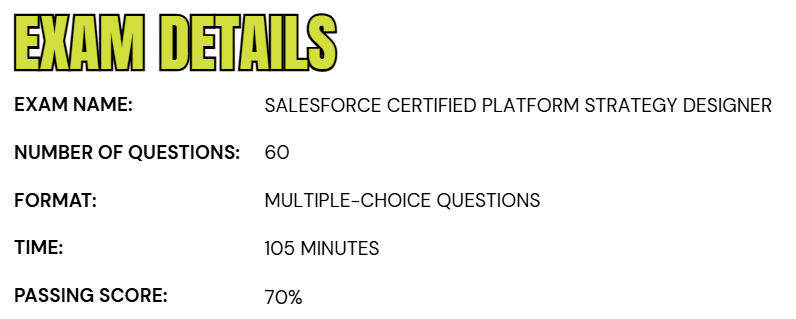
- The Salesforce Certified Platform Strategy Designer Exam consists of 60 multiple-choice questions and must be completed within 105 minutes.
- Candidates are required to achieve a passing score of 70% to earn the certification.
- The exam can be taken either onsite at a proctored testing center or through a secure online proctored environment, providing flexibility for different testing preferences.
- During the exam, no hard-copy or online reference materials are allowed.
- There are no prerequisites for taking this exam, making it accessible to professionals who meet the experience requirements outlined for the Platform Strategy Designer role.
Course Outline
The Salesforce Certified Platform Strategy Designer Exam evaluates a candidate’s proficiency and expertise across key strategic design objectives. Candidates are expected to have practical, hands-on experience applying strategy design principles on the Salesforce Platform and possess solid knowledge in each of the areas outlined below.
1. Understand Value Design: 32%
- Given a customer scenario, creating an effective challenge statement that pairs a business objective with a user problem, to frame the altitude and scope of a design project.
- Based on the challenge statement created, identifying the metrics and signals that will define success.
- Given a customer scenario, evaluating how the internal dynamics of the organization might impact your recommendation on the right approach to solving the challenge statement.
- Given a scenario, explaining how key external context for innovation might influence or impact the organization’s strategy.
- Defending the rationale for strategic directions, including how they satisfy business and user needs, and future implications.
- Given a customer scenario, advocating for ethics and values on behalf of both users and the organization.
2. Learn about Tools and Artifacts: 23%
- Given a business need, connect user needs to high-level Salesforce capabilities.
- Given a customer scenario, determining the criteria for feasibility, desirability, and viability within a user experience.
- Given a customer scenario, identifying the best methods of co-creation to employ with customers and stakeholders.
3. Understand Intangible Deliverables: 26%
- Given a scenario, crafting a strategy to create alignment.
- Given evolving internal dynamics, identifying the key relationships needed to solve the challenge statement.
- Given an audience description, identify the best presentation techniques for communicating a vision.
- Given a scenario, utilizing the tools for productive cross-discipline collaboration.

4. Learn about leveraging Adjacent Roles/Skills: 19%
- Given an aligned vision, creating a roadmap for implementation that is feasible and holds true to the vision in every iteration.
- Given a scenario, determining the technical and business capabilities that underpin the delivery of vision to solution.
- Given a scenario of disparate business and technical deliverables within a design/build team, facilitate productive collaboration.
- Given a scenario, determining the knowledge and skill infusions needed in the creation of a vision.
Salesforce Certified Platform Strategy Designer Exam FAQs
Salesforce Certification Exam Policy
The Salesforce Certification Exam Policy establishes the official guidelines for scheduling, rescheduling, canceling, and completing certification exams, whether taken at an authorized testing center or through an online proctored environment. These policies are designed to ensure fairness, uphold exam security, and provide a consistent experience for all candidates.
– Onsite (Testing Center) Exams
Candidates opting to take their exam at a Pearson VUE testing center can reschedule or cancel their appointment through their Pearson VUE account up to 48 hours prior to the scheduled time. Requests submitted after this window are typically not accepted. Candidates who miss their scheduled appointment without rescheduling will be considered no-shows, resulting in the forfeiture of the full exam fee.
– Online Proctored Exams
For online proctored exams, candidates may modify or cancel their booking up to 24 hours before the exam start time using the Pearson VUE platform. Requests made after this deadline are generally denied. Failure to attend the online session without prior adjustment will also result in loss of the exam fee.
Salesforce Exam Candidate Code of Conduct
All participants in the Salesforce Certification Program are expected to demonstrate professionalism, integrity, and ethical behavior. By registering for an exam, candidates agree to abide by the Salesforce Credential and Certification Program Agreement, which sets the standards for conduct during exam preparation and delivery.
Candidates must rely only on approved Salesforce learning materials, engage responsibly within the Trailblazer Community, and adhere to all exam security protocols. Actions such as sharing or soliciting exam content, using unauthorized resources, or violating proctoring rules are strictly prohibited. Any breach of these standards may result in serious consequences, including invalidated exam results, revocation of existing certifications, or permanent disqualification from the Salesforce Certification Program.
Salesforce Certified Platform Strategy Designer Exam Study Guide
1. Understand the Exam Guide
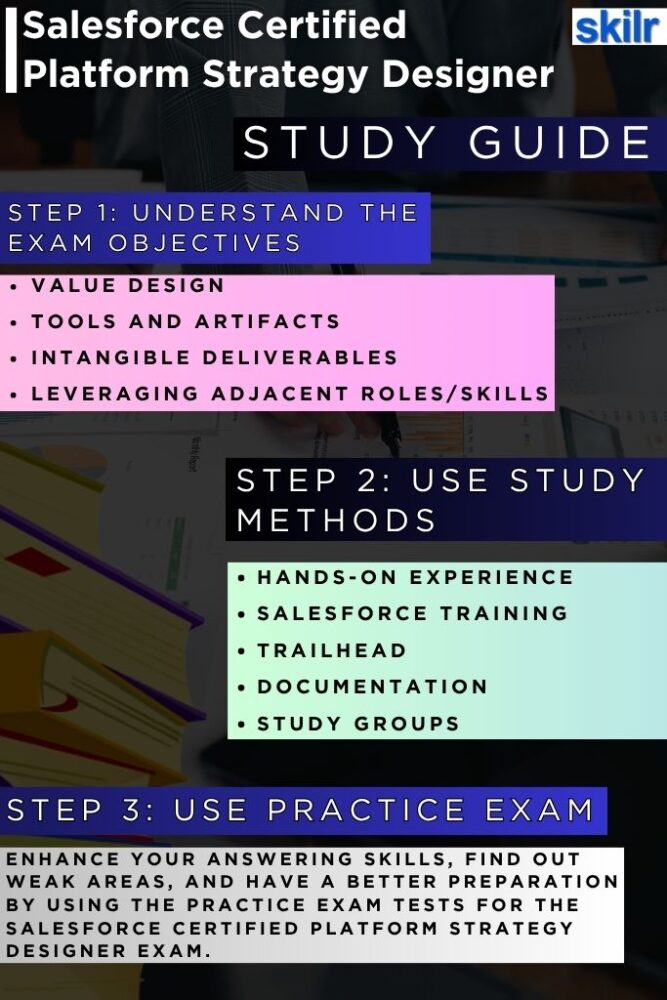
The first step in preparing for the Salesforce Certified Platform Strategy Designer Exam is to thoroughly study the official exam guide. This guide provides a detailed overview of the exam structure, the number of questions, time limits, passing score requirements, and the primary topic areas covered. It also outlines the specific skills and competencies evaluated, from design thinking and problem framing to stakeholder alignment and solution recommendation.
By familiarizing yourself with the exam objectives, you can create a focused study plan that targets high-priority areas, ensuring you allocate sufficient time to each domain. Understanding the guide also helps you manage expectations and reduces surprises on exam day.
2. Combine Hands-On Experience with Training Courses
Success in this certification relies heavily on a blend of practical experience and formal training courses. Hands-on experience enables candidates to apply strategic design principles in real-world Salesforce projects, reinforcing theoretical knowledge with actionable skills. Engaging in structured training programs, whether through Salesforce’s official courses or recognized partners, ensures you cover essential concepts, methodologies, and platform-specific techniques in a systematic way. This combination of experience and guided learning helps build both confidence and competence.
3. Gain Practical Experience to Build Expertise
To truly excel, it is crucial to apply your learning in practical scenarios. Working on actual Salesforce implementations, creating design artifacts, mapping customer journeys, and solving real business challenges will deepen your understanding of system-level solution design. Simulated exercises in Salesforce sandbox environments or project-based assignments allow you to experiment safely while developing critical thinking, problem-solving, and decision-making skills. Practical experience also helps you understand the nuances of translating business requirements into scalable and user-centric Salesforce solutions.
4. Skill Up on Trailhead
Salesforce Trailhead is an essential tool for exam preparation, offering interactive learning modules, trails, and projects that cover a wide spectrum of strategy design topics. Completing relevant Trailhead modules reinforces key concepts such as design thinking, stakeholder management, and user experience alignment.
Trailhead also provides hands-on challenges that mirror real-world scenarios, allowing candidates to practice applying knowledge in a structured and measurable way. Regular engagement with Trailhead ensures that your theoretical understanding is backed by practical, platform-specific skills.
5. Engage with Study Groups and Communities
Participating in study groups, Trailblazer Community discussions, and Trailhead Academy sessions can significantly enhance your learning. Collaboration with peers allows you to share experiences, clarify doubts, and explore alternative solutions to common challenges. Community interactions expose you to diverse perspectives, helping you develop a broader understanding of strategic design practices. Study groups also provide motivation, accountability, and structured discussion, which are valuable for reinforcing knowledge and preparing for scenario-based questions on the exam.
6. Take Practice Tests
Practice exams are a crucial element of preparation, allowing you to assess your readiness and identify knowledge gaps. Regularly attempting mock tests familiarizes you with the exam format, timing, and question types. Reviewing incorrect answers helps you pinpoint areas that need further study and reinforces your understanding of complex concepts.
Additionally, practice tests help develop exam-taking strategies, such as prioritizing questions, managing time effectively, and reducing anxiety during the actual assessment.
7. Review Official Documentation and Tip Resources
Finally, a comprehensive review of Salesforce official documentation, tip sheets, and user guides ensures you have a deep and well-rounded understanding of platform features and best practices. These resources provide detailed explanations, real-world examples, and guidance on applying concepts to business problems. Reviewing these materials enhances your ability to approach scenario-based questions with confidence, while also equipping you with practical knowledge that extends beyond the exam and into your professional work.
