
The Salesforce Certified B2C Solution Architect certification is designed for professionals who possess the expertise to architect, design, and deliver multi-cloud solutions that drive measurable business value for customers. This credential demonstrates a candidate’s ability to leverage the Salesforce Customer 360 Platform to unify business goals, technology, and customer experiences across multiple Salesforce products.
This certification validates that a B2C Solution Architect can integrate insights from different enterprise architecture perspectives to design end-to-end solutions that create strategic business impact. It assesses your ability to:
- Lead business strategy: Guide organizations on their multi-cloud journey, emphasizing customer-centric and differentiated digital experiences.
- Ensure delivery success: Drive outcomes by promoting best practices and implementation standards tailored to specific business use cases.
- Exhibit technical leadership: Identify and align the right Salesforce products and features to a company’s vision, ensuring optimal performance and scalability.
– Prerequisites for the Salesforce Certified B2C Solution Architect Exam
Before pursuing the Salesforce Certified B2C Solution Architect credential, candidates are strongly encouraged to hold prior certifications that demonstrate foundational and technical expertise across the Salesforce ecosystem. These prerequisites ensure that professionals possess the necessary skills to design and deliver complex, multi-cloud solutions effectively.
- Salesforce Certified Platform App Builder
- Salesforce Certified Integration Architect
- Salesforce Certified Data Architect
– Key Responsibilities of a B2C Solution Architect
Professionals aiming for this certification are expected to demonstrate proficiency in areas such as:
- Translating business needs into technical implementations that deliver measurable value.
- Leading the overall business solution vision and aligning it with customer success criteria.
- Guiding implementation teams on multi-cloud integration, testing, and deployment best practices.
- Designing end-state solution architectures while offering phased implementation strategies.
- Defining multi-cloud implementation standards and maintaining architectural consistency.
- Overseeing solution delivery, validating business outcomes, and adjusting plans as required.
– Core Competencies
A Salesforce B2C Solution Architect should be able to:
- Evaluate a company’s digital maturity and recommend scalable, customer-focused strategies.
- Translate customer visions into multi-cloud experiences that align with business goals.
- Model best practices for customer data management across multiple Salesforce products.
- Map business use cases to Salesforce’s multi-cloud capabilities, ensuring alignment with objectives.
- Weigh trade-offs between solution options to ensure technical feasibility and business value.
- Deliver integrated solutions leveraging B2C Commerce, Marketing Cloud, and Service Cloud.
- Lead solution discovery sessions and align key stakeholders around shared outcomes.
- Serve as a solution owner, ensuring that the final implementation achieves its intended business value.
– Who Should Take the Exam
The Salesforce Certified B2C Solution Architect Exam is ideal for:
- Experienced Solution Architects with 2–3 years of architecture and multi-cloud project experience.
- Business and Technology Liaisons responsible for bridging strategic business objectives with Salesforce implementations.
- Consultants or Technical Leads involved in designing, planning, and delivering customer-centric B2C experiences.
- Multi-cloud specialists seeking to validate their expertise in Customer 360 design, integration, and governance.
Exam Details
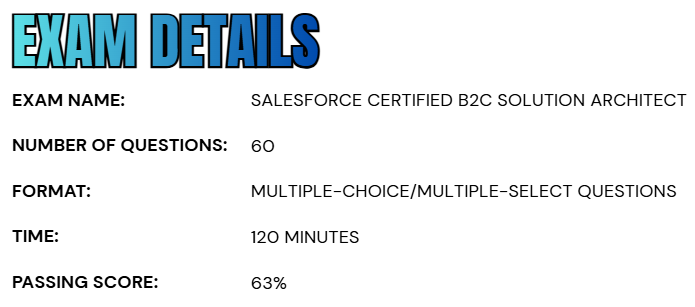
- The Salesforce Certified B2C Solution Architect exam consists of 60 multiple-choice or multiple-select questions, along with up to five unscored questions included for data evaluation purposes.
- Candidates are given 120 minutes to complete the test, and a minimum score of 63% is required to pass.
- The exam can be taken either as a proctored onsite test at an authorized testing center or through a secure online environment.
- During the assessment, no external resources—such as printed materials, notes, or online references—are permitted.
- It’s important to note that unscored questions do not affect the final score and are included solely to collect statistical performance data for future exam development.
Course Outline
The Salesforce B2C Solution Architect exam evaluates a candidate’s expertise and practical understanding across the following key objective areas.
1. Learn About Discovery and Customer Success: 27%
- Given a scenario, determining how to facilitate a successful customer engagement (agenda, plan, gather requirements, document, and design).
- Given a set of business requirements and the understanding of standard Salesforce product capabilities, explaining the reasoning and considerations to use a certain product.
- Given a scenario with a B2C architecture, validating that the associated systems of record, key objects, and risks have been captured and explained.
- Given a set of requirements, recommending the implementation approach and associated relative effort.
- Given a scenario, articulating dev-ops lifecycle and governance required in a multi-cloud environment to achieve change management goals.
2. Understand Functional Capabilities and Business Value: 7%
- Given a set of customer requirements, recommending suitable B2C products and solution approach to demonstrate a customer process which includes marketing, purchase, service and loyalty.
- Given a set of customer requirements for post-purchase activities in a multi-cloud solution, demonstrating how the customer experience can be achieved by leveraging Salesforce B2C products.
3. Understand Architecture Design: 18%
- Given the understanding of retail solution architecture and integrations, illustrating how Salesforce products interact with each other and third-party systems to support consumer commerce journeys.
- Given a use case, analyzing business processes and propose a customer experience solution that generates business value that meets expectations.
- Given a use case, recommending a multi-cloud strategy and implementation approach to create custom personalized experiences that utilize the power of the Customer Data Platform.
- Given data security and residency requirements, recommending an appropriate solution and describe how the solution’s considerations can impact implementation.
4. Learn Data Models and Management: 25%
- Given the Salesforce supported standard object definitions for Commerce objects (profile, orders, products), articulate how key business entities relate between systems of record and systems of engagement.
- Given a set of business objectives and priorities, recommend an appropriate sequence for system integration, data exchanges, and process updates to satisfy known requirements, with recommendations and potential impact to overall program delivery.
- Given a set of customer requirements, articulating the privacy management features across multiple clouds, when to consider a custom solution vs. using out-of-the-box (OOTB) features.
- Given a scenario, identifying appropriate systems of record and describe how you would extend the standard data model for high volume processing, articulate system limitations, and recommending preferred methods for integration between various data formats.
- Given a scenario that requires knowledge of common data migration strategies and standard Salesforce data migration tools, demonstrate best practices on how to transfer data between products and development environments.

5. Understand Integration: 23%
- Given a set of customer requirements, recommending an appropriate design and approach for a multi-cloud integration, understanding the OOTB features, system limitations, and when custom integration is required.
- Given business requirements and use cases, recommend appropriate integration patterns based on data volume, latency, and system limitations.
- Given a B2C use case, recommending features and approaches that ensure security for both customers and internal business users while complying with regional and local legal requirements.
- Understanding the recommended methods on how to integrate systems to Service Cloud, B2C Commerce, and Marketing Cloud environments using APIs and protocols that support various integration design patterns.
Salesforce Certified B2C Solution Architect Exam FAQs
Salesforce Exam Policy
The Salesforce Exam Policy outlines the official procedures and expectations for scheduling, rescheduling, canceling, and completing certification exams—whether taken online or at an authorized testing center. Following these guidelines ensures a fair, secure, and consistent testing experience for all candidates across the Salesforce Certification Program.
Onsite (Testing Center) Exams
Candidates opting to take their exam at a Pearson VUE testing center may reschedule or cancel their appointment up to 48 hours before the scheduled exam time via their Pearson VUE account. Requests made after this deadline are generally not accepted. Failure to appear for the exam without prior notice will be treated as a no-show, resulting in forfeiture of the full exam fee.
Online Proctored Exams
For candidates taking an online proctored exam, rescheduling or cancellation is allowed up to 24 hours before the scheduled start time through the Pearson VUE platform, without additional fees. Requests made after this window are unlikely to be accommodated. Non-compliance with these policies, including missed exams, will lead to loss of the exam fee.
Salesforce Exam Candidate Code of Conduct
All Salesforce certification candidates must adhere to the Credential and Certification Program Agreement, which emphasizes the principles of fairness, integrity, and professionalism throughout the certification journey. Candidates are encouraged to prepare using official Salesforce learning resources, participate in the Trailblazer Community, and maintain ethical behavior during every phase of the exam process.
Any unethical or prohibited conduct—including sharing confidential exam materials, receiving or offering unauthorized assistance, or violating exam protocols—is strictly forbidden. Such actions can lead to serious disciplinary consequences, including exam invalidation, credential suspension or revocation, and potential permanent disqualification from the Salesforce Certification Program.
Salesforce Certified B2C Solution Architect Exam Study Guide
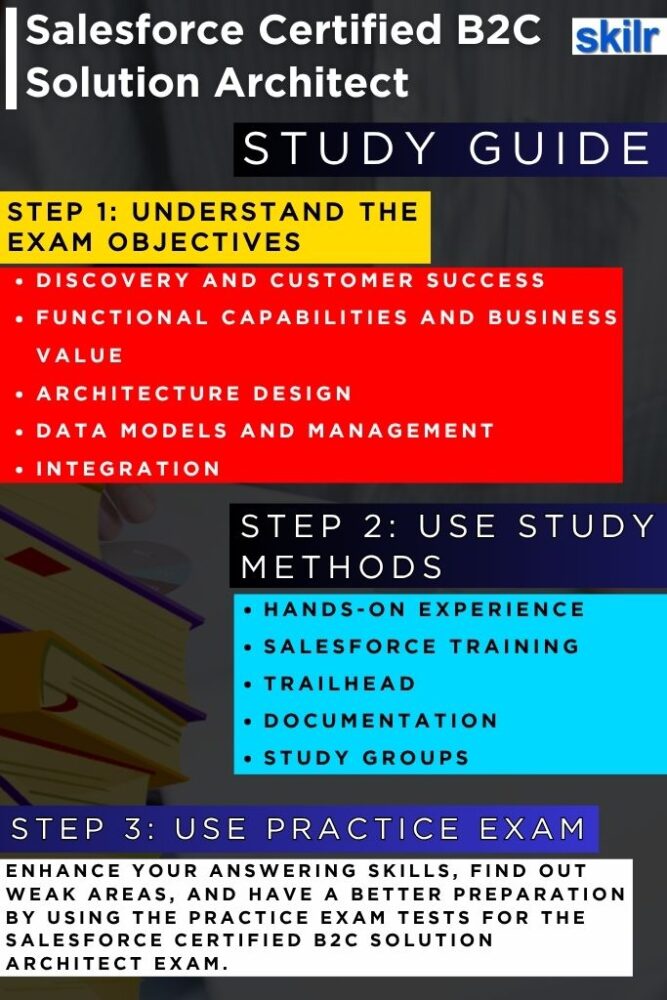
Step 1: Build a Strong Foundation Through Hands-On Experience
Hands-on experience is the cornerstone of success for the Salesforce B2C Solution Architect certification. Candidates should actively work on real or simulated multi-cloud projects that involve Salesforce B2C Commerce, Service Cloud, Marketing Cloud, and Experience Cloud. This exposure helps in understanding how different Salesforce products interact to create unified customer journeys.
Experiment with complex integration scenarios, data synchronization, and system design challenges to gain practical insights into how architectural decisions impact business outcomes. Real-world implementation experience also builds confidence in addressing design trade-offs, scalability considerations, and performance optimization—key areas often tested in the exam.
Step 2: Complete Official Salesforce Training Courses
Formal learning through Trailhead Academy or other authorized Salesforce training partners provides a structured path to mastering core architectural principles. Enrolling in Salesforce-recommended courses ensures that you gain comprehensive knowledge of multi-cloud strategy, system integration patterns, data governance, and Customer 360 implementation frameworks.
These courses are designed by Salesforce experts and mirror the competencies assessed in the certification exam. Completing them not only solidifies your conceptual understanding but also exposes you to real-world use cases, customer success frameworks, and architectural blueprints that can enhance your decision-making during both the exam and actual projects.
Step 3: Strengthen Your Skills with Trailhead
Trailhead, Salesforce’s free interactive learning platform, serves as a vital resource for continuous skill-building. Candidates should complete trails and modules that focus on B2C architecture, API integrations, identity management, customer data platforms (CDP), and marketing automation. Earning badges and superbadges in these areas helps bridge the gap between conceptual learning and hands-on execution.
Trailhead’s guided projects and interactive challenges also reinforce problem-solving skills and enable learners to practice applying architectural concepts in realistic scenarios. Consistently engaging with Trailhead content ensures that your knowledge remains aligned with Salesforce’s latest features, platform updates, and best practices.
Step 4: Join Study Groups and Engage with the Trailblazer Community
Collaboration plays a crucial role in effective exam preparation. Joining study groups, Trailblazer Community circles, and Salesforce architect forums allows candidates to share insights, discuss complex topics, and clarify doubts with experienced professionals. Engaging with peers provides a broader understanding of different implementation perspectives, use-case variations, and solution trade-offs.
Many certified architects actively contribute to these communities by offering study plans, resource recommendations, and real-world advice. Participation in these discussions not only deepens your technical comprehension but also keeps you motivated throughout your preparation journey.
Step 5: Take Practice Exams and Mock Tests
Once you have built a solid knowledge base, testing your readiness through practice exams is essential. Mock tests simulate the actual exam environment, allowing you to assess your understanding of topics such as multi-cloud integration strategies, data modeling, customer experience design, and governance frameworks.
Reviewing your performance on these tests helps identify weak areas that require additional focus. Pay close attention to the reasoning behind each correct and incorrect answer, as this sharpens your analytical thinking and helps you interpret complex scenario-based questions more effectively. Consistent practice under timed conditions also improves your ability to manage the 120-minute exam window efficiently.
Step 6: Review Official Salesforce Documentation and Study Resources
A critical step in your preparation is reviewing the official Salesforce documentation, tip sheets, release notes, and user guides. These materials provide the most accurate and detailed technical information about Salesforce products, architecture best practices, and integration methods. Candidates should particularly focus on multi-cloud implementation guides, Customer 360 architecture whitepapers, and API reference documentation.
These resources are invaluable for understanding Salesforce’s design principles and for staying current with the latest platform capabilities. By aligning your practical experience with official Salesforce documentation, you ensure that your knowledge is both technically sound and exam-relevant.
Step 7: Reinforce Learning Through Continuous Practice and Real-World Simulation
Even after completing training and practice tests, ongoing practice is essential to maintaining mastery. Candidates should continuously refine their architectural thinking by designing sample end-to-end B2C solutions, reviewing customer journey maps, and creating data flow diagrams that align with real-world requirements.
Simulating multi-cloud integration scenarios and validating them in sandbox environments can help you understand the interdependencies between systems. This approach ensures that theoretical knowledge is transformed into applied expertise. Continuous learning also prepares you for evolving Salesforce technologies, ensuring your skills remain relevant long after certification.
