



The Salesforce Certified Field Service Consultant certification validates your ability to design, configure, and deploy end-to-end field service solutions using the Salesforce Field Service managed package, core Salesforce platform capabilities, and the Salesforce Field Service Mobile app.
Professionals in this role are expected to understand real-world field service operations, mobile workforce requirements, and the broader Salesforce data model that supports these processes.
Achieving this certification demonstrates your ability to implement scalable workflows, optimize field operations, and ensure consistent skill and process standards across organizations using Salesforce Field Service.
– Exam Prerequisites
To be eligible for this certification, Salesforce requires candidates to first hold the Salesforce Administrator credential as well as the Salesforce Service Cloud Consultant certification, ensuring that all exam participants have a solid foundation in Salesforce platform capabilities and service management concepts.
– Certification Purpose
This certification is designed to confirm that candidates can translate complex field service business needs into workable Salesforce Field Service solutions. The exam evaluates your ability to:
- Assess organizational requirements
- Configure Field Service features
- Deploy scalable, maintainable solutions
- Ensure smooth integration with Service Cloud and other Salesforce products
The goal is to maintain a high level of expertise among consultants, administrators, and partners working with Salesforce Field Service implementations.
– Who Should Take the Exam?
The Salesforce Certified Field Service Consultant exam is ideal for professionals who work closely with service operations, dispatching, or mobile workforce management. You should consider this certification if you are:
- Involved in implementing or customizing Service Cloud or Salesforce Field Service
- Responsible for improving on-site service delivery, technician scheduling, or resource management
- Working in roles that require strong understanding of mobile workforce tools, service operations, and customer support workflows
It is especially suited for:
- Salesforce Consultants
- Service Cloud Specialists
- Field Service Operations Managers
- Mobile Solution Designers
- System Analysts and Solution Architects
- Support Leads or Service Desk Managers
– Expected Background and Experience
A typical candidate for the Field Service Consultant certification brings:
- 1–2 years of experience in business analysis
- 1+ years of hands-on exposure to field service operations
- 2+ years of experience working in service or support environments
- Practical knowledge of Salesforce Service Cloud and Field Service configuration
Candidates should also understand:
- The complete field service lifecycle, from case creation to work order completion
- When and how to use different Salesforce products (Service Cloud, Field Service, Mobile, Experience Cloud, Knowledge, and the Platform)
– Key Knowledge Areas
A certified consultant should be comfortable designing and implementing solutions related to:
1. Scheduling & Optimization
- Defining service territories
- Managing technician skills
- Configuring service objectives
- Working with complex optimization scenarios
2. Resource & Asset Management
- Assigning and tracking mobile workers
- Managing service resources, crews, and equipment
- Asset hierarchy and lifecycle management
3. Inventory & Parts Management
- Tracking stock levels
- Managing warehouses and vans
- Handling returns and consumption
4. Work Orders & Service Appointments
- Designing lifecycle workflows
- Defining dependencies and constraints
- Understanding orchestration of customer service tasks
5. Contracts, Entitlements & Warranties
- Ensuring service delivery meets contractual terms
- Managing warranty rules and coverage
6. Mobile Experience
- Designing mobile flows for technicians
- Configuring the Field Service Mobile app
- Improving on-site productivity with dynamic forms and actions
7. Reporting & Maintenance
- Creating dashboards for service performance
- Automating recurring service tasks through maintenance plans
– Areas Where Candidates May Need Support
Some advanced areas commonly require deeper preparation, including:
- Complex scheduling logic and route optimization
- Service territory design and best-practice planning
- Understanding advanced optimization rules and constraints
Exam Details

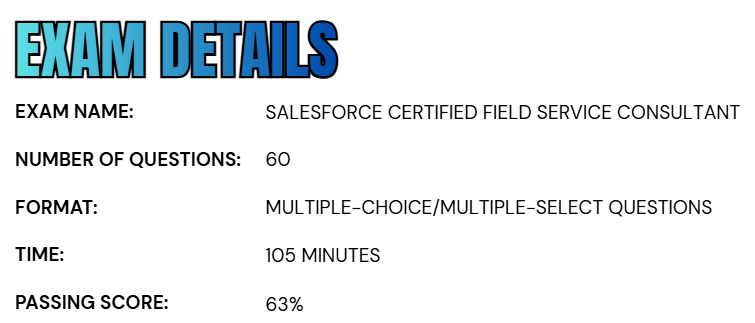
- The Salesforce Field Service Consultant Exam consists of 60 multiple-choice and multiple-select questions, along with up to five additional unscored items that do not impact your final score but may appear during the test.
- Candidates are given 105 minutes to complete the exam, which includes time for any unscored questions that may be presented.
- To successfully pass, you must achieve a minimum score of 63%.
- The exam is offered in two formats: you can take it as a proctored onsite test at an authorized testing center or choose the flexibility of an online proctored environment.
- During the exam, no external materials are permitted, meaning you cannot use hard-copy notes, digital resources, or online references of any kind.
Course Outline
The Salesforce Field Service Consultant Exam evaluates a candidate’s expertise across key functional areas. Test-takers should have practical experience implementing both Salesforce Service Cloud and Salesforce Field Service, with proven ability to apply the features and capabilities outlined in the exam objectives.
1. Understand about Managing Resources: 16%
- Setting up and managing crews.
- Determining how and when to set up different resource types.
- Given a scenario, recommending the appropriate Service Territories and their Members.
- Explaining the relationships between time sheets, time sheet entries, service resources, and Work Orders.
- Demonstrating how to use skills, skill levels, and time-based skills.
- Showing how to use operating hours for service resources, accounts, Work Orders, and booking appointments.
- Distinguishing between Field Service license types and when to deploy them.
2. Process of Managing Work Orders: 23%
- Configuring Work Order processes, parameters, and Work Types.
- Given a scenario, choosing the appropriate Resource Preferences.
- Applying Products Required to a Work Order.
- Analyzing how and when to use Work Order Line Items.
- Illustrating how to configure Work Order Milestones.
- Given a scenario, recommending the appropriate relationship between Service Appointments, Work Orders, and Work Order Line Items.
3. Learn about Managing Scheduling and Optimization: 28%
- Understanding different field service settings for SFS Administrator.
- Given a scenario, choosing the appropriate action to manage a Service Appointment.
- Given a scenario, applying the appropriate lifecycle of a Service Appointment required to execute a Work Order.
- Decide on the appropriating Schedule Policy to achieve the business requirements.
- Given a scenario, determining the appropriate option to execute Complex Work in SFS.
- Explaining the difference between a multi-day Service Appointment and a standard Service Appointment.
- Outlining the differences between aerial versus street-level routing.
- Given a scenario, determine the appropriate dispatch strategy for an organization.
- Comparing different filtering options for the Dispatcher Console.
- Explaining how to set up optimization.
- Given a scenario, decide the appropriate type of scheduling service to use.
- Given a scenario, decide the appropriate type of optimization service to use.
- Understanding the usage of Salesforce Field Service for DateTime tracking fields.
4. Learn about Configuring Mobility: 10%
- Assessing the requirements and tools needed to execute a customer sign-off process.
- Given a scenario, configure the Field Service app to support key business processes.
- Distinguishing between Field Service Mobile and Salesforce Mobile app capabilities.
- Understanding the available SFS Mobile settings.


5. Understand about Managing Inventory: 8%
- Given business requirements, distinguish the appropriate price book model for products consumed.
- Given business requirements, justifying which define the applicable inventory model.
- Explaining the Return Order object model and process.
6. Managing Assets: 5%
- Applying procedural concepts to maintain and update assets and asset relationships.
7. Configuring Maintenance Plans: 5%
- Given a scenario, recommending the appropriate maintenance plan.
8. Understand Permissions and Sharing: 5%
- Understanding use cases for different types of SFS permission sets.
- Explaining how scheduled Service Appointments are shared with service resources.
- Understanding the differences between user territories and service territories.
Salesforce Certified Field Service Consultant Exam FAQs
Salesforce Certification Exam Policy
The Salesforce Certification Exam Policy provides the official rules for scheduling, updating, canceling, and completing any Salesforce certification exam. These policies apply to both in-person testing center appointments and online proctored exams, ensuring a secure, fair, and consistent testing experience for all candidates.
– Onsite Testing Center Exams
If you choose to take your exam at a Pearson VUE testing center, you may change or cancel your appointment through your Pearson VUE account up to 48 hours before your scheduled time. After this window closes, modifications are not permitted. Candidates who fail to appear for their scheduled session without proper rescheduling are considered no-shows and will lose the full exam fee.
– Online Proctored Exams
For online proctored exams, adjustments and cancellations must be made at least 24 hours prior to the appointment via the Pearson VUE portal. Requests submitted after this period are normally declined. Missing an online exam without prior rescheduling also results in forfeiture of the exam fee.
Salesforce Exam Candidate Code of Conduct
All participants in the Salesforce Certification Program are expected to maintain a high level of professionalism, integrity, and ethical behavior. By registering for any certification exam, candidates agree to follow the guidelines outlined in the Salesforce Credential and Certification Program Agreement.
Candidates may only use approved Salesforce learning resources, engage responsibly within the Trailblazer Community, and comply with all exam security and proctoring requirements. Activities such as sharing or attempting to obtain real exam questions, accessing unauthorized materials during the exam, or violating proctor instructions are strictly prohibited.
Any misconduct can lead to score invalidation, loss of earned certifications, or even permanent removal from the Salesforce Certification Program.
Salesforce Certified Field Service Consultant Exam Study Guide


1. Understanding the Salesforce Field Service Consultant Exam Guide
A strong preparation journey begins with a deep review of the official Salesforce exam guide. This document outlines every core topic included in the assessment, detailing the functional areas you must master—from work order management and service appointment lifecycles to scheduling optimization and mobile technician workflows.
By studying the guide closely, you gain clarity on how much weight each domain carries, what level of expertise is expected, and how the exam measures your problem-solving abilities in real-world consultant scenarios. Treat the guide as your blueprint, revisiting it regularly to ensure your study plan stays aligned with Salesforce’s expectations.
2. Blending Hands-On Practice with Formal Training
Preparing for this certification requires more than theoretical understanding. Real value comes from combining hands-on experimentation with structured Salesforce training. Working directly inside Salesforce Field Service and Service Cloud allows you to configure service territories, define skills, explore dispatcher console logic, and simulate work order routing end-to-end.
At the same time, Salesforce’s recommended courses provide deeper conceptual knowledge, including best practices, implementation frameworks, and architectural considerations that may not be obvious through experimentation alone. This combination ensures you understand not just how to configure features, but why specific approaches work best in certain business scenarios.
3. Building Real or Simulated Practical Experience
Practical exposure is essential for developing the judgment needed to handle scenario-based exam questions. The more you actively configure, test, and troubleshoot, the better you internalize how Field Service behaves in real operations. Whether you have access to production environments, sandbox orgs, or Trailhead Playgrounds, use them to build complete workflows—including work order creation, service appointment scheduling, contractor assignments, mobile actions, inventory tracking, and maintenance plans.
As you work through these processes, push yourself to explore advanced configuration options like scheduling policies, optimization rules, or multi-level asset management. These experiences help bridge the gap between conceptual knowledge and real-world consultant execution.
4. Learning from Experts Through Instructor-Led Training
Instructor-led classes give you access to Salesforce-certified trainers who specialize in Field Service implementations. These experts provide guided walkthroughs, practical examples, and detailed explanations of complex topics such as multi-resource scheduling, crew management, inventory handling, and return processes.
They often share insights gained from real customer deployments, including how to avoid common configuration mistakes and how to design scalable solutions. Participating in these sessions also opens the door to direct Q&A opportunities, helping you clarify doubts that self-study might not resolve. This structured, expert-driven approach accelerates your mastery of Field Service concepts significantly. However, the related training includes:
– Implement Salesforce Field Service – FSL201
The FSL201: Implement Salesforce Field Service course teaches you how to configure and deploy Salesforce Field Service to improve technician productivity and streamline service operations. This three-day instructor-led training walks you through the essential setup steps, key configurations, and practical implementation techniques needed to support a successful Field Service rollout.
Through hands-on exercises and real-world examples, you’ll learn how to prepare your org, optimize service workflows, and build a working Field Service model that mirrors an actual business environment. This course is ideal for consultants and Salesforce administrators responsible for implementing Field Service. Participants should have the Salesforce Administrator certification or equivalent experience, along with a basic understanding of Service Cloud.
5. Strengthening Skills Through Trailhead Learning
Trailhead remains one of the most powerful resources for preparing Salesforce professionals. Its Field Service modules and Trailmixes offer hands-on challenges where you can apply key concepts in a controlled environment. These labs help reinforce your understanding of the Field Service object model, the dispatcher console interface, service resource behavior, mobile app functionality, and appointment scheduling logic. The learning experience is interactive, allowing you to immediately test your knowledge as you progress. Additionally, Trailhead Playgrounds give you the freedom to experiment at your own pace, making it easier to build confidence with complex features.
6. Engaging with Study Groups, Communities, and Trailhead Academy
Connecting with other learners dramatically enhances your preparation because Field Service concepts often involve multiple layers, exceptions, and dependencies. Study groups—whether local meetups, online circles, or Trailblazer Community groups—allow you to discuss real use cases, troubleshoot configuration challenges, and share practical insights.
Many candidates find that collaborative conversations help clarify difficult topics such as scheduling policies, optimization windows, contractor workflows, and entitlement-driven processes. Trailhead Academy events also offer additional opportunities to seek guidance from certified experts and stay updated with the latest feature enhancements released by Salesforce.
7. Using Practice Tests and Reviewing Official Salesforce Documentation
Practice exams are an important part of building exam readiness. They help you understand how Salesforce frames scenario-based questions and reveal areas where your knowledge needs strengthening. Alongside mock tests, thoroughly reviewing Salesforce’s official documentation, online help articles, release notes, and tip sheets is essential.
These materials offer precise definitions, step-by-step functionality explanations, and the most current product behavior—which is especially important since Field Service is updated frequently. User guides and sample configurations provide the tactical details needed to answer high-complexity questions accurately, ensuring you enter the exam fully prepared and confident.
