

The Salesforce Certified Marketing Cloud Engagement Developer exam validates the skills of professionals who build, customize, and optimize solutions within Marketing Cloud. It is intended for developers with real-world, hands-on experience working across Marketing Cloud’s data, messaging, and scripting capabilities—especially those who have already earned the Salesforce Certified Marketing Cloud Email Specialist credential.
This certification focuses on developers who create dynamic, personalized marketing experiences, including emails, landing pages, and data-driven forms using HTML, CSS, AMPscript, and SQL. Candidates should also be familiar with using Marketing Cloud APIs, configuring data models, and supporting multi-channel subscriber management.
A qualified Engagement Developer is comfortable working as a full-stack Marketing Cloud practitioner—managing data, implementing personalization logic, troubleshooting scripting issues, and developing assets that support both tactical and long-term campaign strategies. They generally bring a minimum of one year of development experience within Marketing Cloud and its related tools.
– Prerequisite
– Who Should Take This Exam?
This exam is ideal for:
- Developers who actively build or customize Marketing Cloud assets
- Professionals who already hold the Marketing Cloud Email Specialist credential
- Individuals experienced in scripting languages such as AMPscript and SSJS
- Developers responsible for creating dynamic content, landing pages, or custom preference centers
- Technical practitioners who work closely with Marketing Cloud data models, SQL operations, and automation
- Those involved in integrating Marketing Cloud using REST or SOAP APIs
- Marketing technologists aiming to validate their expertise in delivering personalized digital experiences
– Skills & Knowledge Expected from Candidates
A successful Marketing Cloud Engagement Developer should be able to:
- Design and configure data models, including data extensions, shared DEs, and the Contact model
- Manage and automate data imports
- Work efficiently with platform and customer data using SQL, views, and Send Logs
- Write foundational SQL queries, including joins
- Build dynamic, personalized emails, landing pages, and interactive forms
- Produce custom web experiences and preference pages within Marketing Cloud
- Understand and implement subscription management workflows
- Troubleshoot and solve scenarios involving REST and SOAP APIs
- Study and apply concepts from Salesforce’s recommended learning resources and documentation
Exam Details
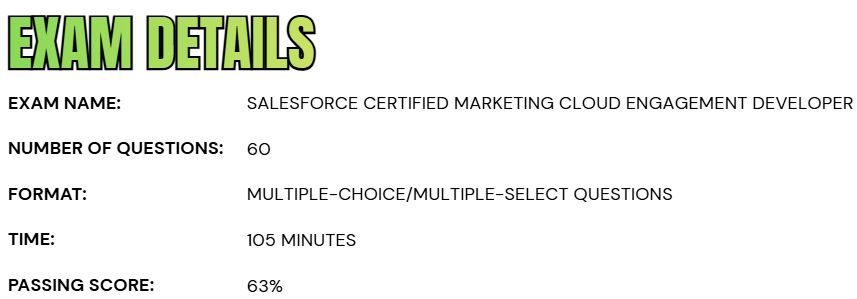
- The Salesforce Marketing Cloud Engagement Developer Exam consists of 60 scored questions in multiple-choice or multiple-select format, along with up to five unscored items that do not affect the final result.
- Candidates are given 105 minutes to complete the assessment, and a minimum score of 63% is required to pass.
- The exam can be taken either at an authorized testing center or through an online proctored setup, offering flexibility based on the candidate’s preference.
- During the test, no external resources—whether printed or digital—are permitted, ensuring that all responses reflect the candidate’s own knowledge and hands-on experience.
Course Outline
The Salesforce Marketing Cloud Engagement Developer Exam evaluates a candidate’s proficiency across several core domains. Test-takers are expected to have practical, hands-on experience developing within Marketing Cloud and its related tools, and they must demonstrate strong understanding and capability in each of the key areas outlined.
1. Understand Data Modeling: 14%
- Configuring account Contact model in Marketing Cloud.
- Given a scenario, differentiating the various types and uses of data extensions in Marketing Cloud.
- Describing how contact records relate across channels.
- Explaining the Contact Delete process.
2. Learn about Programmatic Languages: 35%
- Given a scenario, demonstrating knowledge of AMPscript and SSJS language syntax and functions.
- Implementing standard development best practices using Marketing Cloud programming languages.
- Describing how Marketing Cloud handles AMPscript processing.
- Given a customer scenario, determining how to programmatically exclude a subscriber at email send time.
3. Overview API: 22%
- Given a scenario, describing API objects, methods, and routes.
- Describing the OAuth authentication flow and how an access token is used in SOAP and REST headers.
- Given a scenario, evaluating the significance of response handling.

4. Understand Data Management: 22%
- Configuring import activity using various file formats within Marketing Cloud.
- Given a scenario, applying SQL to produce the desired results.
- Given a scenario, explaining the different ways to extract data from Marketing Cloud.
- Describing SQL best practices for managing data in Marketing Cloud.
- Given a scenario, applying best practices for send logs.
- Given a scenario, describing how data is affected by the Contact delete process.
5. Learn About Security: 7%
- Identifying different options to secure data in Marketing Cloud.
- Describing security best practices in Marketing Cloud.
Salesforce Certified Marketing Cloud Engagement Developer Exam FAQs

Salesforce Certification Exam Policy
The Salesforce Certification Exam Policy outlines the formal rules for scheduling, modifying, canceling, and completing certification exams, whether taken online or at an approved testing center. These policies ensure fairness, consistency, and the protection of exam integrity across all testing formats.
– Onsite (Testing Center) Exams
For exams taken at Pearson VUE testing centers, candidates may reschedule or cancel their appointment up to 48 hours before the scheduled exam time through their Pearson VUE account. Requests made after this deadline are typically not allowed. Candidates who fail to appear for their appointment without prior notice are considered no-shows and will forfeit the full exam fee.
– Online Proctored Exams
For online proctored exams, candidates may reschedule or cancel their booking up to 24 hours before the start time using the Pearson VUE platform, with no extra charge. Changes requested after this cutoff are generally not accepted. Missing the exam without properly rescheduling will also result in forfeiting the exam fee.
Salesforce Exam Candidate Code of Conduct
All individuals participating in the Salesforce Certification Program are expected to uphold strong standards of honesty, integrity, and professionalism. By registering for a certification exam, candidates agree to follow the Salesforce Credential and Certification Program Agreement, which clearly outlines expectations for ethical behavior during exam preparation, delivery, and related activities.
Candidates should rely on official Salesforce study materials, participate responsibly within the Trailblazer Community, and follow all exam security and procedural guidelines. Any form of misconduct—such as sharing or seeking confidential exam content, using unauthorized aids, or violating proctoring rules—is strictly prohibited. Breaches of these standards may result in severe consequences, including voided exam results, suspension or revocation of certifications, or permanent removal from the Salesforce Certification Program.
Salesforce Certified Marketing Cloud Engagement Developer Exam Study Guide

1. Understand the Exam Guide
Your preparation begins with a thorough review of the official Salesforce Exam Guide, which outlines the core knowledge areas, exam objectives, scoring distribution, and the skills expected from a Marketing Cloud Engagement Developer. This document provides the clearest picture of what Salesforce will assess, helping you understand the balance between topics such as data modeling, AMPscript, SQL, APIs, and personalization capabilities.
By studying the guide in detail, you can prioritize your learning, identify areas that require additional focus, and structure your preparation strategy around the competencies that carry the most weight in the exam. Treat the exam guide as the blueprint for your study plan because it reflects exactly what you will face on test day.
2. Combine Hands-On Experience with Formal Training
Since this certification is practical and development-focused, hands-on exposure to Marketing Cloud is essential. Working directly within the platform helps you understand how to configure data extensions, create dynamic content, troubleshoot errors, and interact with various Marketing Cloud builders and studios.
Alongside practical work, formal training courses—whether through Trailhead Academy or other Salesforce learning partners—provide deeper context and expert-led insights that reinforce your experience. The combination of doing and learning enriches your understanding of Marketing Cloud’s capabilities, ensuring you have the technical grounding needed to tackle the exam’s scenario-based questions with confidence.
3. Build and Strengthen Your Skills Through Trailhead
Trailhead offers a structured and interactive approach to learning everything required for the exam. Through guided modules, hands-on challenges, and real-world projects, you gain exposure to essential topics like AMPscript functions, personalization strings, SQL queries, landing page development, automations, and API interactions. Completing full trails and superbadges provides an opportunity to practice real scenarios that mirror tasks you’d face as a Marketing Cloud developer. Trailhead also updates content regularly, ensuring you are learning from the most current platform features and best practices.
4. Gain Practical Experience to Deepen Your Expertise
To truly master the concepts assessed in the exam, consistent practical work is necessary. Experiment by creating sample customer journeys, designing dynamic and personalized emails, building custom preference pages, implementing data imports, and writing SQL queries to segment customer data. Explore different studios within Marketing Cloud—Email Studio, CloudPages, Automation Studio, and Contact Builder—to develop a holistic understanding of how all components function together. This real-world practice builds muscle memory and confidence, making it easier to answer even the most complex exam questions.
5. Learn Collaboratively Through Study Groups, Communities, and Trailhead Academy
Engaging with the Salesforce community accelerates your learning by exposing you to diverse perspectives and shared experiences. The Trailblazer Community offers active discussions, troubleshooting support, and guidance from certified professionals who have already passed the exam. Study groups and peer learning sessions often help simplify complex concepts, provide alternative learning resources, and keep you accountable throughout your preparation. Trailhead Academy also offers instructor-led courses that break down advanced topics and provide deeper insights into exam expectations and common pitfalls.
6. Evaluate Your Readiness with Practice Tests
Practice exams are a crucial part of your preparation as they simulate the actual testing experience and reveal how well you understand the material. These tests help you identify weak areas, improve time management, and get used to the style and phrasing of Salesforce exam questions. Repeated practice builds familiarity and reduces test-day anxiety. By analyzing your results and revisiting difficult concepts, you create a reinforcement loop that sharpens your knowledge and improves your chances of passing on the first attempt.
7. Study Salesforce Documentation, Tip Sheets, and User Guides
Salesforce’s official documentation is one of the most authoritative sources for mastering Marketing Cloud’s technical capabilities. These resources cover platform behavior, API schemas, scripting best practices, SQL syntax, and system limitations with a level of detail not always found in training courses. Tip Sheets condense critical information into easy-to-reference insights, while User Guides explain complex features in a more instructional format. Regularly reviewing these materials ensures you develop a deep and accurate understanding of the platform, enabling you to answer exam questions with clarity and precision.
